

Quadrilaterals
Four sides, one family tree — a square is a special rectangle and a special rhombus, and any quadrilateral at all can tile a floor without gaps.
Original notes — ready CBSE (NCERT, English Medium) • Class 9 • Mathematics • Book: Ganita Manjari — Part 2
Chapter 12: Quadrilaterals — EG's own notes, in simple words
Book: Ganita Manjari — Part 2 (CBSE, Class 9) | Chapter 12 | Medium: English
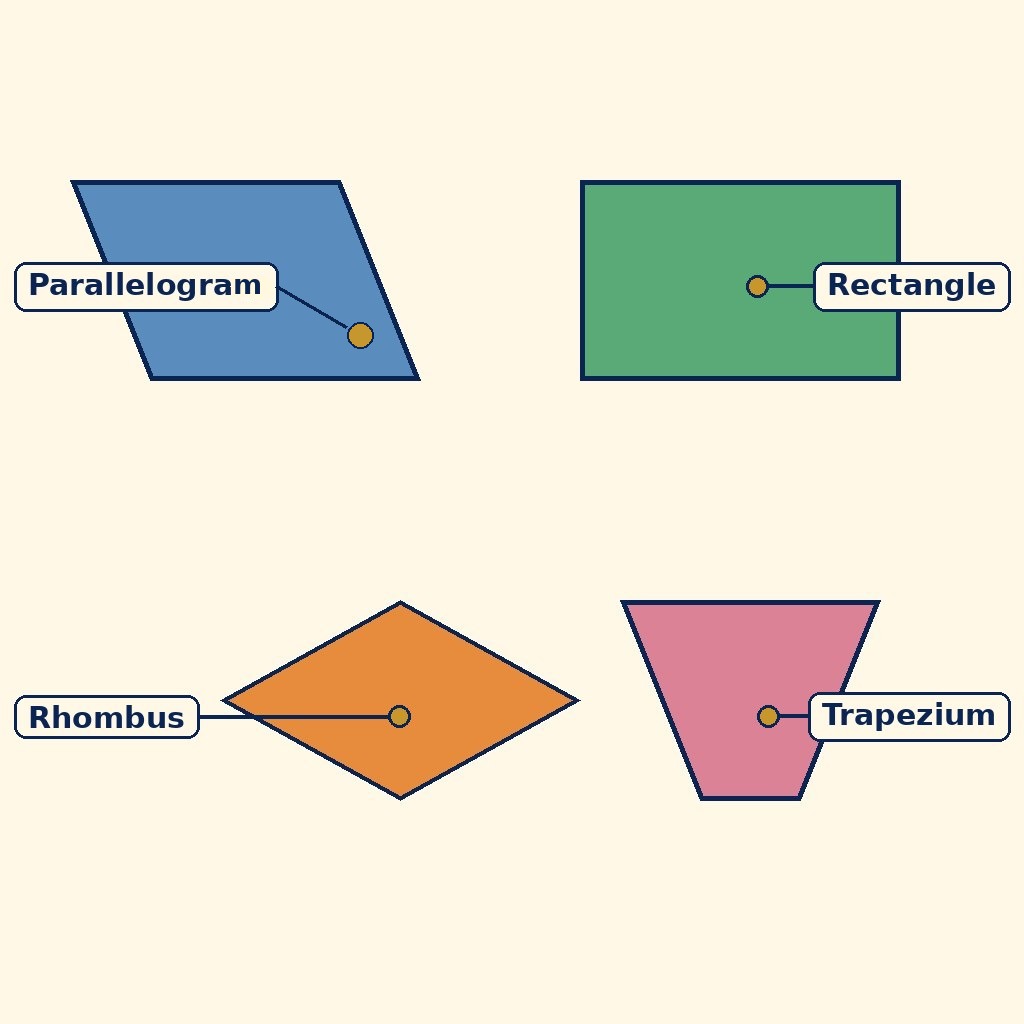
Diagram (labels are printed on the image): Four quadrilaterals side by side — a parallelogram, a rectangle, a rhombus and a trapezium — each showing its parallel sides and diagonals.

A tiled floor — quadrilaterals fitting together without gaps, exactly as the chapter describes.
What the chapter is about
A quadrilateral is a four-sided closed figure, and its family is full of familiar faces: parallelograms, rectangles, rhombuses, squares and trapeziums. They are related like a family tree — a square is a special rectangle and a special rhombus, and every rectangle is a special parallelogram. Knowing the tree saves you from re-proving every property for every shape.
The chapter proves the key properties using congruent triangles: in a parallelogram, opposite sides are equal, opposite angles are equal, and the diagonals bisect each other. Once those are proved, the special cases follow by adding one extra condition — a right angle makes a rectangle, equal sides make a rhombus, and both together make a square.
Two more gems appear here: the midpoint theorem, which says the segment joining the midpoints of two sides of a triangle is parallel to the third side and half its length, and the fact that the medians of a triangle meet at a single point, the centroid. Quadrilaterals even tile the plane — any quadrilateral shape, repeated, can cover a floor without gaps.
The chapter sorts quadrilaterals by their angles as well as their sides. A convex quadrilateral has all its interior angles below 180° and bulges outwards, like a rectangle; a non-convex quadrilateral, sometimes called a dart, has one interior angle above 180° and dents inwards. The test is simple: if every interior angle is below 180°, the quadrilateral is convex, and only convex quadrilaterals behave like the familiar family in the tree.
Two facts tie the chapter together. First, the angles of any quadrilateral add to 360° — so if three angles are 95°, 85° and 100°, the fourth must be 80°. Second, any quadrilateral, even a strange one, tiles the plane: take four copies, meet them at one point, and their four angles around that point add to exactly 360°, so they fit with no gap and no overlap. That is why floors can be tiled with quadrilaterals of almost any shape.
What you should learn
- Use the properties of parallelograms and their special cases, the midpoint theorem, and the centroid.
- Tell convex from non-convex quadrilaterals by their interior angles.
- Find a missing angle with the 360° angle sum.
- Explain why any quadrilateral tiles the plane.
Key Terms
- Quadrilateral — A closed figure with four sides and four angles.
- Parallelogram — A quadrilateral with both pairs of opposite sides parallel.
- Rhombus — A parallelogram with all sides equal.
- Midpoint theorem — The segment joining the midpoints of two sides of a triangle is parallel to the third side and half its length.
- Centroid — The point where the three medians of a triangle meet; it divides each median in the ratio 2:1.
- Convex quadrilateral — A quadrilateral whose interior angles are all below 180°; it bulges outwards, with no dent.
- Non-convex quadrilateral (dart) — A quadrilateral with one interior angle above 180°; it dents inwards at that vertex.
Remember
- In a parallelogram: opposite sides equal, opposite angles equal, diagonals bisect each other.
- A rectangle is a parallelogram with a right angle; a rhombus has all sides equal; a square has both.
- Midpoint theorem: join of midpoints is parallel to the third side and half its length.
- The diagonals of a rhombus bisect each other at right angles.
- Angle sum 360° works for every quadrilateral, convex or not.
- Four copies of any quadrilateral meet at a point with no gap, because their angles add to 360°.
Exam Tip / Common Mistake
Common mistake: saying a square is not a rectangle. A square satisfies every property of a rectangle, plus more — special cases belong to the family, they do not leave it.
Chart / Table: The quadrilateral family
| Point | Detail |
|---|---|
| Parallelogram | Opposite sides parallel and equal; diagonals bisect each other |
| Rectangle | Parallelogram + one right angle; diagonals equal |
| Rhombus | Parallelogram + all sides equal; diagonals at right angles |
| Square | Rectangle + rhombus; all sides equal, all angles 90° |
| Trapezium | At least one pair of opposite sides parallel |
Worked method: the fourth angle of a quadrilateral
- A quadrilateral has angles 95°, 85° and 100°. The four angles must add to 360°.
- The three known angles add to 95 + 85 + 100 = 280°.
- The fourth angle = 360° − 280° = 80°.
Practice set — try it yourself
- In parallelogram ABCD, AB = 6 cm and BC = 4 cm. Find CD and AD.
Hint: Hint: Opposite sides of a parallelogram are equal. - A quadrilateral has diagonals that bisect each other. What can you conclude?
Hint: Hint: Which property identifies a parallelogram? - In a rhombus, one diagonal is 10 cm and the other is 24 cm. Find its side.
Hint: Hint: Diagonals bisect at right angles — use Pythagoras in one quarter. - In triangle PQR, M and N are midpoints of PQ and PR. If QR = 12 cm, find MN.
Hint: Hint: Use the midpoint theorem. - Is every rhombus a parallelogram? Is every parallelogram a rhombus? Explain.
Hint: Hint: Check the definitions both ways.
Questions with Answers
- Define a parallelogram and state two of its properties.
A parallelogram is a quadrilateral with both pairs of opposite sides parallel. Its opposite sides are equal, and its diagonals bisect each other. - Why is a square both a rectangle and a rhombus?
A square has all angles 90°, so it meets the definition of a rectangle, and all sides equal, so it meets the definition of a rhombus. - State and use the midpoint theorem.
The segment joining the midpoints of two sides of a triangle is parallel to the third side and half its length. If the third side is 14 cm, the segment is 7 cm. - How do the diagonals of a rhombus behave?
They bisect each other at right angles, and each diagonal bisects the angles at the vertices it joins. - What is the centroid of a triangle?
It is the point where the three medians meet. It divides each median in the ratio 2:1, counting from the vertex.
Extension questions
- A quadrilateral has angles 95°, 85° and 100°. Find the fourth angle.
360° − (95° + 85° + 100°) = 360° − 280° = 80°. - In a parallelogram, angle A = 70°. Find angles B, C and D.
Opposite angles are equal and adjacent angles add to 180°: B = 110°, C = 70°, D = 110°. - A quadrilateral has an interior angle of 200°. Is it convex or non-convex? Why?
Non-convex: one interior angle above 180° means it dents inwards. - A quadrilateral's diagonals bisect each other. What can you conclude, and why?
It is a parallelogram: diagonals bisecting each other is the identifying property of a parallelogram. - Why can any quadrilateral tile a plane without gaps?
Four copies placed around one point contribute their four angles, which add to 360° — exactly filling the space around the point. - Is a trapezium a parallelogram? Explain.
Not necessarily. A trapezium has at least one pair of parallel sides, but a parallelogram needs both pairs parallel.
Opposite sides parallel and equal, diagonals bisecting, angles adding to 360° — and four copies of any quadrilateral fill the plane around a point exactly.
How to use this page: Read the summary, say the Key Terms in your own words, then try the practice set without looking. Use the Questions with Answers to check yourself afterwards. Ask your teacher or parent to check your answers.