

Chapter 9: The Amazing World of Solutes, Solvents, and Solutions
Original notes — ready CBSE (NCERT, English Medium) • Class 8 • Science • Book: Curiosity
Chapter 9: The Amazing World of Solutes, Solvents, and Solutions — EG's own notes, in simple words
Book: Curiosity (CBSE, Class 8) | Chapter 9 | Medium: English
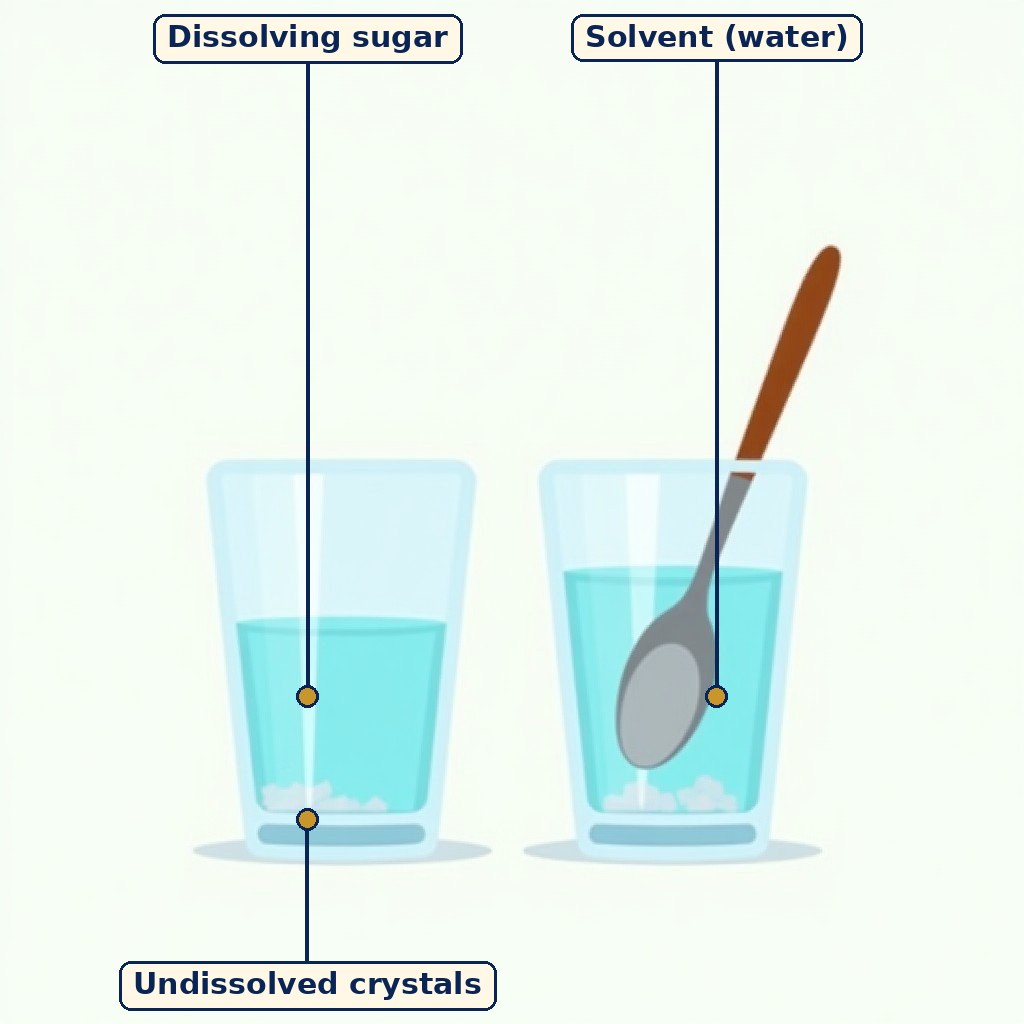
Diagram (labels are printed on the image): Diagram (labels are printed on the image): sugar dissolving in water in one glass, and undissolved crystals left in another. A general picture about solutions, not a diagram from the book.

Making lemonade — a solution we make at home. A general picture, not a book scene.
What the chapter is about
When we stir sugar into water, the sugar seems to disappear — but it has not vanished. It has dissolved. The sugar is the solute, the water is the solvent, and the sweet liquid we get is a solution. Solutions are all around us: salt water, lemonade and even air.
A solution looks the same throughout — it is homogeneous, which means its composition is uniform. The solute particles spread between the solvent particles and cannot be seen separately. Filtering will not separate them, because the solute has become part of the liquid.
How much solute can dissolve depends on the solvent and the temperature. A solution that cannot dissolve any more solute at that temperature is saturated. Warming the water usually lets more solute dissolve, which is why sugar dissolves faster in hot tea than in cold water.
What you should learn
Notice what solute, solvent and solution mean, why a solution is uniform, and what saturated means — and how temperature changes solubility.
Key Terms
- Solute — The substance that dissolves in a solution, usually present in smaller amount.
- Solvent — The substance in which the solute dissolves, usually present in larger amount.
- Solution — A uniform mixture formed when a solute dissolves in a solvent.
- Solubility — The amount of a solute that can dissolve in a given amount of solvent at a given temperature.
- Saturated solution — A solution that cannot dissolve any more solute at that temperature.
Remember
- Solute + solvent = solution; the solution looks the same throughout.
- Dissolved solute cannot be removed by filtration.
- A saturated solution cannot dissolve more solute at that temperature.
- Heating usually increases solubility, so more solute dissolves.
Exam Tip / Common Mistake
Common mistake: saying the solute disappears. It does not disappear — its particles spread among the solvent particles. That is why the solution still tastes sweet and weighs more than the water alone.
Chart / Table: Solutions at a glance
| Point | Detail |
|---|---|
| Solute | Dissolves; e.g. sugar, salt |
| Solvent | Dissolves the solute; e.g. water |
| Solution | Uniform mixture; e.g. salt water, lemonade |
| Saturated | No more solute can dissolve at that temperature |
| Effect of heating | Usually increases solubility |
Practice set — try it yourself
- In salt water, which is the solute and which is the solvent?
Hint: Think about which one dissolves. - Why is a solution called homogeneous?
Hint: Think about looking the same throughout. - What is a saturated solution?
Hint: Think about no more dissolving. - Why does sugar dissolve faster in hot water?
Hint: Think about temperature and particle movement. - Can you separate salt from salt water by filtration? Why not?
Hint: Think about dissolved particles.
Questions with Answers
- What is a solution? Give an example.
A solution is a uniform mixture formed when a solute dissolves in a solvent. For example, when salt dissolves in water, we get a salt solution in which the salt is spread evenly through the water. - How is a solution different from a suspension?
In a solution the solute particles are spread evenly and cannot be seen or filtered out. In a suspension the particles are larger, can be seen, settle down on standing and can be separated by filtration. - What is a saturated solution?
A saturated solution is one that has dissolved as much solute as it can at that temperature. If more solute is added, it will remain undissolved at the bottom. - How does temperature affect solubility?
For most solids in water, solubility increases with temperature. That is why more sugar dissolves in hot water than in the same amount of cold water. - Sugar dissolved in water tastes sweet everywhere in the glass. Why?
Because the sugar particles spread uniformly among the water particles, the solution is homogeneous — every part of it has the same composition and the same sweet taste.
How to use this page: Read the summary, say the Key Terms in your own words, then try the practice set without looking. Use the Questions with Answers to check yourself afterwards. Ask your teacher or parent to check your answers.