

Chapter 1: Foundations of Physical Education and Well-being
Movement, mind and safety together — how activity builds fitness, character and a safe school.
Original notes — ready CBSE (NCERT, English Medium) • Class 8 • Physical Education • Book: Khel Yatra
Foundations of Physical Education and Well-being — EG's own notes, in simple words
Book: Khel Yatra (CBSE, Class 8) | Chapter 1 | Medium: English
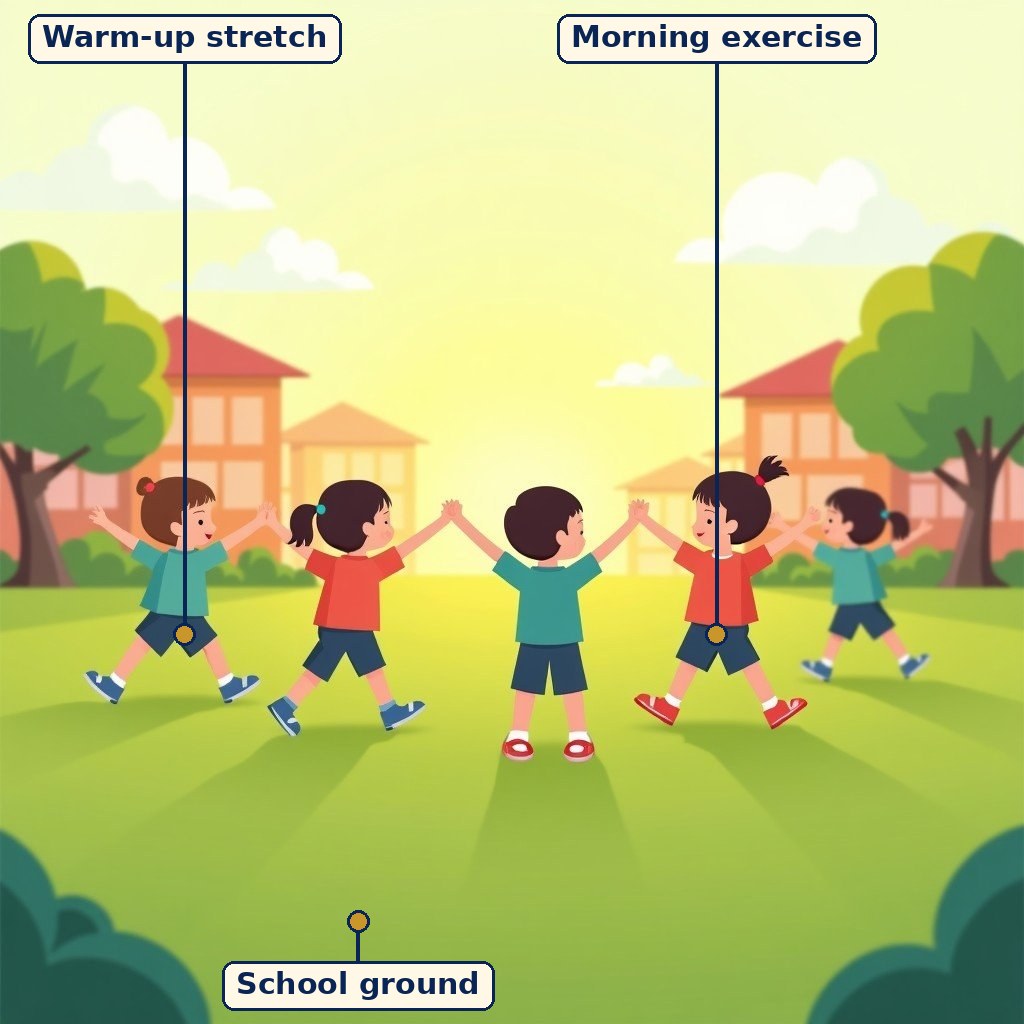
Diagram (labels are printed on the image): Students exercising together on the school ground. A general picture about physical education, not a book scene.

A healthy daily routine — play, good food and rest. A general picture about well-being.
What the chapter is about
This unit links physical activity with personal growth. It joins fitness, mental resilience, teamwork and safety awareness with ideas from physics and biology. Pupils learn how balance, force, motion and gravity affect movement, and how muscles, bones, breathing and blood circulation support performance. They also build motivation, courage and discipline by taking on physical challenges, tracking progress and working on self-improvement.
Every activity in the unit follows the same lesson pattern: a warm-up, the main activity, a cool-down, and a circle time in which the class talks about what was learnt. Safety runs through all of it — and so does a clear duty to recognise and report bullying, mental-health concerns and inappropriate behaviour, so that school stays safe, respectful and supportive for everyone.
The ten activities at a glance
| Activity | What it teaches |
|---|---|
| Horse Vault Race (FPE-1) | Vaulting safely over a partner; balance and good technique |
| Progressive Mass Drill (FPE-2) | Coordinated movement in sync on a count of eight; major muscles |
| Baraf Pani (FPE-3) | The harm of bullying; the power of the upstander |
| Char Tali (FPE-4) | Alertness; how society can stop harassment |
| Conduction Relay (FPE-5) | Heat transfer by conduction; insulators slow it down |
| Motion-in-Action Relay (FPE-6) | Linear, rotational and projectile motion; SI and CGS units; gravity |
| Breathing in Action (FPE-7) | How breathing and pulse rise with effort; energy production |
| Flex and React Challenge (FPE-8) | Neuromuscular control — brain and muscles working together |
| Move Like a Machine (FPE-9) | The musculoskeletal system: bones, muscles and joints |
| Adapt and Achieve (FPE-10) | How the body adapts to strength, endurance and flexibility training |
Moving well and moving safely
In the Horse Vault Race, partners of almost similar height and weight take turns: one bends over as the "horse" (chin to chest bone, squatting on all fours) while the other jumps carefully over, then they swap roles. The pair that crosses the finish line first wins, and circle time compares whose jump was most efficient and how balance was kept in the vault position.
The Progressive Mass Drill is done in rows, one arm's distance apart. A demonstrator on a raised platform performs freehand movements while the teacher counts from one to eight, and everyone imitates in sync. Drum beats can replace the count, and sticks, balls, hoops or ribbons can replace free hands. Circle time asks pupils to feel which major muscles of the arms and legs are working, and how syncing actions with commands or music gives a feeling of holistic pleasure.
Standing up, together
Baraf Pani teaches about bullying through four roles: the bully, the victim, bystanders who watch, and the upstander — a bystander who chooses to act. When the bully tags a victim, the victim freezes; a bystander can unfreeze them only with a reassuring remark such as "You are not alone!" or "I am with you"; the upstander can stop the bully by tagging them and saying "Stop, that is not okay!" Roles keep switching so everyone plays each part, and circle time discusses how upstanders can stop bullying in real life.
Char Tali uses four lines — starting line, warning line, danger line, finish line. One group is the Aggressor, the other is Society, and one Society member is the victim, standing at the finish line with their back turned. While the victim is not looking, the Aggressor creeps forward; when the victim claps four times and turns, any Aggressor caught moving is out. Society members posted at the warning and danger zones try to make the Aggressor move without touching them — but if an Aggressor reaches a zone line, all Society members in that zone are out. The Aggressor aims to reach the finish line uncaught; Society aims to protect the victim.
Bullying, harassment, mental-health worries and inappropriate behaviour are never to be hidden or laughed off. Tell a trusted adult or teacher at once — that is exactly what upstanders and a caring society do, in games and in real life.
Physics and biology you can feel
The Conduction Relay is run over 20 metres in four 5-metre parts: galloping, hopping, duck walk and sprinting, carrying an object to a teammate. Team B first feels the object's heat directly, then grips the same object through a handkerchief or towel and repeats the run. Circle time compares the two: wrapping blocks direct contact, so heat is transferred less readily — a hands-on lesson in conduction. Trying objects of wood, plastic and metal, or running at different times of day, shows the idea further.
The Motion-in-Action Relay has three stations. Station 1 is linear motion (a 20-metre run, time recorded); Station 2 is rotational motion (three spins around a cone, then a sprint); Station 3 is projectile motion (throwing a softball at a target, distance measured). Time is in seconds in both SI and CGS units, while distance is in metres (SI) or centimetres (CGS). At each station the first team earns 5 points, the second 3, and the last 1; the highest total wins. Circle time links speed to running time, spinning speed to dizziness, and throwing angle to distance — and the teacher's notes connect force with projectiles, speed with linear motion, and centripetal force with rotation.
Breathing in Action measures the body at rest and under effort. First, sitting quietly for one minute, pupils count breaths and pulse for 60 seconds each (pulse from the radial artery, as demonstrated by the teacher). Then Zone 1 (low intensity: walking in place or slow jogging, 2 minutes), Zone 2 (medium: moderate jumping jacks or fast jogging, 1 minute) and Zone 3 (high: a 30-metre sprint or burpees for 30 seconds), measuring after each. Finally, sitting quietly for 3 minutes, pulse is checked every 30 seconds to watch recovery. The pattern is the lesson: harder effort means faster breathing and pulse, because working muscles need more oxygen for energy — and fitter pupils recover towards baseline faster.
Muscles, nerves and adaptation
The Flex and React Challenge pairs flexibility with reaction — catching a ball lightly thrown while holding a hamstring stretch, or touching a cone on command while in a lunge. Scoring is 1 point for good flexibility, 1 for a correct quick response, and 3 bonus points for smoothly combining the two. The idea is neuromuscular control: the brain and muscles must cooperate for every movement, in sport and in daily life.
Move Like a Machine runs four stations in a circle: flexion and extension (bicep curls), jumping and landing (squat jumps), push-and-pull (push-ups or resistance-band pulls) and balancing (one-leg balance). Teams score 3 points for finishing fastest, 1 for proper form and 1 bonus point for smooth collaboration and encouragement.
Adapt and Achieve gives each station 5 minutes: strength (push-ups, squats, band pulls — bones and muscles grow stronger with resistance), endurance (jumping jacks, running in place, skipping — muscles learn to sustain repeated activity), flexibility (forward bends, lunges, shoulder reaches — joints and muscles stretch further) and recovery (lying down, deep breathing, light stretching — rest lets muscles repair and grow). There is deliberately no competition here: effort and personal bests are recognised instead. Daily-life links are direct — carrying groceries uses strength, walking long distances uses endurance.
Nearly every activity in this unit has the same four parts: warm-up, activity, cool-down and circle time. Naming the circle-time topic (for example "Role of upstanders" or "Heat transfer: conduction") is an easy way to show you know what the activity was really teaching.
Self-assessment at the end of the unit
The unit closes with a self-assessment on a 1-to-5 scale. Pupils rate themselves on: appreciation for teammates (knowing their strengths and weaknesses, encouraging them, valuing difference); standing against bullying; standing against harassment — in both cases, the top levels mean acting confidently and seeking help from trusted people; understanding physics concepts in play (force, pressure and more); understanding biology in play; and identifying the major muscles used in an activity and noticing classmates' muscle-related difficulties and reporting them to the teacher.
Key Terms
- Well-being — Feeling healthy, energetic and calm in body and mind, supported by movement, food, sleep and good relationships.
- Upstander — A bystander who chooses to act against bullying instead of only watching.
- Conduction — Transfer of heat through direct contact between an object and the body (or another object).
- Linear / rotational / projectile motion — Moving in a straight line; spinning around a centre; and moving through the air after being thrown.
- SI and CGS units — Two unit systems: SI uses metres for distance, CGS uses centimetres; time is seconds in both.
- Neuromuscular control — The brain and muscles working together to produce controlled movement.
- Musculoskeletal system — Bones, muscles and joints working together to support movement.
- Adaptation — How bones, muscles and joints change with training and recover with rest.
Remember
- Every activity has a warm-up, the activity itself, a cool-down and a circle-time discussion.
- An upstander acts ("Stop, that is not okay!") and a bystander who only watches does not stop bullying.
- In Char Tali, Society protects the victim by getting the Aggressor to move while the victim is not looking.
- A towel or handkerchief between hand and object reduces heat transfer by conduction.
- Distance: metres in SI, centimetres in CGS; time: seconds in both.
- Breathing and pulse rise with effort and fall back during recovery; fitter pupils recover faster.
- Strength, endurance and flexibility training each adapt the body differently, and rest is part of adaptation.
- Report bullying, harassment and injuries to a trusted adult — never hide them.
Answers here should name the concept behind the game: conduction, motion, neuromuscular control, adaptation, or the role of the upstander. A game description without its concept earns only part marks.
Physical education in Class 8 is more than play: it is fitness, physics and biology felt in the body, plus the courage to stand against bullying and the teamwork that makes a society protective. Warm up, play safely, cool down, and talk about what you learnt — that discussion is where the learning is fixed.
Practice set — try it yourself
- What are the four parts of nearly every activity in this unit?
Hint: Think about what comes before and after the game, and the discussion at the end. - In Baraf Pani, what exactly must a bystander say while unfreezing a victim?
Hint: Think of a reassuring sentence, not just a tap. - Why does Team B feel less heat when it grips the object through a towel?
Hint: Think about direct contact and conduction. - In the Motion-in-Action Relay, which quantity is measured in metres in SI but centimetres in CGS, and which stays in seconds in both?
Hint: One is distance, the other is time. - Why do breathing rate and pulse rate rise in Zone 3 of Breathing in Action?
Hint: Think about what working muscles need for energy.
Questions with Answers
- What is the link this unit explores between physical activity and personal growth?
The unit connects activity with fitness, mental resilience, teamwork and safety, and with physics (balance, force, motion, gravity) and biology (muscles, bones, respiration, circulation). Pupils build motivation, courage and discipline by facing physical challenges, tracking progress and improving themselves. - Who is an upstander, and how does Baraf Pani show what one does?
An upstander is a bystander who chooses to act. In Baraf Pani, when the bully freezes a victim by tagging them, bystanders may unfreeze them with a reassuring remark, and the upstander stops the bully by tagging them and saying "Stop, that is not okay!" Roles rotate so everyone experiences each viewpoint. - How does Char Tali show the role of society against harassment?
Society members stationed at the warning and danger zones try to make the Aggressor move without touching them, so the victim — who claps four times and turns — can catch them moving. If the Aggressor reaches a zone line, that zone's Society members are out; if they reach the finish line uncaught, the Aggressor wins. Protection works only when society acts together. - What does the Conduction Relay prove about heat transfer?
Heat passes by direct contact (conduction). Gripping a warm object directly lets heat reach the hand, while gripping it through a handkerchief or towel reduces that transfer. Changing the object's material (wood, plastic, metal) or the time of day gives further comparisons. - How does the body adapt to the four stations of Adapt and Achieve?
Strength work makes bones and muscles stronger against resistance; endurance work trains muscles to sustain repeated activity; flexibility work increases joint range of motion; and recovery — rest, deep breathing, light stretching — lets muscles repair and grow. Adaptation therefore needs training plus rest, not training alone.
Questions with Answers — Extension
- (Match) Match: Horse Vault Race — balance and vaulting technique; Progressive Mass Drill — sync on a count of eight; Motion-in-Action Relay — three kinds of motion; Flex and React — brain-muscle coordination.
- (Reason) Why are Horse Vault partners paired by similar height and weight? — So the vault is safe and fair: a much heavier or taller vaulter over a much smaller "horse" would be unsafe and would hide differences in technique.
- (Numbers) In the Motion-in-Action Relay, a team finishes first at one station, second at another and last at the third. What is its total? — 5 + 3 + 1 = 9 points.
- (Apply) A pupil's pulse is still well above baseline 3 minutes after Zone 3. What does Breathing in Action suggest, and what should they do? — Recovery is slow, which suggests lower fitness for that effort; they should rest, breathe deeply, and build fitness gradually with regular lower-intensity work rather than repeating the hard effort at once.
- (Distinguish) How is social protection in Char Tali different from a single upstander in Baraf Pani? — Baraf Pani shows one person choosing to act; Char Tali shows a whole group organised in zones protecting a victim together — individual courage versus collective responsibility.
- (Sequence) Put the Breathing in Action stages in order: Zone 2, baseline, recovery, Zone 1, Zone 3. — Baseline, Zone 1 (low), Zone 2 (medium), Zone 3 (high), recovery.
- (True / False) In CGS units, time is measured in centimetres. — False. Time is seconds in both SI and CGS; only distance changes (metres to centimetres).
- (Explain) Why does Move Like a Machine award a bonus point for collaboration, not only for speed? — Because proper form and mutual encouragement are part of safe, effective movement; speed alone, with poor form, risks strain and teaches nothing about teamwork.
How to use this page: Read the summary, say the Key Terms in your own words, then try the practice set without looking. Use the Questions with Answers to check yourself afterwards. Ask your teacher or parent to check your answers.