

Proportional Reasoning-1
When two things change by the same factor, they stay proportional — the idea behind similar pictures, ratios, fair sharing and unit conversion.
Original notes — ready CBSE (NCERT, English Medium) • Class 8 • Mathematics • Book: Ganita Prakash — Part I
Chapter 7: Proportional Reasoning-1 — EG's own notes, in simple words
Book: Ganita Prakash — Part I (CBSE, Class 8) | Chapter 7 | Medium: English
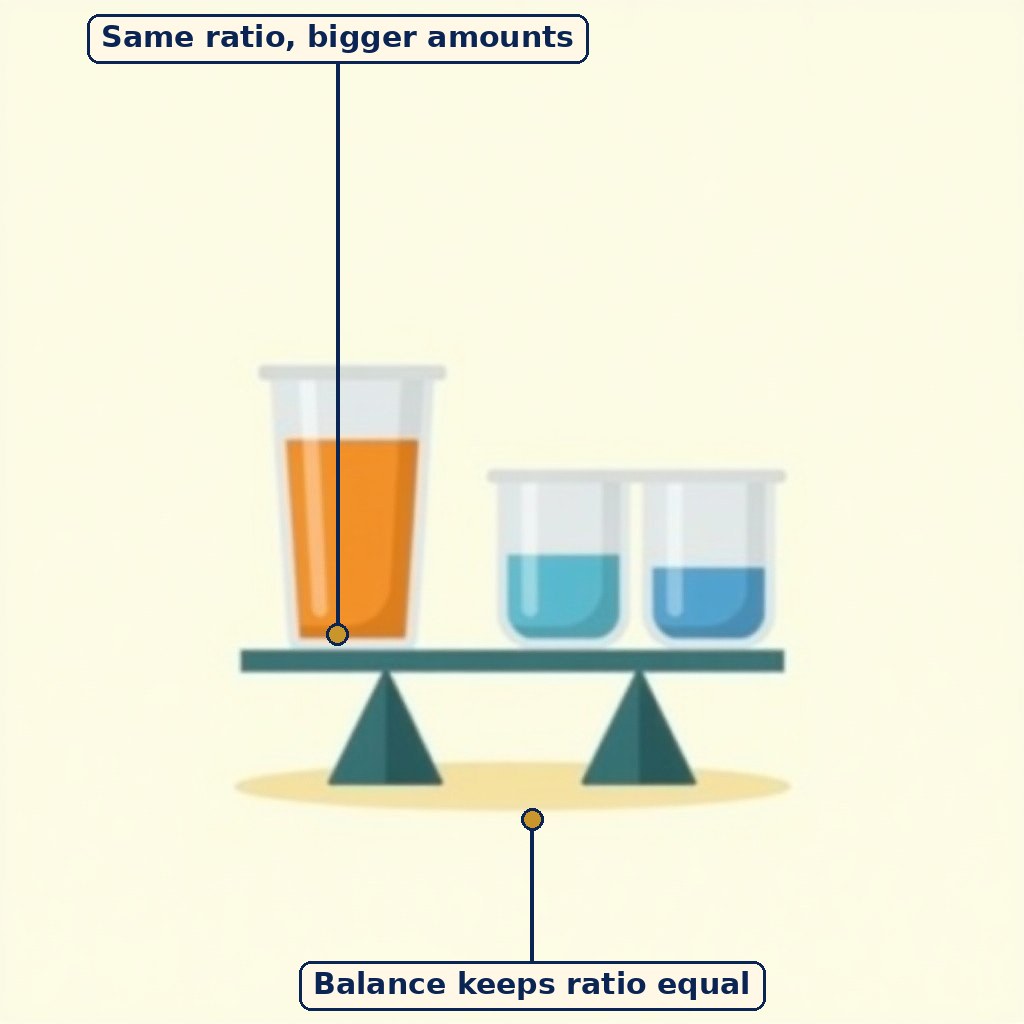
Diagram (labels are printed on the image): Two sets of containers with juice and water in equal ratio, beside a balance scale. A general picture of proportion, not a book scene.

A cook measuring equal proportions of ingredients with cups and spoons. A general picture of keeping ratios equal in a recipe, not a book scene.
What the chapter is about
Stretch a picture by the same factor in width and height and it still looks the same; stretch width and height by different factors and it looks distorted. The chapter's opening pictures make this concrete: images 60 mm by 40 mm, 30 mm by 20 mm and 90 mm by 60 mm all share the width-to-height ratio 3 : 2, so they look similar, while a 40 mm by 20 mm picture (ratio 2 : 1) looks stretched. When two quantities change by the same factor, their relationship is proportional, and a ratio is how we write it: in a : b, a and b are the terms of the ratio.
To simplify a ratio, divide both terms by their highest common factor: 60 : 40 = 3 : 2. Two ratios are proportional when they simplify to the same ratio, which can be checked by cross-multiplication: a : b and c : d are proportional exactly when a × d = b × c. The unitary method solves problems from a single value: if 5 pens cost ₹75, one pen costs ₹15, so 8 pens cost ₹120. Sharing unequally follows the same idea: share ₹900 in the ratio 2 : 3 by dividing it into 2 + 3 = 5 equal parts of ₹180, giving ₹360 and ₹540. Finally, unit conversions are proportional reasoning in disguise: 1 km = 1000 m, 1 hour = 60 minutes and 1 litre = 1000 mL, so 2.5 km = 2500 m and 180 minutes = 3 hours.
The trap to avoid is adding or subtracting the same amount instead of multiplying by the same factor: reducing both sides of a picture by 20 mm each does not keep it similar, because the factors differ.
What you should learn
- Decide whether two changes are proportional by comparing factors, not differences.
- Write and simplify ratios, and test proportionality by cross-multiplication.
- Solve problems with the unitary method.
- Share a quantity in a given ratio, including unequal sharing.
- Convert between units using proportional reasoning.
Key Terms
- Ratio — A comparison of two quantities by division, written a : b; the numbers a and b are its terms.
- Proportional — Two ratios are proportional when they are equal after simplification.
- Simplest form — A ratio with both terms divided by their highest common factor; 60 : 40 = 3 : 2.
- Unitary method — Finding the value of one unit first, then scaling up to the required number.
- Cross-multiplication — Checking a : b = c : d by testing whether a × d = b × c.
Remember
- Same factor, not same difference, keeps things proportional.
- Simplify ratios by dividing both terms by their HCF.
- a : b and c : d are proportional exactly when a × d = b × c.
- Sharing in ratio 2 : 3 means 2 parts and 3 parts out of 5 equal parts.
Exam Tip / Common Mistake
Common mistake: saying two pictures are similar because both sides changed by the same amount. Similarity needs the same factor: width × 1.5 and height × 1.5, not width − 20 and height − 20.
Image A is 60 × 40 and image D is 90 × 60. Width factor: 90 ÷ 60 = 1.5. Height factor: 60 ÷ 40 = 1.5. Equal factors, so the pictures look similar — and both ratios simplify to 3 : 2.
Always simplify before comparing ratios: 30 : 20 and 90 : 60 look different but are both 3 : 2, so they are proportional.
Chart / Table: Ratio and proportion examples
| Ratio | Simplest form | Proportional to 3 : 2? |
|---|---|---|
| 60 : 40 | 3 : 2 | Yes — itself |
| 30 : 20 | 3 : 2 | Yes |
| 90 : 60 | 3 : 2 | Yes |
| 40 : 20 | 2 : 1 | No |
Worked method: share a quantity in a ratio
- Add the ratio terms to get the total number of parts: 2 + 3 = 5.
- Divide the quantity by the total parts to get one part: ₹900 ÷ 5 = ₹180.
- Multiply by each term: 2 × ₹180 = ₹360 and 3 × ₹180 = ₹540.
- Check: ₹360 + ₹540 = ₹900, and 360 : 540 simplifies to 2 : 3.
Practice set — try it yourself
- Simplify 60 : 40.
Hint: Divide both terms by their highest common factor. - Are 30 : 20 and 45 : 30 proportional? Check by cross-multiplication.
Hint: Compare 30 × 30 with 20 × 45. - Share ₹1000 in the ratio 3 : 2.
Hint: How many equal parts are there in total? - Convert 2.5 km into metres.
Hint: 1 km = 1000 m. - If 5 pens cost ₹75, what do 8 pens cost?
Hint: Find the cost of one pen first.
Questions with Answers
- What is a ratio?
A comparison of two quantities of the same kind by division, written a : b, where a and b are the terms of the ratio. - Are 30 : 20 and 45 : 30 proportional?
Yes. Cross-multiplying: 30 × 30 = 900 and 20 × 45 = 900. The products are equal, so the ratios are proportional (both simplify to 3 : 2). - 5 pens cost ₹75. What do 8 pens cost?
One pen costs ₹75 ÷ 5 = ₹15, so 8 pens cost 8 × ₹15 = ₹120. - Share ₹900 in the ratio 2 : 3.
Total parts = 5, one part = ₹900 ÷ 5 = ₹180, so the shares are ₹360 and ₹540. - Convert 180 minutes into hours.
60 minutes = 1 hour, so 180 minutes = 180 ÷ 60 = 3 hours.
Extension questions
- Are 12 : 16 and 18 : 24 proportional?
Yes: both simplify to 3 : 4, and cross-multiplication gives 12 × 24 = 288 = 16 × 18. - 4 kg of rice costs ₹240. What does 7 kg cost?
1 kg costs ₹240 ÷ 4 = ₹60, so 7 kg costs 7 × ₹60 = ₹420. - Convert 1.2 litres into millilitres.
1 litre = 1000 mL, so 1.2 litres = 1200 mL. - Share ₹1500 in the ratio 1 : 2 : 3.
Total parts = 6, one part = ₹250, so the shares are ₹250, ₹500 and ₹750. - A picture 60 mm wide is enlarged to 90 mm wide. What must its 40 mm height become to stay similar?
The factor is 90 ÷ 60 = 1.5, so the height must become 40 × 1.5 = 60 mm. - Write 45 minutes as a fraction of an hour in simplest form.
45 : 60 simplifies (dividing by 15) to 3 : 4, so 45 minutes is 3/4 of an hour.
Proportional means changing by the same factor. Ratios record the comparison, simplification and cross-multiplication test equality, the unitary method scales from one unit, sharing divides into ratio parts, and conversions are proportions with fixed factors.
How to use this page: Read the summary, say the Key Terms in your own words, then try the practice set without looking. Use the Questions with Answers to check yourself afterwards. Ask your teacher or parent to check your answers.