

Power Play
Repeated doubling, powers of 10, and the laws that let you multiply powers without multiplying everything out.
Original notes — ready CBSE (NCERT, English Medium) • Class 8 • Mathematics • Book: Ganita Prakash — Part I
Chapter 2: Power Play — EG's own notes, in simple words
Book: Ganita Prakash — Part I (CBSE, Class 8) | Chapter 2 | Medium: English
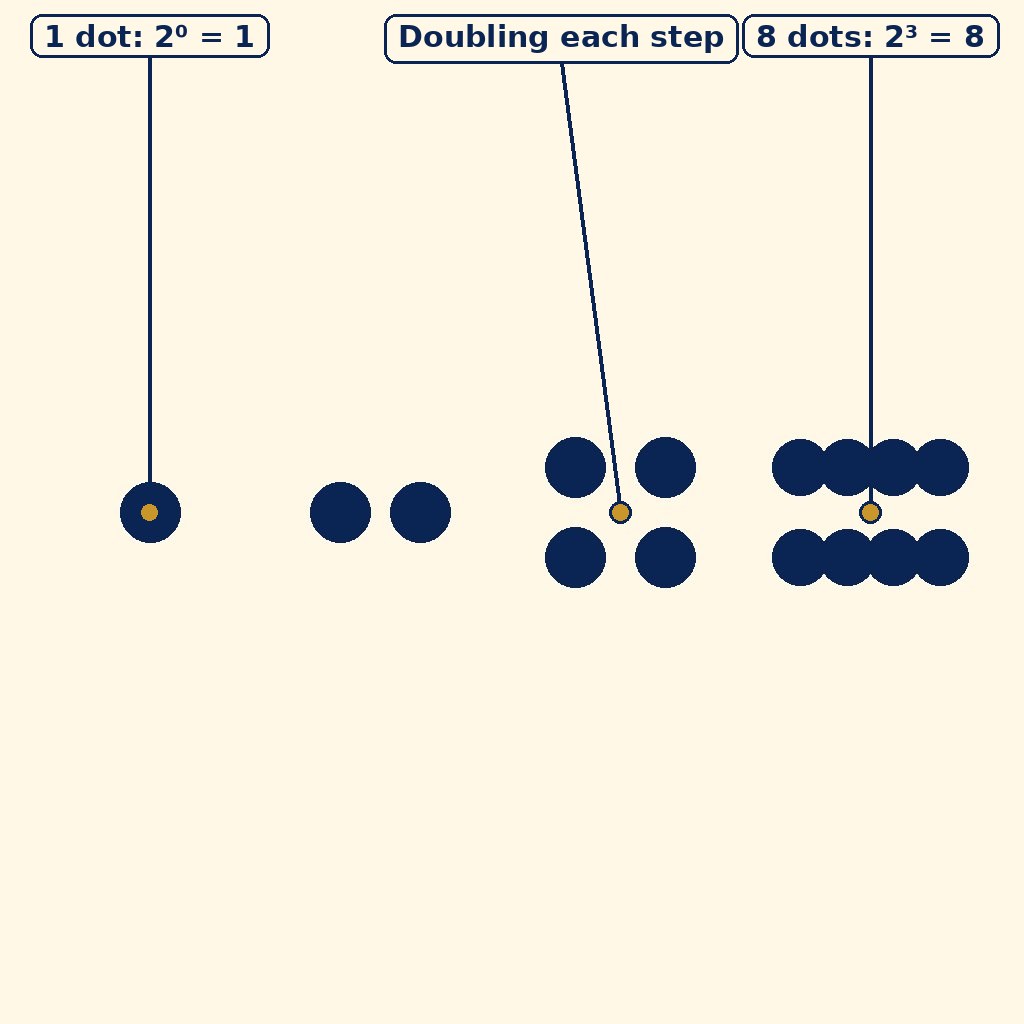
Diagram (labels are printed on the image): Clusters of dots that double from left to right — one, then two, then four, then eight. A general picture of repeated doubling, not a book scene.

A plant with leaves on its branches. A general picture of growth, not a book scene.
What the chapter is about
Start with a length of 0.001 cm and keep doubling it. After 10 doublings it has been multiplied by 2¹⁰ = 1024, giving 1.024 cm — a tiny length has grown a thousandfold in just ten steps. That is the power of powers: repeated multiplication written in shorthand as an exponent. In aⁿ, a is the base and n is the exponent, and aⁿ means a multiplied by itself n times.
The laws of exponents follow from that meaning. Multiplying powers with the same base adds exponents (aᵐ × aⁿ = aᵐ⁺ⁿ); dividing subtracts them (aᵐ ÷ aⁿ = aᵐ⁻ⁿ); a power of a power multiplies them ((aᵐ)ⁿ = aᵐⁿ). Going the other way down the ladder gives a⁰ = 1 and negative powers: a⁻ⁿ = 1 ÷ aⁿ, so 2⁻³ = 1/8. Powers of 10 run the place-value system: 561.903 = 5 × 10² + 6 × 10¹ + 1 × 10⁰ + 9 × 10⁻¹ + 0 × 10⁻² + 3 × 10⁻³, and large or small numbers can be written compactly with them, such as 72000 = 7.2 × 10⁴ and 0.00004 = 4 × 10⁻⁵.
Watch the comparisons: 2¹⁰ = 1024 is slightly bigger than 10³ = 1000, which is why repeated doubling outruns decimal growth at first. And 2³ × 2⁴ = 2⁷ = 128, not 2¹² — exponents add only when the bases match.
What you should learn
- Write repeated multiplication and division in exponent form.
- Apply the laws: multiply (add), divide (subtract), power of a power (multiply).
- Explain a⁰ = 1 and a⁻ⁿ = 1 ÷ aⁿ.
- Expand numbers using powers of 10, including negative powers for decimals.
- Compare powers such as 2¹⁰ and 10³.
Key Terms
- Base — The number multiplied repeatedly; in 2⁵ the base is 2.
- Exponent (power) — How many times the base is multiplied by itself; in 2⁵ the exponent is 5.
- Exponential notation — Writing repeated multiplication as a power, for example 2 × 2 × 2 × 2 = 2⁴.
- Negative exponent — a⁻ⁿ means 1 ÷ aⁿ; 10⁻² = 1/100 = 0.01.
- Standard form — Writing a number as a small decimal times a power of 10, for example 7.2 × 10⁴.
Remember
- aᵐ × aⁿ = aᵐ⁺ⁿ and aᵐ ÷ aⁿ = aᵐ⁻ⁿ (same base only).
- (aᵐ)ⁿ = aᵐⁿ and a⁰ = 1 for any non-zero a.
- 2¹⁰ = 1024, just above 10³ = 1000.
- Negative exponents make fractions, not negative numbers: 2⁻³ = 1/8, not −8.
Exam Tip / Common Mistake
Common mistake: writing 2³ × 2⁴ = 2¹². Exponents add when multiplying, so it is 2⁷ = 128. Also, 3² = 9 is not 3 × 2 = 6.
After each doubling, the length doubles but the number of steps grows slowly. Ten doublings multiply by about a thousand — that is why powers describe fast growth like bacteria and folding paper.
Before simplifying, circle the bases. If they differ, the exponent laws do not combine them — work each power out separately.
Chart / Table: Powers worth knowing
| Power | Value | Power | Value |
|---|---|---|---|
| 2⁵ | 32 | 10³ | 1000 |
| 2¹⁰ | 1024 | 10⁻² | 0.01 |
| 3⁴ | 81 | 5⁰ | 1 |
| 2⁻³ | 1/8 | 4³ | 64 |
Worked method: simplify with the laws
- Write every factor with the same base where possible.
- For multiplication, add the exponents; for division, subtract them.
- For a power of a power, multiply the exponents.
- Turn any negative exponent into a fraction at the end and check by expanding one small case.
Practice set — try it yourself
- Find 2⁷.
Hint: Double 2 six times, or use 2⁵ = 32 and double twice more. - Write 3⁻² as a fraction.
Hint: A negative exponent means one divided by the positive power. - Simplify 5³ × 5² as a single power, then find its value.
Hint: Same base, so add the exponents. - Write 0.00004 in standard form.
Hint: Move the decimal point until one non-zero digit is before it, and count the places. - Simplify (2³)².
Hint: A power of a power multiplies the exponents.
Questions with Answers
- What is 10⁶?
10⁶ = 1,000,000 (one million). - What is 2⁻³?
2⁻³ = 1 ÷ 2³ = 1/8. - Expand 405.07 using powers of 10.
405.07 = 4 × 10² + 0 × 10¹ + 5 × 10⁰ + 0 × 10⁻¹ + 7 × 10⁻². - Which is greater, 2¹⁰ or 10³, and by how much?
2¹⁰ = 1024 and 10³ = 1000, so 2¹⁰ is greater by 24. - A strip of length 0.001 cm is doubled 10 times. What is its final length?
0.001 × 2¹⁰ = 0.001 × 1024 = 1.024 cm.
Extension questions
- Simplify 3⁴ ÷ 3².
Same base, so subtract: 3⁴⁻² = 3² = 9. - What is 6⁰? Explain in one line.
1. Any non-zero number to the power 0 is 1, since aⁿ ÷ aⁿ = a⁰ = 1. - Write 10⁻⁴ as a decimal.
10⁻⁴ = 1 ÷ 10⁴ = 0.0001. - Simplify 4³ × 4⁻¹.
4³⁻¹ = 4² = 16. - Write 72000 in standard form.
72000 = 7.2 × 10⁴. - Write 1/32 as a power of 2.
32 = 2⁵, so 1/32 = 2⁻⁵.
Powers are repeated multiplication in shorthand. Same-base multiplication adds exponents, division subtracts them, a power of a power multiplies them, a⁰ = 1, and negative exponents give fractions. Powers of 10 run place value both ways.
How to use this page: Read the summary, say the Key Terms in your own words, then try the practice set without looking. Use the Questions with Answers to check yourself afterwards. Ask your teacher or parent to check your answers.