

Chapter 5: Somebody's Mother
A crowd walks past an old woman at a crossing — until one boy stops.
Original notes — ready CBSE (NCERT, English Medium) • Class 8 • English • Book: Poorvi Unit 2: Values and Dispositions
Chapter 5: Somebody's Mother — EG's own notes, in simple words
Book: Poorvi (CBSE, Class 8) | Chapter 5 | Unit 2: Values and Dispositions | Medium: English
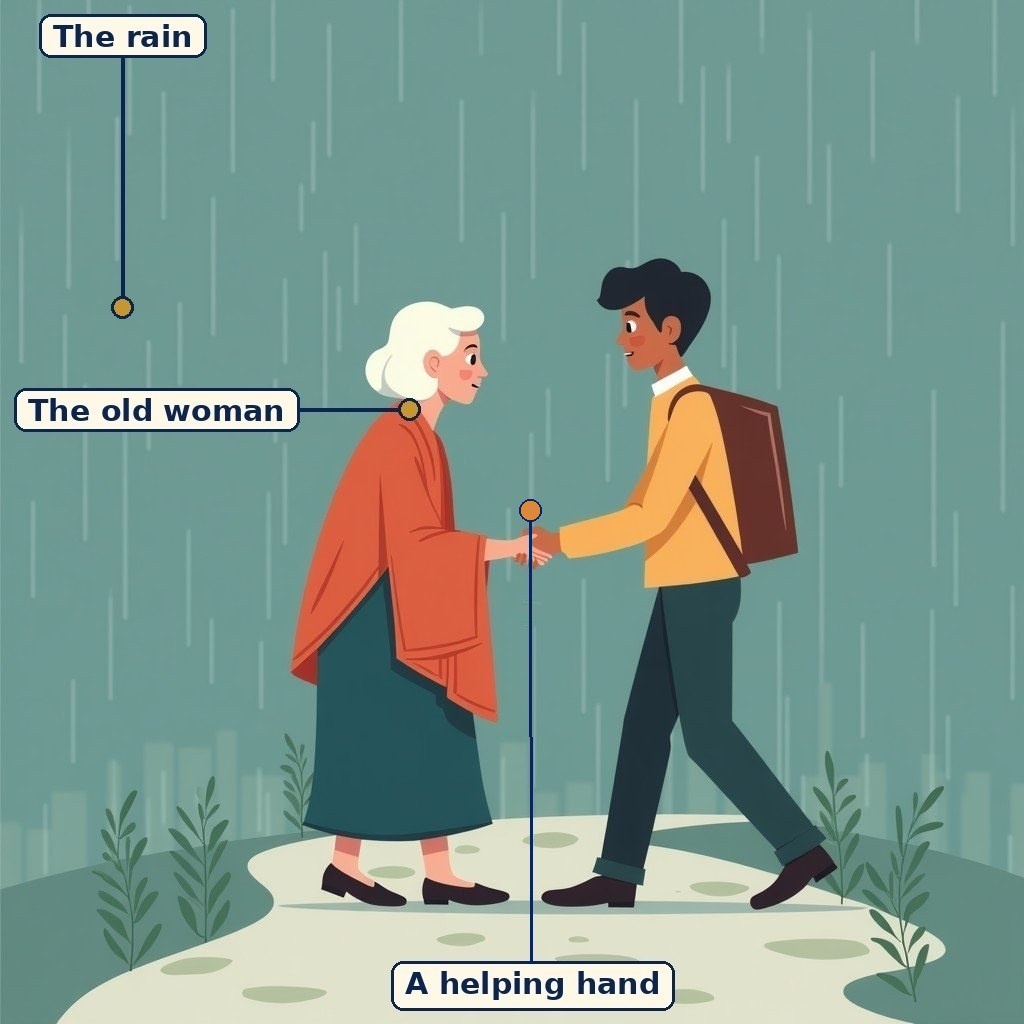
Diagram (labels are printed on the image): Diagram (labels are printed on the image): An old woman in the rain being offered help by a young person. A general picture about kindness to elders; it is not a scene from the book.

A young person helping an elderly woman cross a wet street with an umbrella. A general picture about care for elders, not a book scene.
What the lesson is about
This poem, by Mary Dow Brine, opens on a cold winter's day. An old woman, ragged and grey and bent with the cold, stands at a crossing and waits long, alone and uncared for amid the throng. The street is wet with recent snow, her feet are aged and slow, and she is afraid to stir in case carriage wheels or horses' feet crowd her down in the slippery street.
Down the street come schoolboys, glad in the freedom of school let out, laughing and shouting, hailing the snow piled white and deep. They hurry past the old woman, and none offers her a helping hand — she is so meek, so timid, afraid to stir. The crowd's hurry is the poem's quiet accusation: many people see need, and pass by.
At last one boy comes — the gayest laddie of all the group. He pauses beside her and whispers that he will help her cross if she wishes to go. She places her aged hand on his strong young arm, and he guides her trembling feet along without hurt or harm, proud that his own feet are firm and strong. Then he goes back to his friends, his young heart happy and well content.
His explanation to his friends is the poem's heart. She is somebody's mother, he says, for all she is aged and poor and slow — and he hopes some fellow will lend a hand to help his own mother, if ever she is poor and old and grey when her own dear boy is far away. That night the old woman bows her head in prayer: God be kind to the noble boy, who is somebody's son, and pride and joy.
Key Terms
- Ragged — Worn and torn, describing poor, old clothing.
- Throng — A large crowd of people.
- Meek — Quiet and gentle, here too timid to ask for help.
- Timid — Shy and easily frightened.
- Laddie — A boy or young lad.
- Content — Happy and satisfied, at peace with what one has done.
Remember
- The old woman is never named — she is 'somebody's mother', and that is the point.
- The boy who helps is the merriest of the group, not the most serious.
- His reason looks forward: his own mother may one day need the same help.
- The poem ends with two prayers in balance: his hope, and her blessing.
The poem's turning line is the boy's explanation that she is somebody's mother. Name it in answers, and paraphrase the scenes around it; do not copy whole stanzas.
Chart / Table: The poem's two halves
| Item | Detail |
|---|---|
| The crowd | Laughing, hurrying, passing the old woman by. |
| The one boy | Pauses, whispers his offer, guides her across. |
| His reason | She is somebody's mother, as his own mother is somebody's. |
| The close | Her prayer blesses the boy who is somebody's son. |
Language focus — Let us learn
- Antonyms in a grid: the lesson hides antonyms of words from the poem — including words related to firm, meek, merry, kind, anxious and bent — in a letter grid, to be found horizontally, vertically and diagonally. Use a dictionary where needed, and check each find against the poem's sense.
- Describing words: notice how the poem builds its picture from adjectives — ragged and grey, aged and slow, meek, timid — and practise replacing one with an opposite to feel how the picture changes.
- Sound and sense: the poem's rhymes and rhythm carry its feeling: the hurrying boys move quickly, the old woman's lines move slowly. Read it aloud and mark where the pace changes.
Listen, Speak, Write, Explore
- Listen: a woman reads a special news broadcast; arrange pictures in the correct sequence of the events you hear.
- Speak: read aloud the words from the poem ending in '-ed', and sort them by their final sound, listening for the three different endings.
- Write: a diary entry about a day you helped someone in need — what happened, what you did, and how you felt afterwards.
- Explore: in ancient Indian scriptures, Earth herself is addressed as mother — the Prithvi-Sukta, the hymn to the earth, in the Atharva Veda. Compare that idea with the poem's title.
Practice set — try it yourself
- Why is the old woman afraid to cross alone?
Hint: Think about snow, slippery streets, carriages and horses, and her slow feet. - Why do the other boys pass her by?
Hint: Think about hurry and freedom after school — and about not stopping to look. - What does the boy's whisper show about his character?
Hint: Think about gentleness: he offers, he does not order or show off. - Why does the boy mention his own mother?
Hint: Think about the golden rule: treat others as you would wish your own to be treated. - Why does the poem end with the old woman's prayer?
Hint: Think about balance: a kindness given is answered by a blessing.
Questions with Answers
- Describe the old woman at the start of the poem.
She is old, ragged and grey, bent with the winter cold, standing long at a crossing, alone and uncared for, her feet aged and slow on a street wet with recent snow. - How do the schoolboys behave when they pass her?
Glad in the freedom of school let out, laughing and shouting, they hurry past like a flock of sheep and offer her no helping hand. - What does the one boy do, and how does he do it?
The gayest laddie of the group pauses, whispers that he will help her cross if she wishes, and guides her trembling feet along with her hand on his strong young arm, without hurt or harm. - What reason does the boy give his friends?
She is somebody's mother, for all she is aged and poor and slow — and he hopes someone will lend a hand to his own mother if she is ever poor, old and grey when her own boy is far away. - What is the poem's message?
Treat every elder as somebody's mother or father. Kindness to a stranger is kindness you would wish for your own family.
Extension questions — go further
- True or false: the old woman asked the boys for help.
False. She was too meek and timid to ask; the boy offered. - Which word describes the old woman's clothing — ragged, splendid, or new?
Ragged. - Why is the boy called the 'gayest laddie' important to the poem?
Because the merriest boy is also the kindest — high spirits and kindness belong together, not apart. - What does 'somebody's mother' mean in the poem?
That a stranger is not nobody: she belongs to someone, loves and is loved, and deserves the care we would give our own. - Name the two prayers, or hopes, that close the poem.
The boy's hope that someone will help his mother one day, and the old woman's prayer that God be kind to the noble boy. - Give an antonym of timid as used in the poem's vocabulary work.
Bold or confident — the opposite of shy and easily frightened. - Why does the poet repeat 'aged and poor and slow'?
To make the reader feel the woman's condition fully, so the boy's kindness lands with full force. - Write, in your own words, the boy's speech to his friends in two sentences.
Open answer — it must carry both ideas: she is somebody's mother, and his own mother may one day need the same hand. - How would the poem change if the old woman had been helped by the whole crowd?
It would lose its point: one person's choice to stop is what the poem celebrates, against a crowd that walks on. - Name one small helping act you could do this week for an elder in your neighbourhood.
Open answer — for example, carrying a bag, giving up a seat, or walking with someone across a busy road.
A crowd walks past an old woman at a crossing — until one boy stops. His explanation to his friends is the poem's heart.
- Read the summary and say the Key Terms in your own words.
- Try the practice set without looking.
- Check yourself with the Questions with Answers.
- Attempt the extension questions for full NCERT coverage.
- Ask your teacher or parent to check your answers.
How to use this page: Read the summary, say the Key Terms in your own words, then try the practice set without looking. Use the Questions with Answers to check yourself afterwards. Ask your teacher or parent to check your answers.