

Chapter 14: Magnifying Glass
A spider, a dewdrop, a scrap of chalk — and suddenly the moon is within reach.
Original notes — ready CBSE (NCERT, English Medium) • Class 8 • English • Book: Poorvi Unit 5: Science and Curiosity
Chapter 14: Magnifying Glass — EG's own notes, in simple words
Book: Poorvi (CBSE, Class 8) | Chapter 14 | Unit 5: Science and Curiosity | Medium: English

Diagram (labels are printed on the image): Diagram (labels are printed on the image): A large magnifying glass over a leaf showing its veins enlarged, with a notebook beside it. A general picture about observation; it is not a scene from the book.
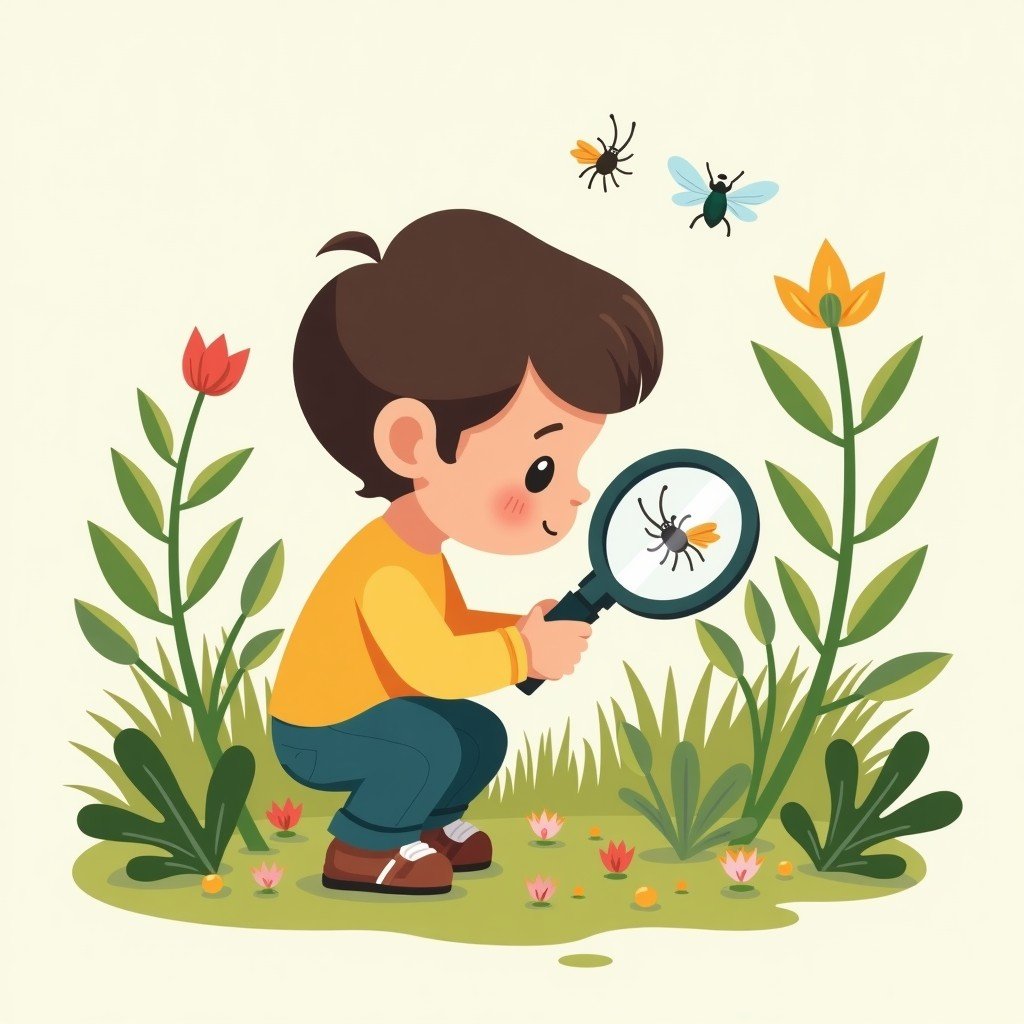
A child exploring tiny insects and leaves in a garden with a magnifying glass. A general picture about curiosity, not a book scene.
What the lesson is about
This poem, by Walter de la Mare, is about the magic of seeing the world through a magnifying glass. The speaker lies in wait and watches how the deft spider jets the woven web-silk from its spinnerets, with tigerish claws, while silly flies stumble into its net — with all those eyes. The small world, watched closely, becomes dramatic and strange.
The poem's pattern repeats stanza by stanza: an ordinary thing is introduced, and the glass makes it marvellous. Not even the tiniest thing, the speaker says, but the glass will make more marvellous and itself surpass. A scrap of chalk shows a myriad shells; a drop of water seems like a hive of bees; a forest of flowers and trees appears in miniature. The glass does not invent these wonders — it reveals what close observation finds.
The poem is rich in poetic devices. It uses simile and metaphor to compare small things with grand ones, alliteration for music, personification when the glass is said to make magic talk, and vivid visual imagery throughout. Its tone is wonder and curiosity, and its exclamation marks — at the tigerish claws, the many eyes, and the afternoon walk to the moon — carry the speaker's excitement.
The final stanza leaps from the small to the vast. With lenses like this one, eyeing the moon, it would seem you could walk there in an afternoon. The poem's message is that curiosity and close observation transform the everyday: the world is already marvellous, and a lens — or a careful eye — is enough to show it. The poem is written in six stanzas of four lines each, a quatrain form, with the rhyme scheme ABCB.
Key Terms
- Deft — Skilful and quick with the hands — here, the spider's weaving.
- Spinnerets — The organs from which a spider produces silk.
- Woven — Made by weaving threads together.
- Myriad — A very large number; countless.
- Marvellous — Wonderful; causing great wonder.
- Quatrain — A stanza of four lines.
Remember
- Structure: six stanzas, four lines each, rhyme ABCB.
- Tone: wonder and curiosity, not fear or sadness.
- Pattern: a small thing introduced, then made extraordinary by the glass.
- Final image: the moon seeming within an afternoon's walk.
A device without an example earns little. Pair each one: personification with 'magic talk', visual imagery with the myriad shells in chalk, exclamation with the tigerish claws.
Chart / Table: The poem's pattern
| Item | Detail |
|---|---|
| The spider | Deft weaving, tigerish claws, flies with all those eyes. |
| A scrap of chalk | A myriad shells hidden inside it. |
| A drop of water | Seeming like a hive of bees. |
| The moon | Seeming within reach in an afternoon, through lenses. |
Language focus — Let us learn
- Words from the text: fill blanks with words from the box — woven, myriad, deft, stumble, surpass, marvellous — for example, a deft description, a story woven with fascinating details, a marvellous storytelling technique, myriad emotions, a reader who will stumble upon twists, and twists that surpass understanding.
- Collective nouns: match phrases to make collective nouns — a swarm of locusts, a constellation of stars, a grove of trees, a troupe of dancers, a battalion of soldiers, and a fleet of ships.
- Idioms with eye: the poem uses 'eyeing the moon'. Match other idiomatic expressions with eye to their meanings with a dictionary, and use two of them in sentences of your own.
Listen, Speak, Write, Explore
- Listen: a father and daughter discuss lesser-known Indian inventions; mark the four true statements as you listen.
- Speak: pronouncing /v/ and /f/ — the lower lip lightly touches the edge of the upper teeth, and air flows through the small gap. Practise word pairs that differ only in these sounds.
- Write: a conversation in dialogue form — engaging, natural speech between two people, with speakers clearly marked and the exchange moving forward.
- Explore: children with low vision benefit from visual aids such as magnifying spectacles, stand magnifiers and hand-held magnifiers. Compare these tools with the poem's glass.
Practice set — try it yourself
- What does the speaker watch the spider do, and why is it marvellous?
Hint: Think about silk, claws and flies: what does the glass reveal that the bare eye misses? - What is the poem's main idea?
Hint: Think about the discuss options: wonders in nature, or the power of close observation? - Why does the poet use exclamation marks?
Hint: Think about excitement: what feeling do the claws, the eyes and the moon produce? - What is 'magic talk' in the poem?
Hint: Think about personification: what is given a voice that it does not literally have? - Why does the poem end with the moon?
Hint: Think about scale: from a spider to the moon, what journey has observation made?
Questions with Answers
- What does the speaker see through the magnifying glass?
A deft spider jetting woven web-silk from its spinnerets, with tigerish claws, while silly flies stumble into its net; and in other stanzas, a myriad shells in a scrap of chalk, a drop of water like a hive of bees, and a forest of flowers and trees in miniature. - What is the poem's form?
Six stanzas of four lines each — quatrains — with the rhyme scheme ABCB. - What is the poem's tone?
Wonder and curiosity, carried by exclamation marks and by imagery that turns small things grand. - Give one example each of personification and visual imagery in the poem.
Personification: the glass is said to make 'magic talk', giving a voice to an instrument. Visual imagery: a myriad shells showing in a scrap of chalk, or a forest of flowers and trees seen in miniature. - What is the poem's message?
That close observation transforms the everyday: the world is already marvellous, and a lens — or a careful, curious eye — reveals wonders hidden in the smallest things, until even the moon seems within reach.
Extension questions — go further
- How many stanzas and lines does the poem have?
Six stanzas, four lines each. - What is the rhyme scheme?
ABCB. - True or false: the poem's tone is peaceful and emotional.
False by the lesson's own choice — the tone is wonder and curiosity. - Fill the blank with a word from the box: With his _____ description, the author wrote beautifully.
Deft. - Fill the blank: The reader will _____ upon unexpected twists.
Stumble. - Match the collective noun: a _____ of stars.
A constellation. - Match the collective noun: a _____ of ships.
A fleet. - Match the collective noun: a _____ of soldiers.
A battalion. - What does 'eyeing the moon' mean in the final stanza?
Looking at the moon through a lens, so that it seems close enough to walk to in an afternoon. - Write a four-line quatrain of your own about something small seen closely.
Open answer — checked for quatrain form, close observation, and one vivid image.
A spider, a dewdrop, a scrap of chalk — and suddenly the moon is within reach. The final stanza leaps from the small to the vast.
- Read the summary and say the Key Terms in your own words.
- Try the practice set without looking.
- Check yourself with the Questions with Answers.
- Attempt the extension questions for full NCERT coverage.
- Ask your teacher or parent to check your answers.
How to use this page: Read the summary, say the Key Terms in your own words, then try the practice set without looking. Use the Questions with Answers to check yourself afterwards. Ask your teacher or parent to check your answers.