

Chapter 5: Discovering the Elements of Music
Melody, rhythm and lyrics in action: vocal range, harmony, konnakkol in Adi tala, tabla bols, and singing together.
Original notes — ready CBSE (NCERT, English Medium) • Class 8 • Arts • Book: Kriti
Chapter 5: Discovering the Elements of Music — EG's own notes, in simple words
Book: Kriti (CBSE, Class 8) | Chapter 5 | Section: Music | Medium: English

Diagram (labels are printed on the image): A tala chart: eight beats of Adi tala with claps, finger counts and waves, and the konnakkol phrase ThaKaDhiMi ThaKaJhaNu.
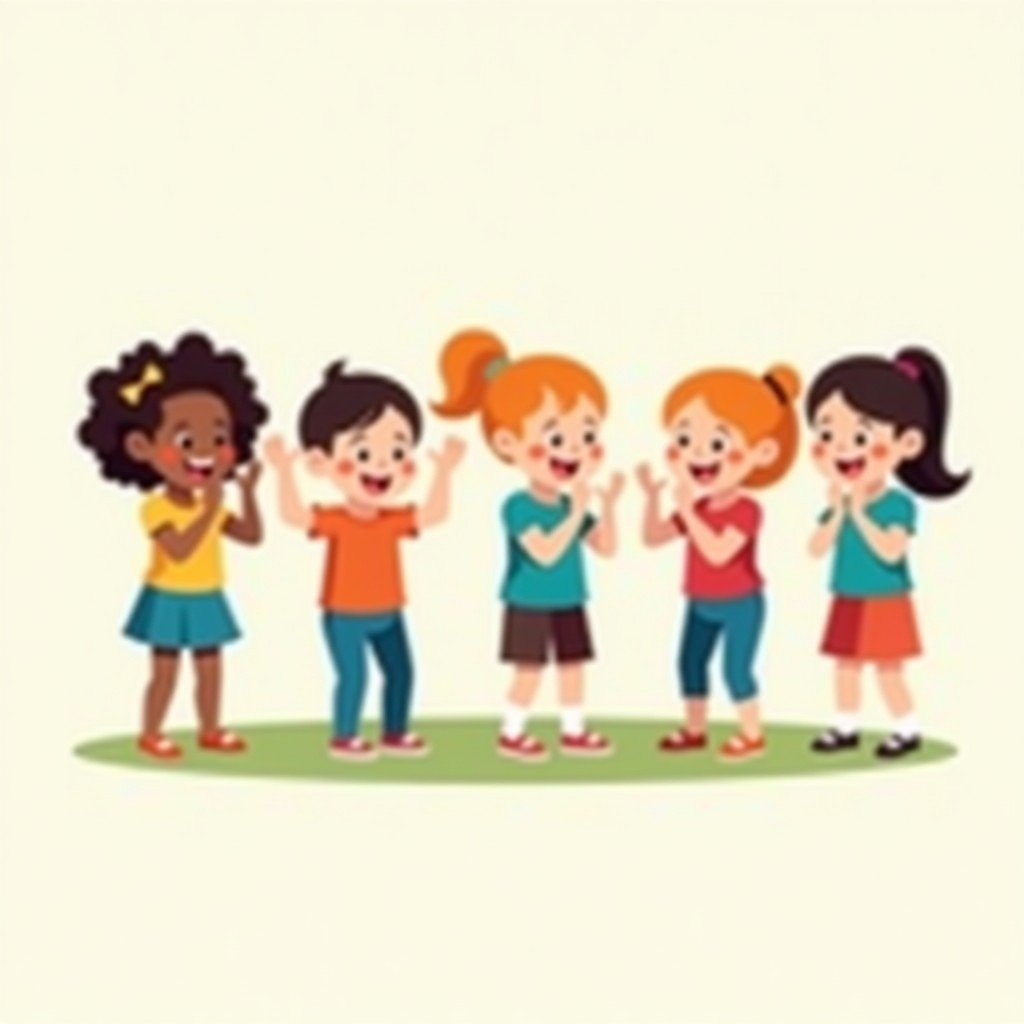
Children singing together in a group, keeping tala with claps and hand gestures.
What the chapter is about
When we listen to a piece of music or sing a song, it is made of constituent elements. The main elements of music are melody (raga), rhythm (tala) and lyrics (sahitya). This chapter discovers further aspects of rhythm, melody and lyrics, and observes how they come together when we sing a song.
It begins with the voice itself. Vocal range is the span from the lowest to the highest note you can comfortably sing, and extending it develops your singing. Activity 5.1 practises the lower register, the mandra saptak, with patterns that descend step by step; students are asked to notice the pattern and create a similar one for the higher register, the tara saptak. While practising, keep the head and neck in a neutral position to avoid straining the voice or throat muscles. Activity 5.2 builds flexibility — sing slowly and increase the tempo as you get comfortable — and Activity 5.3 practises warmups in harmony: canons, first learnt in Grade 7, are a first step towards singing harmony.
Konnakkol and swaras in Adi tala
Konnakkol is the rhythm language of Carnatic music. Activity 5.5 recites a konnakkol phrase in Adi tala: an 8-akshara phrase, ThaKaDhiMi ThaKaJhaNu (4 + 4 = 8). The eight beats are kept as clap, little finger, ring finger, middle finger, clap, wave, clap, wave. At 1st speed there is 1 count per beat; at 2nd speed, 2 counts per beat (ThaKa, DhiMi, and so on); at 3rd speed, 4 counts per beat (ThaKaDhiMi, ThaKaJhaNu). Students observe the proportionate change in syllables as speed changes — and discuss which mathematical concept it relates to.
Activity 5.6 repeats the same exercise with swaras instead of konnakkol syllables: at 1st speed S R G M P D N Ṡ across the eight beats, at 2nd speed SR GM PD NṠ ṠN DP MG RS, and at 3rd speed SRGM PDNṠ ṠNDP MGRS. Students are then asked to make their own patterns in Adi tala using swaras.
Tabla bols, speeds and the ensemble
In Hindustani music, many stalwarts have created beautiful patterns in talas, including Paran, Chakradhaar, Uthaan, Fard and Palta. Activity 5.7 recites the Saraswati Paran, composed by Swami Pagal Das, a praise of Goddess Saraswati whose bols include Dhin Dhin Dhage Tirakita. Activity 5.8 fixes the speed patterns for reciting bols: Ek gun is 1 bol per beat, Dugun 2 bols per beat, Tigun 3 bols per beat and Chaugun 4 bols per beat.
Activity 5.9 brings it together in an ensemble: rehearse a group song many times, using chorus singing and canons, and present it before the class. The chapter ends with a patriotic song, 'Jayati Jayati Bharata Mata', credited to the Sangeet Natak Akademi, which students learn to sing individually or in a group.
When speed doubles, the syllables per beat double too — 1, then 2, then 4 counts per beat. That proportionate change is the same idea as ratio in mathematics.
Keep head and neck neutral while practising mandra saptak, and build flexibility slowly — speed comes only after comfort.
Key Terms
- Raga (melody) — The melodic framework of a piece — the notes and their relationships.
- Tala (rhythm) — The rhythmic cycle that organises beats in time, such as Adi tala's eight beats.
- Sahitya (lyrics) — The words of a song.
- Vocal range — The span from the lowest to the highest note you can comfortably sing.
- Mandra saptak / Tara saptak — The lower / higher register of the voice.
- Konnakkol — The rhythm language of Carnatic music, spoken in syllables like ThaKaDhiMi.
- Adi tala — An eight-beat tala cycle, kept with clap, finger counts and waves.
- Bol — A rhythmic syllable used in tabla and konnakkol recitation, such as Dhin or Dhage.
- Paran — A composition type in tabla repertoire, here the Saraswati Paran by Swami Pagal Das.
- Canon — Singing the same melody starting at different times — a first step towards harmony.
Remember
- Music's main elements: melody (raga), rhythm (tala), lyrics (sahitya).
- Range: mandra (lower) and tara (higher) saptak; practise with a neutral head and neck.
- Konnakkol phrase in Adi tala: ThaKaDhiMi ThaKaJhaNu, 8 aksharas over 8 beats.
- Speeds: 1st = 1 count/beat, 2nd = 2, 3rd = 4; tabla: Ek gun, Dugun, Tigun, Chaugun.
- Saraswati Paran (Swami Pagal Das); patriotic song 'Jayati Jayati Bharata Mata'.
Exam Tip / Common Mistake
Common mistake: speeding up before the pattern is secure, or straining the neck in low notes. Slow, comfortable and steady first — speed is the last thing to add.
Chart / Table: Adi tala — beats, counts and speeds
| Point | Detail |
|---|---|
| Beat pattern | Clap, little finger, ring finger, middle finger, clap, wave, clap, wave |
| Konnakkol phrase | ThaKaDhiMi ThaKaJhaNu (4 + 4 = 8 aksharas) |
| 1st speed | 1 count per beat: Tha Ka Dhi Mi Tha Ka Jha Nu |
| 2nd speed | 2 counts per beat: ThaKa DhiMi ThaKa JhaNu |
| 3rd speed | 4 counts per beat: ThaKaDhiMi ThaKaJhaNu |
| Swara version | 1st: S R G M P D N Ṡ; 3rd: SRGM PDNṠ ṠNDP MGRS |
| Tabla speeds | Ek gun 1, Dugun 2, Tigun 3, Chaugun 4 bols per beat |
Practice set — try it yourself
- Name the three main elements of music.
Hint: Melody, rhythm, lyrics. - What is vocal range, and what are mandra and tara saptak?
Hint: Span of comfortable notes; lower and higher registers. - Write the 8-akshara konnakkol phrase for Adi tala.
Hint: ThaKaDhiMi ThaKaJhaNu. - At 2nd speed, how many counts fall on each beat?
Hint: Two. - Name the tabla speed with 4 bols per beat.
Hint: Chaugun.
Questions with Answers
- What are raga, tala and sahitya?
Raga is melody, tala is rhythm and sahitya is lyrics — the three main elements that come together in any song. - How is the konnakkol phrase kept in Adi tala?
The 8-akshara phrase ThaKaDhiMi ThaKaJhaNu is spread over eight beats kept as clap, little finger, ring finger, middle finger, clap, wave, clap, wave; at 1st speed one syllable falls on each beat. - How do 2nd and 3rd speeds change the same phrase?
At 2nd speed there are 2 counts per beat (ThaKa, DhiMi...), and at 3rd speed 4 counts per beat (ThaKaDhiMi, ThaKaJhaNu) — the same phrase, packed faster into the same eight beats. - What are Ek gun, Dugun, Tigun and Chaugun?
Tabla recitation speeds: Ek gun is 1 bol per beat, Dugun 2, Tigun 3 and Chaugun 4 bols per beat. - What is the Saraswati Paran, and who composed it?
A tabla composition in praise of Goddess Saraswati, composed by Swami Pagal Das, using bols such as Dhin Dhin Dhage Tirakita.
Extension questions — go deeper
- Create your own 8-akshara konnakkol phrase and write it at 1st, 2nd and 3rd speeds. What happens to the number of syllables per beat?
Any 8-syllable phrase works, for example ThaKaDhiMi ThaKaDhiMi; the syllables per beat grow 1 → 2 → 4 while the eight beats stay the same — a ratio pattern. - Why does the chapter ask you to keep head and neck neutral during mandra saptak practice?
Because straining the neck strains the throat muscles and the voice; a neutral position lets the low register sound freely and safely. - Convert the swara pattern SRGM PDNṠ ṠNDP MGRS back to 1st speed. Which swara falls on beat 5?
At 1st speed the pattern is S R G M P D N Ṡ, so beat 5 is P (pancham). - A canon is called a first step towards harmony. Explain why, in your own words.
In a canon, groups sing the same melody starting at different times, so two different notes sound together — the simplest form of harmony, without needing separate parts. - Plan an ensemble performance for your class using this chapter: what would you rehearse, and in what order?
Start with range and flexibility warmups, then konnakkol in Adi tala, then the swara version, then the Saraswati Paran bols, and finally present a group song or the patriotic song with chorus and canon parts.
- Raga, tala, sahitya — the three elements.
- Mandra/tara saptak and safe practice.
- Adi tala beats and the konnakkol phrase.
- Speeds: 1st/2nd/3rd and Ek gun to Chaugun.
- Saraswati Paran and ensemble singing.
How to use this page: Read the summary, say the Key Terms in your own words, then try the practice set without looking. Use the Questions with Answers to check yourself afterwards. Ask your teacher or parent to check your answers.