

Chapter 13: Innovation, Inclusivity and Inspiring Change
New ideas, open doors: martial arts in dance, dance for everyone, and artists who change society.
Original notes — ready CBSE (NCERT, English Medium) • Class 8 • Arts • Book: Kriti
Chapter 13: Innovation, Inclusivity and Inspiring Change — EG's own notes, in simple words
Book: Kriti (CBSE, Class 8) | Chapter 13 | Section: Dance and Movement | Medium: English
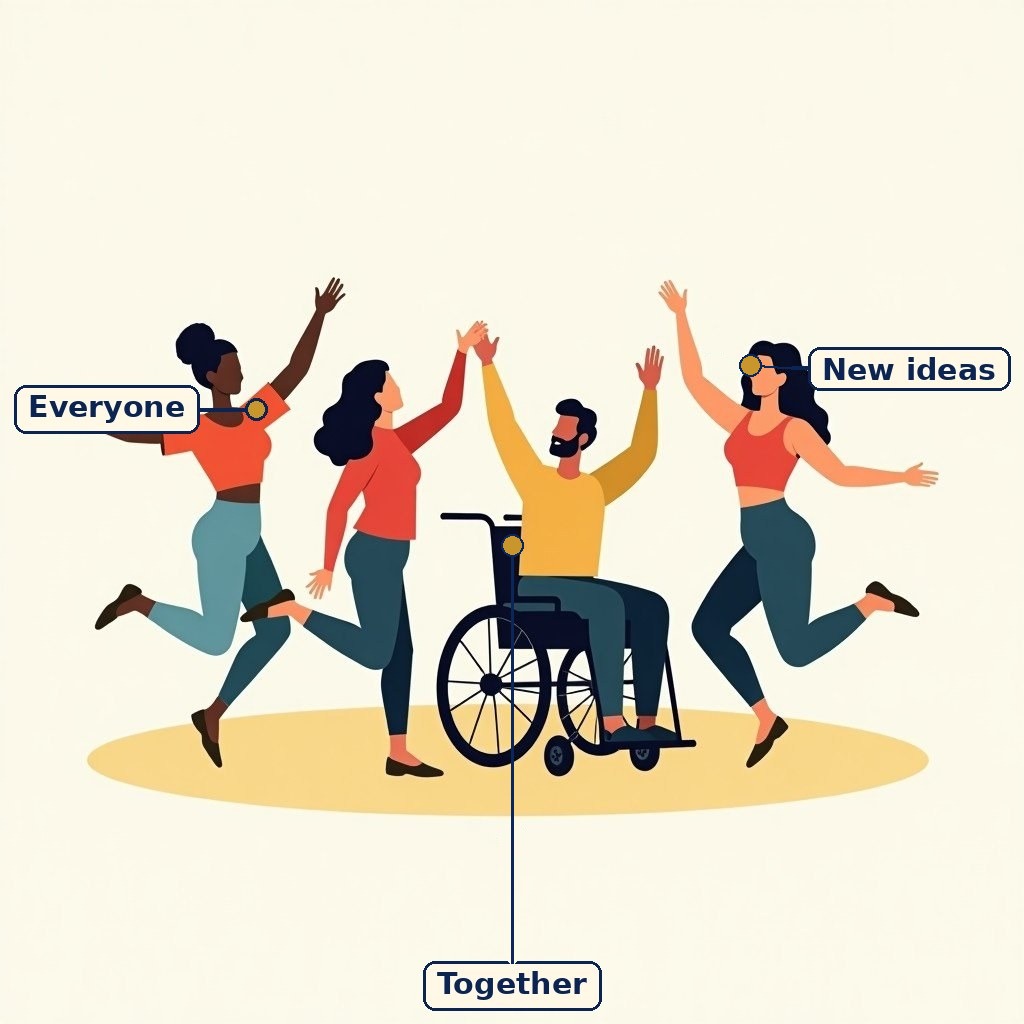
Diagram (labels are printed on the image): A labelled diagram of martial-arts movement in dance: Thang-Ta sword and spear lines beside kalaripayattu stances.
Dancers of different ages and abilities performing together on one stage, celebrating unity in diversity.
What the chapter is about
The deeper the roots of a tree, the higher the branches reach. Similarly, the more knowledge and depth you have of your dance traditions, the more you can create and innovate. Innovation in dance means using traditional vocabulary to tell contemporary stories and show current scenarios — and many dance artists and institutions have done exactly that, building on the two pioneers of modern dance development in India whom students learnt about in Grade 7.
Martial arts give dance new movement vocabulary. Thang-Ta is a martial arts practice from Manipur; the words mean the 'Art of Sword and Spear'. It harmonises inner energies with outer actions, expressing movements with rhythmic breath control, and it is also ritualistic in practice. It is believed that all movements of the Meitei people originated from Thang-Ta. Kalaripayattu, the martial art of Kerala, was amalgamated with yoga and Bharatanatyam by the famous dancer and choreographer Chandralekha, a pioneer in her choreographies and productions. Activity 13.1, 'Watch and learn', asks students to practise one or two movements of these martial arts with a visiting practitioner or under a teacher's guidance; Activity 13.2, 'Dance the now', asks them to choreograph a contemporary theme.
Inclusivity in dance
Inclusivity in dance is essential in today's society. More dancers are creating work accessible to all, including those who are differently-abled. Dance teachers work with people of all ages and abilities, bringing the joy of dance to all without barriers and inhibitions. Even on national television and important platforms, differently-abled dancers perform and are represented. Dance is also beyond gender: traditions predominantly performed by male artists have opened their doors to female artists, and most folk traditions have men and women dancing alongside each other. There is no gender bias — the beauty of dance is in bringing people together.
The chapter gives a landmark example: on 26 January 2025, India's 76th Republic Day, the Ministry of Culture set a Guinness World Record by bringing together over 5,000 folk and tribal artists from across India to perform on Kartavya Path in New Delhi — the largest ensemble of folk and tribal artists at a single venue — symbolising inclusivity as artists from various cultural and tribal backgrounds shared one stage, celebrating unity through diversity. Activity 13.3, 'Dance for all', Activity 13.4, 'Inspiring change', and Activity 13.5, 'Dance beyond gender' — researching a transgender dance artist and presenting a journal or case study — carry the theme into student work.
Innovation is not abandoning tradition. The chapter's image is a tree: deep roots in tradition let branches reach higher into new ideas.
Research one transgender artist for Activity 13.5 and present a journal: their art, their contribution, and their role in promoting diversity.
Key Terms
- Innovation — Creating new work by using traditional dance vocabulary for contemporary stories and scenarios.
- Thang-Ta — Manipuri martial art, the 'Art of Sword and Spear', harmonising inner energy with outer action and rhythmic breath.
- Kalaripayattu — The martial art of Kerala, blended with yoga and Bharatanatyam by Chandralekha.
- Chandralekha — Pioneering dancer and choreographer who amalgamated kalaripayattu and yoga with Bharatanatyam.
- Inclusivity — Dance open to all — all ages, all abilities, all genders — without barriers or inhibitions.
- Kartavya Path record — The 26 January 2025 Guinness World Record: over 5,000 folk and tribal artists at one venue.
Remember
- Innovation grows from deep roots in tradition.
- Thang-Ta (Manipur): Art of Sword and Spear; rhythmic breath; Meitei movements originate from it.
- Chandralekha: kalaripayattu + yoga + Bharatanatyam.
- Inclusivity: differently-abled dancers, all ages and abilities, dance beyond gender.
- 26 January 2025: 5,000+ folk and tribal artists, Kartavya Path, Guinness World Record.
- Activity 13.5: journal on a transgender dance artist.
Exam Tip / Common Mistake
Common mistake: calling any new step 'innovation'. Real innovation keeps the tradition's vocabulary and grammar while saying something new with it.
Chart / Table: Innovation and inclusivity
| Point | Detail |
|---|---|
| Thang-Ta | Manipur; sword and spear; rhythmic breath control; ritualistic |
| Kalaripayattu | Kerala martial art; blended with yoga and Bharatanatyam by Chandralekha |
| Innovation | Traditional vocabulary for contemporary stories and issues |
| Inclusivity | All ages, abilities and genders; no barriers |
| 26 Jan 2025 | 76th Republic Day; 5,000+ artists; Kartavya Path; Guinness record |
| Dance beyond gender | Male traditions opening to women; transgender artists researched |
Practice set — try it yourself
- What does Thang-Ta mean?
Hint: The Art of Sword and Spear. - Which choreographer blended kalaripayattu and yoga with Bharatanatyam?
Hint: Chandralekha. - What record was set on 26 January 2025?
Hint: Largest ensemble of folk and tribal artists at one venue. - How many artists performed at Kartavya Path?
Hint: Over 5,000. - What does Activity 13.5 ask you to research?
Hint: A transgender dance artist.
Questions with Answers
- What is innovation in dance, according to this chapter?
Using deep knowledge of dance traditions to create new work — telling contemporary stories and showing current scenarios with traditional vocabulary, as modern pioneers have done since Grade 7's examples. - Describe Thang-Ta and its place in Meitei culture.
Thang-Ta is Manipur's martial art, the 'Art of Sword and Spear', harmonising inner energies with outer actions through rhythmic breath control, and ritualistic in practice. All movements of the Meitei people are believed to have originated from it. - How did Chandralekha innovate?
The famous dancer and choreographer pioneered amalgamating kalaripayattu and yoga with Bharatanatyam in her choreographies and productions. - What does inclusivity in dance mean, with examples?
Dance accessible to all: differently-abled dancers on national platforms, teachers working with all ages and abilities, male traditions opening to female artists, and folk traditions where men and women dance together — no gender bias. - What happened on 26 January 2025, and why does the chapter cite it?
On India's 76th Republic Day, the Ministry of Culture set a Guinness World Record with over 5,000 folk and tribal artists performing together on Kartavya Path, New Delhi — the largest such ensemble at a single venue, symbolising unity through diversity.
Extension questions — go deeper
- Choreograph a 1-minute piece on a current issue — for example, saving water — using one traditional step and one martial-arts movement. Explain both choices.
A good answer names the issue, the traditional step (for example a grounded sthana showing the earth's weight) and the martial movement (for example a Thang-Ta-inspired sweeping arm showing water's flow), and says why each fits. - Why is the tree image a good explanation of innovation?
A tree's branches reach high only because its roots go deep: without tradition's roots, new work has nothing to stand on; with them, it can grow in new directions without falling. - A school dance show excludes a wheelchair-using student from the stage. Using this chapter, argue for their inclusion and suggest how.
Inclusivity means joy without barriers: the show can be choreographed with the student's movement vocabulary, with formations that include rather than sideline them — as the chapter's differently-abled performers prove on national stages. - Research a transgender dance artist and write the opening paragraph of the Activity 13.5 journal.
A strong opening names the artist, their form, and one concrete contribution — for example breaking a gender barrier in a tradition — before analysing their role in promoting diversity. - Compare the Kartavya Path record with a normal stage show. What does scale add to the message of inclusivity?
Scale makes the message visible: 5,000 artists from many cultures on one path proves diversity is not a slogan but a shared stage — unity performed, not just claimed.
- Innovation from tradition: tree image.
- Thang-Ta and kalaripayattu details.
- Chandralekha's pioneering blend.
- Inclusivity: ability, age, gender.
- Kartavya Path record and Activity 13.5.
How to use this page: Read the summary, say the Key Terms in your own words, then try the practice set without looking. Use the Questions with Answers to check yourself afterwards. Ask your teacher or parent to check your answers.