

Chapter 7: Heat Transfer in Nature
Conduction, convection and radiation — plus the water cycle, seepage and groundwater.
Original notes — ready CBSE (NCERT, English Medium) • Class 7 • Science • Book: Curiosity
Chapter 7: Heat Transfer in Nature — EG's own notes, in simple words
Book: Curiosity (CBSE, Class 7) | Chapter 7 | Medium: English
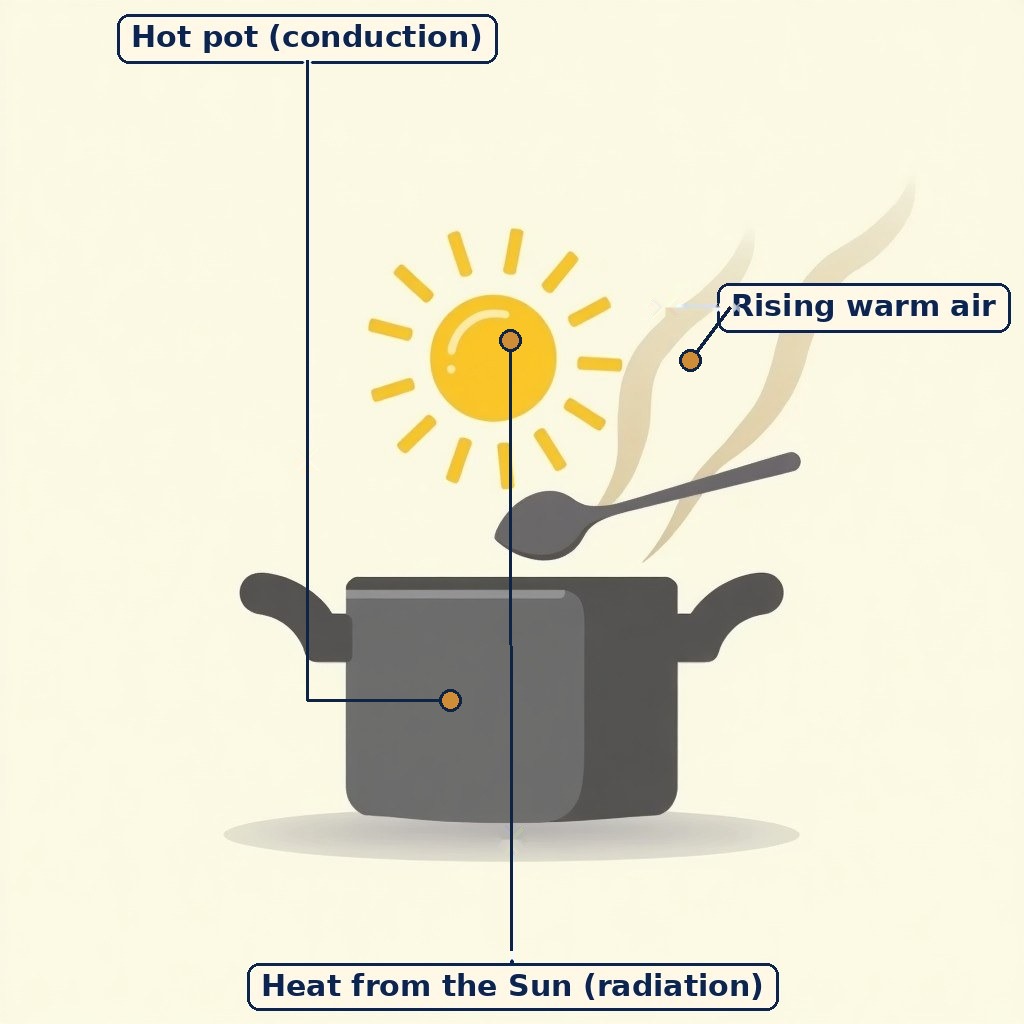
Diagram (labels are printed on the image): Heat transfer: conduction in the pot, warm air rising, and heat from the Sun. A general picture; it is not a scene from the book.
Sun and sea breeze at the coast. A general picture about heat transfer, not a book scene.
What the chapter is about
Heat is a form of energy that flows from a hotter object to a colder one. It can travel in three ways. In conduction, heat passes through a solid from one particle to the next without the particles themselves moving far, which is why a metal spoon in hot soup soon feels hot at the handle. Metals are good conductors; wood, plastic and cloth are poor conductors, or insulators.
In convection, heat travels through liquids and gases because the heated part moves. When water is heated, warm water rises and cool water sinks, setting up a convection current. The same happens in air: warm air rises, which is how sea breezes and land breezes form near coasts, and why smoke rises from a fire.
In radiation, heat travels without any medium at all, even through empty space. Heat from the Sun reaches the Earth by radiation, and we feel warmth near a fire without touching it. Dark surfaces absorb more radiant heat than light, shiny ones, which is why dark clothes feel hotter in the Sun.
7.1 Conduction of heat — the pin-and-wax experiment
The chapter opens in Gangtok, where Pema watches her grandmother cook thukpa in a large metal pan and asks why cooking utensils are generally made of metals. The answer links back to the metals chapter: metals are good conductors of heat. Kerala, closer to the equator with a long coastline, is warmer and more humid than Sikkim — the Sun is our main source of heat, and places near the equator are generally hot.
In Activity 7.1 a metal strip about 15 cm long carries four pins stuck on with wax, about 2 cm apart, labelled I, II, III and IV. The end away from the stand is heated with a candle. Pin I, closest to the flame, falls first, then II, then III, then IV — never all together. As heat travels along the strip and reaches a pin, the wax holding it melts and the pin falls. This is conduction: heat passes from the hotter part of an object to the colder part, particle to particle, while the particles themselves do not move from their positions. In solids, heat transfer takes place mainly through conduction.
Materials like metals that allow heat to pass easily are good conductors of heat — that is why we cook in metal utensils. Glass, wood, clay and porcelain are poor conductors (insulators): with a wood or glass strip the pins in Activity 7.1 would not fall, and tea or coffee kept in clay or porcelain cups stays hot longer. Woollen clothes keep us warm because woollen fabric traps air in its pores, and air is a poor conductor, so heat flow from our bodies to the surroundings is reduced. Air trapped between two thin blankets is the reason we prefer them to one thick blanket. Houses use the same idea: hollow bricks trap air and keep a house warm in winter and cool in summer, and in the Mori block of Uttarkashi in Uttarakhand, houses have walls of two wooden layers filled with cow dung and mud between them — wood and mud are poor conductors, so they prevent heat loss.
7.2 Convection — why smoke rises, and currents in water
In Activity 7.2 two identical paper cups hang inverted from the ends of a wooden stick. A burning candle under one cup makes that cup rise: the air around the flame heats up, expands, occupies more space, becomes lighter and rises. A partially inflated balloon kept in the Sun grows larger for the same reason. Smoke from burning firewood or an incense stick rises because smoke — a mixture of hot gases and tiny solid particles released when something burns — is warmer than the surrounding air.
Activity 7.3 shows the same thing in a liquid. A grain of potassium permanganate sits at the centre of a beaker of water, heated from below by a candle. The coloured streak moves up in the middle and comes down from the sides: water at the bottom gets heated, expands, becomes lighter and rises, while cooler, heavier water on the sides sinks to take its place, and the cycle continues until the whole volume is heated. This is convection — heat transfer by the actual movement of particles of liquids and gases from one place to another. Water, like air, is heated by convection.
7.2.1 Land and sea breeze — land heats and cools faster than water
In Activity 7.4 two identical bowls, one of soil and one of water, each with a thermometer whose bulb is immersed without touching the bottom or sides, are kept in sunlight and read every 5 minutes for 20 minutes. The soil temperature rises more than the water temperature in the same time: soil heats up faster than water. Brought indoors to cool for 20 minutes, the soil also cools faster than water.
During the day the land gets heated faster than the water, so warm air above the land rises and cooler air moves from the sea towards the land — this is the sea breeze, which relieves people from heat in hot coastal places, and is why windows of coastal houses are placed facing the sea. At night the process reverses: land cools faster than the sea, air above the warmer sea rises, and cooler air from the land moves towards the sea — the land breeze. So people near the seashore find that the wind direction reverses between day and night.
7.3 Radiation — heat without any medium
Sitting around the fireplace, Pema and Palden feel warm without touching the fire: heat reaches them directly from the hot object by radiation. The heat of the Sun reaches us through this process too, and heat transfer by radiation does not require any medium. All objects radiate heat — a hot utensil kept away from the flame cools down by radiating heat to its surroundings. Light-coloured clothes reflect most of the heat falling on them, so they feel more comfortable in summer; dark surfaces absorb more heat, so dark clothes feel more comfortable in winter.
In daily life the three processes often happen together. When water is heated in a pan, heat passes from the flame to the utensil by conduction, the water in the utensil is heated by convection, and the warmth felt around the flame and the hot pan is due to radiation. The Himalayan bukhari shows the same combination: an iron stove in which wood or charcoal is burnt, with a long pipe as a chimney venting out the smoke, and a flat top that serves as a platform for cooking utensils — all three processes of heat transfer are involved when it warms a room and cooks food.
7.4 Water cycle, seepage and groundwater
The Sun is the main source of heat for the Earth, and its heat speeds up evaporation — wet clothes dry faster on a sunny day, and water evaporates from oceans, rivers and lakes, and from trees and plants through transpiration. Water vapour rises, cools and condenses to form clouds, and clouds bring rain, snow and hail — precipitation. The continuous movement of water, upward as water vapour and downward through precipitation, passing through soil, rocks and plants and finally returning to water bodies, is the water cycle. It redistributes and replenishes water in rivers, lakes and oceans and conserves the total amount of water on the Earth. In summer, snow and ice melt through the Sun's radiation and flow down as rivers into the oceans, and the melted ice is replenished by fresh snow in winter.
In Activity 7.5 three inverted bottles hold clay, sand and gravel, with 200 mL of water added to each and the water collected for 10 minutes. Water seeps fastest through gravel, slower through sand and slowest through clay, because the spaces between gravel particles are wider than those in sand and clay. The process of surface water seeping through soil and rocks is infiltration, and water infiltrates more readily where the spaces between soil and rock particles are wider, open and interconnected. The seeped water is stored in the pore spaces of sediments and openings in rocks beneath the surface as groundwater, and the underground layers of sediments and rocks that store water in pore spaces are called aquifers — the water we extract by digging wells or drilling bore wells, from a few metres to hundreds of metres below ground.
Groundwater is not unlimited: growing population needs have led to excessive extraction, and decreased vegetation cover plus increased concrete surfaces in urban areas have limited infiltration, so groundwater is getting depleted. Rainwater harvesting and recharge pits are used to replenish it, and the water cycle helps recharge groundwater sources for a sustainable supply. In Ladakh, people make ice stupas in winter: water from mountain streams is channelled down through underground pipes and sprayed into the cold air, where it freezes layer by layer into a tall cone-shaped structure that melts slowly in spring, providing water for farming and other needs through the summer. The chapter also remembers Varahamihira, an astronomer and mathematician of the sixth century CE in Ujjaini (modern Ujjain), Madhya Pradesh, who in his Brihatsamhita gave methods for predicting seasonal rainfall from cloud formation, wind patterns, and the positions of stars and the Moon.
What you should learn
Learn the three ways heat travels — conduction in solids, convection in fluids, radiation without a medium — and match each to a daily example.
- Explain conduction with the pin order I, II, III, IV, and why wood/glass pins do not fall.
- Explain convection in air and in water, and draw the sea-breeze / land-breeze reversal.
- Explain radiation without a medium, and name all three processes in the heating-pan example.
- Trace the water cycle, infiltration, groundwater and aquifers, and explain ice stupas.
Key Terms
- Conduction — Transfer of heat through a solid, particle to particle.
- Convection — Transfer of heat by the movement of a liquid or gas.
- Radiation — Transfer of heat without a medium, as from the Sun.
- Conductor — A material that lets heat pass easily, like metal.
- Insulator — A material that slows heat transfer, like wood or wool.
- Infiltration — Surface water seeping through soil and rocks.
- Aquifer — An underground layer of sediments and rocks that stores water in pore spaces.
- Precipitation — Water falling from clouds as rain, snow or hail.
- Transpiration — Water evaporating from trees and plants into the air.
Remember
- Heat always flows from hotter to colder.
- Conduction: solids; convection: liquids and gases; radiation: no medium needed.
- Warm fluids rise and cool fluids sink in convection.
- Dark surfaces absorb more radiant heat than light, shiny ones.
Exam Tip / Common Mistake
Common mistake: saying heat rises. Heat does not rise; warm air or water rises because it becomes lighter. In answers, name the moving fluid, not heat itself.
Heat itself does not rise. Warm air or water rises because it becomes lighter on heating. In answers, name the moving fluid — warm air rises, hot smoke rises — not heat itself.
Examiners love the pan example because it holds all three processes at once: flame to utensil = conduction, water inside = convection, warmth felt around = radiation. Learn it as one connected picture, not three separate definitions.
Chart / Table: Three ways heat travels
| Point | Detail |
|---|---|
| Conduction | Through solids, particle to particle | Example: metal spoon in hot soup |
| Convection | By moving liquid or gas | Example: sea breeze, boiling water currents |
| Radiation | Without any medium | Example: heat of the Sun reaching Earth |
| Good conductor | Metal, copper, aluminium |
| Insulator | Wood, plastic, wool, air trapped in clothes |
Table: Which process, where, and why
| Process | Medium needed? | How it works | Chapter example |
|---|---|---|---|
| Conduction | Yes — a solid | Particle passes heat to its neighbour; particles stay in place | Pins falling I, II, III, IV on a heated metal strip |
| Convection | Yes — a liquid or gas | Heated particles actually move; warm rises, cool sinks | Potassium permanganate streak in heated water |
| Radiation | No medium needed | Heat travels directly from a hot object | Sun's heat reaching the Earth; warmth near a fireplace |
| Water cycle link | Sun's radiation | Evaporation, condensation, precipitation, infiltration | Rain recharging aquifers; ice stupas in Ladakh |
Steps: the pin-and-wax conduction test (Activity 7.1)
- Take a metal strip about 15 cm long and stick four pins on it with wax, about 2 cm apart, labelled I, II, III and IV.
- Fix the strip to a stand, or support it between two bricks if no stand is available.
- Heat the end of the strip away from the stand with a candle or spirit lamp, under a teacher's or adult's supervision.
- Predict the order in which the pins will fall, then watch and record the actual order and the reason for it.
- Compare with a wood or glass strip: the pins do not fall, because poor conductors do not carry the heat along.
Practice set — try it yourself
- Why does the handle of a metal spoon get hot in soup?
Hint: Think about conduction. - Why does warm water rise when heated?
Hint: Think about convection currents. - How does the Sun's heat reach us through space?
Hint: Think about the way that needs no medium. - Why do woollen clothes keep us warm?
Hint: Think about trapped air as an insulator. - Why does a dark shirt feel hotter in the Sun?
Hint: Think about absorption of radiation.
Questions with Answers
- Name and explain the three ways heat is transferred.
Conduction transfers heat through a solid, particle to particle, as in a metal spoon in hot soup. Convection transfers heat by the movement of liquids or gases, as warm water rises and cool water sinks. Radiation transfers heat without a medium, as the Sun's heat reaches Earth through space. - Why are cooking handles made of wood or plastic?
Wood and plastic are insulators, so they conduct heat poorly. A metal handle would carry heat from the pot to the hand, but an insulated handle stays cool enough to hold. - Explain how a sea breeze forms.
During the day the land heats faster than the sea. Warm air over the land rises, and cool air from over the sea moves in to take its place. This moving cool air is the sea breeze. - Why do we feel warm near a fire even without touching it?
Heat from the fire reaches us by radiation, which travels through air without needing contact or a medium. That is why we feel warmth from a distance. - A student says heat rises in a room. Correct her statement.
Heat itself does not rise. Warm air rises because it becomes lighter than cool air. The correct statement is that warm air rises and sets up a convection current.
More questions with answers — extension
- In Activity 7.1, pins I and II fall earlier than pins III and IV. Why do all the pins not fall at the same time?
Heat travels along the strip from the heated end, so it reaches pin I first and melts its wax first, then reaches II, III and IV in turn. The pins cannot fall together because the heat has to travel the distance along the strip, pin by pin. - A smoke detector is to be fitted in a room. Where is the most suitable place — near the floor, in the middle of a wall, on the ceiling, or anywhere? Give a reason.
On the ceiling. Smoke is warmer than the surrounding air, so it rises; a detector on the ceiling meets the smoke first, while one near the floor would detect it last. - A shopkeeper serves cold lassi in a tumbler that has a small leak, and gives another tumbler to put the leaky one inside. Will this keep the lassi cold for longer? Explain.
Yes. The air trapped between the two tumblers is a poor conductor of heat, so it slows down heat flow from the surroundings into the cold lassi, keeping it cold for a longer time — the same idea as two thin blankets or hollow bricks. - State True or False with reasons: (i) Heat transfer in solids takes place through convection. (ii) Convection takes place by the actual movement of particles. (iii) Areas with clay allow more seepage than sandy areas. (iv) Movement of cooler air from land to sea is called land breeze.
(i) False — in solids heat transfer is mainly by conduction; convection needs moving liquid or gas particles. (ii) True — convection is defined by the actual movement of particles. (iii) False — seepage is fastest through gravel, slower through sand and slowest through clay. (iv) True — at night cooler air moves from the land towards the sea, and that is the land breeze. - Some ice cubes placed in a dish melt into water after some time. Where do the ice cubes get heat for this change?
From their surroundings — the air around them and the dish itself. Surrounding objects radiate and conduct heat to the colder ice, and that heat melts the ice into water. - A burning incense stick is fixed pointing downwards. In which direction will its smoke move? Explain, and say what diagram you would draw.
The smoke will still move upwards. Smoke is a mixture of hot gases and tiny solid particles, warmer and therefore lighter than the surrounding air, so it rises even when the stick points down. The diagram would show the stick pointing down with the smoke trail curving upwards from its tip. - Why are hollow bricks used for the outer walls of houses in hot regions?
Hollow bricks trap air inside them, and trapped air is a poor conductor of heat. The trapped air slows heat flow from the hot outside into the house, keeping it cooler in summer — and the same bricks keep it warmer in winter. - Explain how large water bodies prevent extreme temperatures in areas around them.
Water heats up and cools down more slowly than land — the chapter's soil-and-water activity shows soil gaining and losing temperature faster than water in the same time. So places near large water bodies do not heat up as sharply by day or cool as sharply by night; the water moderates the temperature around it, and sea breezes relieve the heat. - Explain how water seeps through the surface of the Earth and gets stored as groundwater.
Surface water seeps through soil and rocks by infiltration, moving most easily where the spaces between particles are wider, open and interconnected — fastest through gravel, slower through sand, slowest through clay. The water is stored in pore spaces of sediments and openings in rocks as groundwater, and the underground layers that store it are aquifers, tapped by wells and bore wells. - “The water cycle helps in the redistribution and replenishment of water on the Earth.” Justify this statement.
Evaporation lifts water from oceans, lakes and rivers and from plants as vapour; condensation forms clouds; precipitation returns it as rain, snow or hail over land and sea; part flows into water bodies and part infiltrates to recharge groundwater. So water is continuously moved around and its supply in rivers, lakes, oceans and aquifers is replenished, while the total amount of water on Earth is conserved.
- Conduction: hotter to colder part, particle to particle, particles stay put; metals good, wood/glass/clay/porcelain poor.
- Convection: actual movement of liquid/gas particles; warm rises, cool sinks; sea breeze by day, land breeze by night.
- Radiation needs no medium; all objects radiate; light clothes reflect, dark clothes absorb.
- Water cycle: evaporation, condensation, precipitation, infiltration; groundwater stored in aquifers; ice stupas store winter water for spring.
How to use this page: Read the summary, say the Key Terms in your own words, then try the practice set without looking. Use the Questions with Answers to check yourself afterwards. Ask your teacher or parent to check your answers.