

Chapter 12: Earth, Moon, and the Sun
Rotation, revolution, seasons and eclipses — why days, years and shadows in the sky happen.
Original notes — ready CBSE (NCERT, English Medium) • Class 7 • Science • Book: Curiosity
Chapter 12: Earth, Moon, and the Sun — EG's own notes, in simple words
Book: Curiosity (CBSE, Class 7) | Chapter 12 | Medium: English
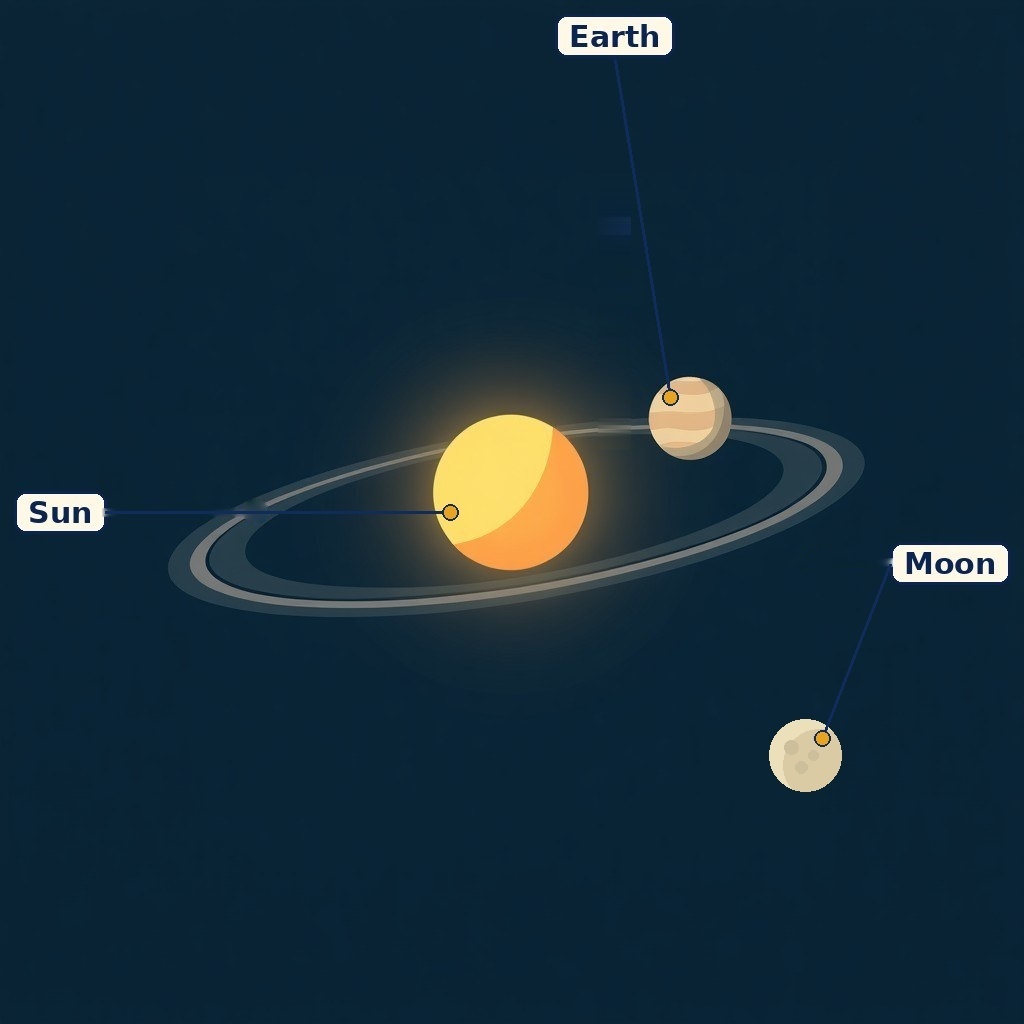
Diagram (labels are printed on the image): The Sun, Earth and Moon with the Moon's orbit around Earth. A general diagram; it is not a scene from the book.

A full moon in the night sky. A general picture about the Moon, not a book scene.
What the chapter is about
The Earth moves in two ways. It spins on its axis, which is called rotation, and it travels around the Sun, which is called revolution. Rotation takes about 24 hours and gives us day and night: the part facing the Sun has day, the part facing away has night. Revolution takes about 365 days and, together with the tilt of the Earth's axis, gives us the seasons.
The Moon is Earth's natural satellite. It goes around the Earth in about 27 days, and it does not make its own light; we see it because it reflects sunlight. As the Moon moves, the part of its lit side that we can see changes, giving the phases of the Moon, from new moon to full moon and back. The Moon's pull also helps cause tides in the seas.
Sometimes the Sun, Moon and Earth line up. When the Moon comes between the Sun and the Earth, its shadow falls on Earth and we get a solar eclipse. When the Earth comes between the Sun and the Moon, Earth's shadow falls on the Moon and we get a lunar eclipse. A solar eclipse must never be watched with bare eyes, because direct sunlight can damage the eyes.
12.1 Rotation of the Earth
The chapter opens with Rashmika in Kanniyakumari, puzzled by coconut-tree shadows that are long in the morning and shorter in the afternoon. She wonders: does the Sun move across the sky, or does the Earth move? The answer is that the Earth spins — rotates — on its own axis, an imaginary line through its North and South Poles. The Earth rotates from west to east, so the Sun appears to move from east to west across the sky, and shadows change length through the day. One rotation takes about 24 hours and gives us day and night: the part facing the Sun has day, the part turned away has night.
12.2 Revolution of the Earth
While rotating, the Earth also revolves around the Sun, completing one revolution in about 365 days and 6 hours — the extra 6 hours add up to about a full day every four years. As the Earth moves around its orbit, the night sky we see changes through the year: different stars and constellations come into view in different seasons, because we look out into space from a different position.
12.2 Seasons on the Earth
Seasons are caused by the tilt of the Earth's axis, not by distance from the Sun. The Earth's axis is tilted with respect to its orbit, and it keeps pointing in the same direction all year round as it revolves. So for part of the year the Northern Hemisphere leans toward the Sun and gets longer days and summer, and for the other part it leans away and gets winter; the Southern Hemisphere has the opposite seasons at the same time. In the Northern Hemisphere the longest day is around 21 June (summer solstice) and the shortest day and longest night around 22 December (winter solstice); around 21 March and 23 September day and night each last about 12 hours (spring and autumn equinoxes). At the North Pole, the Sun rises in the east on the equinox day, 21 March, and then stays up continuously for months.
12.3 Eclipses
A solar eclipse happens when the Moon comes between the Sun and the Earth and blocks sunlight from reaching us. Where the Moon blocks the Sun completely, observers see total darkness — a total solar eclipse; where it blocks only part of the Sun, they see a partial solar eclipse. A lunar eclipse happens when the Earth comes between the Sun and the Moon and blocks sunlight from reaching the Moon, so the Earth's shadow falls on the full Moon. Because the Moon's shadow on the Earth is small, a total solar eclipse is seen from only a small part of the Earth, while a lunar eclipse, being the Earth's much larger shadow on the Moon, can be seen from a large part of the Earth. The chapter also notes, as a deeper dive, that the planets really move around a point very close to the Sun rather than its exact centre, and the Sun wobbles slightly around that point — and scientists use tiny wobbles of other stars to discover exoplanets around them.
What you should learn
Learn rotation versus revolution, why we have day and night and seasons, why the Moon shines, and the difference between solar and lunar eclipses.
- Explain day and night by the Earth's rotation, and the year by its revolution.
- Explain seasons by the tilt of the axis, with solstice and equinox dates.
- Distinguish solar from lunar eclipses, and total from partial solar eclipses.
Key Terms
- Rotation — The spinning of the Earth on its axis, taking about 24 hours.
- Revolution — The movement of the Earth around the Sun, taking about a year.
- Phase of the Moon — The changing shape of the Moon's lit part as seen from Earth.
- Solar eclipse — When the Moon's shadow falls on Earth, hiding the Sun.
- Lunar eclipse — When Earth's shadow falls on the Moon.
- Rotation — The spinning of the Earth on its own axis, taking about 24 hours, causing day and night.
- Revolution — The movement of the Earth around the Sun, taking about 365 days and 6 hours.
- Solstice — The days of longest and shortest daylight: about 21 June and 22 December in the Northern Hemisphere.
- Equinox — A day when day and night are about equal (12 hours each): about 21 March and 23 September.
Remember
- Rotation (24 hours) gives day and night.
- Revolution (about 365 days) plus axial tilt gives seasons.
- The Moon shines by reflected sunlight; it makes no light of its own.
- Solar eclipse: Moon between Sun and Earth. Lunar eclipse: Earth between Sun and Moon.
Exam Tip / Common Mistake
Common mistake: saying the Moon's phases are caused by Earth's shadow. Phases happen because we see different parts of the Moon's sunlit side as it orbits. Earth's shadow causes only a lunar eclipse.
Looking at the Sun with bare eyes can damage your eyes permanently, even during an eclipse when the Sun looks dimmer. Use only proper eclipse viewers or indirect methods, with an adult's guidance.
Chart / Table: Earth, Moon and Sun
| Point | Detail |
|---|---|
| Rotation | Spinning on axis | About 24 hours | Day and night |
| Revolution | Orbit around the Sun | About 365 days | Seasons with tilt |
| Moon phases | Changing lit part seen from Earth | New moon to full moon |
| Solar eclipse | Moon between Sun and Earth | Moon's shadow on Earth |
| Lunar eclipse | Earth between Sun and Moon | Earth's shadow on Moon |
Table: Earth, Moon and Sun at a glance
| Event | What happens | Key fact |
|---|---|---|
| Day and night | Earth rotates on its axis | About 24 hours per rotation |
| Year | Earth revolves around the Sun | About 365 days and 6 hours |
| Summer solstice (N. Hemisphere) | Northern Hemisphere leans toward the Sun | Around 21 June — longest day |
| Winter solstice (N. Hemisphere) | Northern Hemisphere leans away from the Sun | Around 22 December — shortest day |
| Equinoxes | Neither hemisphere leans toward the Sun | Around 21 March and 23 September — 12 hours day, 12 hours night |
| Solar eclipse | Moon between Sun and Earth | Total seen from a small area only |
| Lunar eclipse | Earth between Sun and Moon | Seen from a large part of the Earth |
Steps: showing day and night with a globe and torch
- Place a globe in a darkened room and shine a torch on it from one side to stand for the Sun.
- Mark a place on the globe and spin the globe slowly: the mark moves into light (day) and into darkness (night).
- Tilt the globe's axis and move it around the torch, keeping the tilt pointing the same way, to see how seasons arise.
Practice set — try it yourself
- What causes day and night?
Hint: Think about the Earth spinning. - Why do we have seasons?
Hint: Think about revolution and tilt together. - Why does the Moon shine at night?
Hint: Think about reflected sunlight. - What is the difference between a solar and a lunar eclipse?
Hint: Think about which body is in the middle. - Why must a solar eclipse not be watched with bare eyes?
Hint: Think about eye damage from sunlight.
Questions with Answers
- How does rotation cause day and night?
The Earth spins on its axis once in about 24 hours. The part facing the Sun experiences day, while the part facing away experiences night. As the Earth turns, day and night move across its surface. - Why does the Earth have seasons?
The Earth revolves around the Sun in about a year, and its axis is tilted. During the year different parts receive sunlight more directly at different times, giving summer, winter and the in-between seasons. - Why does the Moon change shape in the sky?
The Moon does not make its own light; it reflects sunlight. As it orbits the Earth, the portion of its sunlit side facing us changes, so we see phases from new moon to full moon and back. - Explain a solar eclipse and a lunar eclipse.
A solar eclipse happens when the Moon comes between the Sun and the Earth, so the Moon's shadow falls on Earth. A lunar eclipse happens when the Earth comes between the Sun and the Moon, so Earth's shadow falls on the Moon. - Why should a solar eclipse never be watched with bare eyes?
Looking directly at the Sun, even during an eclipse, can seriously damage the eyes. Safe viewing needs proper eclipse glasses or an indirect method like pinhole projection.
More questions with answers — extension
- Rashmika notices coconut-tree shadows long in the morning and shorter in the afternoon. Does the Sun move, or does the Earth move? Explain.
The Earth moves: it rotates on its axis from west to east, so the Sun only appears to move from east to west. As the Sun's apparent position rises through the morning, shadows shorten; the changing shadow is evidence of rotation, not of the Sun travelling around the Earth. - Why can lunar eclipses be seen from a large part of the Earth, while a total solar eclipse is seen from only a small part?
A lunar eclipse is the Earth's shadow falling on the Moon, and everyone on the night side of the Earth can see the Moon at once. A total solar eclipse is the Moon's much smaller shadow falling on the Earth, so only the small area inside that shadow sees total darkness. - If the Earth's axis were not tilted with respect to its orbit, what would happen to the seasons? Explain.
There would be almost no seasons. Without tilt, each place would receive the same amount of sunlight all year round, so day length would stay nearly equal everywhere and temperatures would not swing between summer and winter as they do now. - The Earth takes 365 days and 6 hours for one revolution. Why does this matter for the calendar?
Four lots of 6 hours make about 24 hours — one extra day. That is why, about every four years, the calendar gains an extra day (a leap day), keeping the calendar in step with the Earth's actual journey around the Sun. - Draw two circles with the same centre, of radii 14.7 cm and 15.2 cm, with 1 cm standing for 10 million km. What distances do they stand for, and what does the small difference show?
They stand for 147 million km and 152 million km — the Earth's closest and farthest distances from the Sun. The difference is only 5 million km against about 150 million km, a small fraction, showing that distance from the Sun cannot explain the seasons; the tilt of the axis does. - At the North Pole, the Sun rises in the east on 21 March and stays up for months. Explain this with the tilt of the axis.
On the equinox the Sun is over the equator, so at the North Pole it appears on the horizon. As the Northern Hemisphere then leans toward the Sun through its summer, the Pole stays in sunlight continuously — its day lasts for months instead of hours. - A total solar eclipse darkens the sky at midday in one town, but a town 500 km away sees only a partial eclipse. Why?
The Moon's shadow on the Earth is narrow. Only places inside the central shadow see the Sun fully blocked (total eclipse); places outside it but still in the wider partial shadow see only part of the Sun blocked. - Why does the night sky look different in different seasons?
Because the Earth has moved to a different place in its orbit around the Sun. Looking out from a different position, we face a different part of the sky at night, so different stars and constellations are visible. - Repeat the globe-and-torch activity, moving the globe around the lamp while keeping its tilt pointing the same way. What do you observe about the Northern and Southern Hemispheres?
At one position the Northern Hemisphere is lit more and has longer days while the Southern Hemisphere is lit less; at the opposite position the reverse is true. That is why the two hemispheres have opposite seasons at the same time. - If the tilt of the Earth's axis increased, would seasons become more or less extreme? What example does the chapter suggest you investigate?
More extreme: a bigger tilt would lean each hemisphere further toward the Sun in its summer and further away in its winter, making summers hotter and winters colder. The chapter suggests investigating Uranus, whose tilt is far greater than the Earth's, and its seasons.
- Rotation (about 24 hours) gives day and night; revolution (about 365 days 6 hours) gives the year.
- Seasons come from the tilt of the axis, not from distance to the Sun.
- Solar eclipse: Moon between Sun and Earth. Lunar eclipse: Earth between Sun and Moon.
How to use this page: Read the summary, say the Key Terms in your own words, then try the practice set without looking. Use the Questions with Answers to check yourself afterwards. Ask your teacher or parent to check your answers.