

Chapter 10: Life Processes in Plants
How plants grow, make food by photosynthesis, transport water and food, and respire.
Original notes — ready CBSE (NCERT, English Medium) • Class 7 • Science • Book: Curiosity
Chapter 10: Life Processes in Plants — EG's own notes, in simple words
Book: Curiosity (CBSE, Class 7) | Chapter 10 | Medium: English
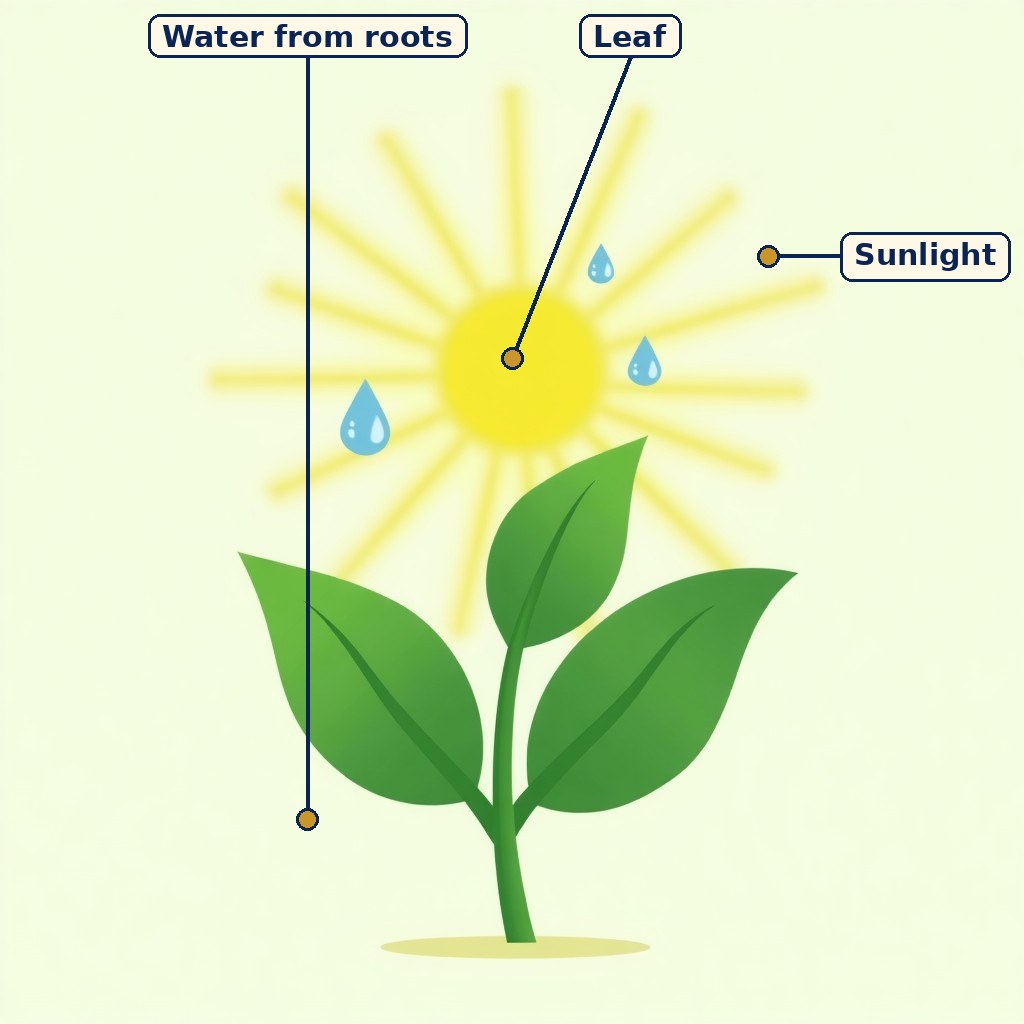
Diagram (labels are printed on the image): A leaf using sunlight, water and air to make food. A general diagram of photosynthesis; it is not a scene from the book.

A green plant growing in sunlight. A general picture about plant life, not a book scene.
What the chapter is about
Plants also carry out life processes, but in their own way. The most famous is photosynthesis, the process by which green plants make their own food. Using sunlight, chlorophyll in the leaves traps light energy, and the plant combines water from the roots with carbon dioxide from the air to make glucose and release oxygen. This is why plants are called producers: they make food for themselves and, through food chains, for animals too.
Leaves are built for this job. Tiny pores called stomata let carbon dioxide in and oxygen and water vapour out, and they can open and close to control water loss. Water and minerals travel up from the roots through tubes called xylem, while food made in the leaves travels to other parts through tubes called phloem. This transport system works in all parts of the plant.
Plants also lose water as vapour from leaves, a process called transpiration. Transpiration pulls more water up from the roots and cools the leaf. Plants respire too, day and night, breaking down some of their food to release energy, just as animals do. Growth, response to light and reproduction complete the picture of plant life.
10.1 How do plants grow? — sunlight and water both matter
As a plant grows, new leaves and branches emerge, its height increases and its stem thickens. Food provides nutrients — carbohydrates, fats, proteins, vitamins and minerals — along with water, all essential for growth. Activity 10.1 tests what growth needs: three pots of similar saplings of a fast-growing plant like chilli or tomato, observed for two weeks for height, number of leaves and leaf colour. Pot A is kept in direct sunlight with adequate water every day; Pot B in direct sunlight without water; Pot C in the dark with adequate water.
The plant in Pot A grows better than the plant in Pot C, which gets water but no sunlight, and the plant in Pot B may have died because it got no water even though it received adequate sunlight. The inference is clear: plants require both sunlight and water for their growth. An ancient Indian text, the Vrikshayurveda, already recorded this kind of practical knowledge: its line “Trees do not produce fruits and flowers merely because they are planted” introduces observations on plant growth, soil and agricultural practices, including organic manure made by mixing water, barley and seeds like green, black and horse grams.
10.2.1 Leaves — the food factories of plants
Animals get food from plants, directly by eating plants or indirectly by eating animals that eat plants — but plants do not eat food. Plants store food in the form of starch, a carbohydrate, produced in the leaves, which are generally broad and flat and mostly green because of chlorophyll, the green pigment that helps capture sunlight efficiently. That is why leaves are called the food factories of plants.
Activity 10.2 tests a leaf for starch: keep a leaf in boiling water for five minutes to soften it, dip it in a test tube of alcohol placed in a beaker of boiling water until the leaf becomes colourless, then put a few drops of diluted iodine solution on the decolourised leaf. A blue-black colour means starch is present. Decolourisation matters because it lets the colour change be seen easily — and alcohol must never be placed near a heat source directly, as it is highly flammable and can cause fire and burns.
Activity 10.3 asks whether sunlight contributes to starch production. Bhaskar took a leaf with green and non-green patches from each of two similar potted plants — one kept in sunlight, one in the dark for 36 hours — sketched the patches with tracing paper, and ran the iodine test. On the sunlight plant, the green patches turned blue-black (starch present) but the non-green patches did not; on the dark plant, even the green patches showed no blue-black (no starch produced). The inference: chlorophyll helps prepare starch in the presence of sunlight and is essential for it. Non-green patches may simply lack enough chlorophyll to prepare detectable starch. Some leaves look red, violet or brown because they contain more of those coloured pigments than green chlorophyll, hiding the green colour — some of those pigments also help in photosynthesis, and an iodine test on such leaves still shows starch, proving photosynthesis has taken place.
10.2.2 Role of air — carbon dioxide is essential
Activity 10.4 tests which gas from the air is essential. A potted green plant is kept in the dark for two to three days to destarch it, losing any stored starch. Half of one leaf is inserted into a wide-mouthed bottle containing caustic soda (sodium hydroxide), which absorbs carbon dioxide from the air, through a split cork, leaving the other half outside; the set-up is placed in sunlight for a few hours. Caustic soda is a strong chemical that can cause skin burns, so only teachers should handle it. After the iodine test, the part of the leaf outside the bottle turns blue-black (starch present), but the part inside the bottle does not — because the caustic soda absorbed the carbon dioxide. Carbon dioxide in the air is essential for plants to prepare starch.
10.2.3 Photosynthesis in a nutshell — and oxygen released
Putting Activities 10.3 and 10.4 together: sunlight, water, chlorophyll and carbon dioxide are essential for synthesising food in plants. This process, by which plants prepare food in the presence of sunlight and chlorophyll, is called photosynthesis, and a leaf is its primary site — though other green parts of the plant that contain chlorophyll also perform photosynthesis. During photosynthesis, food is produced as glucose, a simple carbohydrate: glucose is an instant source of energy and later gets converted into starch for storage. The word equation is: Carbon dioxide + Water —(Sunlight, Chlorophyll)→ Glucose + Oxygen.
Activity 10.5 shows that oxygen is released. A water plant under a funnel with an inverted test tube is kept in sunlight in set-up A and in the dark in set-up B: bubbles emerge and collect in the inverted test tube only in set-up A. When the collected gas is tested, a lit matchstick inserted into the tube burns with an intense flame, showing the gas is rich in oxygen. So oxygen is released during photosynthesis, and photosynthesis occurs in the presence of sunlight. The chapter also honours Rustom Hormusji Dastur (1896–1961), a plant scientist who headed the Botany Department at the Royal Institute of Science, Bombay (now the Institute of Science, Mumbai) from 1921–1935 and studied the effects of water, temperature and the colour of light on photosynthesis.
10.2.4 Stomata — where gases are exchanged
Photosynthesis needs carbon dioxide in and oxygen out — which part of the plant exchanges them? Activity 10.6 peels a thin layer from the lower surface of a leaf of rhoeo, money plant, onion, hibiscus, coleus or any grass, places it on a microscope slide with a drop of water and a drop of ink under a coverslip, and observes it under a microscope. Tiny pores appear on the peel: these pores are called stomata, and stomata on the surface of leaves help in the exchange of gases.
10.3 Transport in plants — xylem up, phloem around
Water, along with minerals from the soil, is taken up by the roots. Activity 10.7 shows how it travels: two tumblers, one with plain water (A) and one with a few drops of red ink (B), each hold a twig of a similar tender plant, preferably with white flowers such as white sadabahar or balsam, its stem cut obliquely under water. The next day, red colour is visible in the stem, leaves and flowers of the plant in tumbler B, and a magnifying glass shows red in the cut stem too. The red ink moved upwards through thin tube-like structures called xylem, present in the stem, branches and leaves — and just like red ink, minerals dissolved in water also move up the stem through the xylem to the leaves and other parts.
Food made in the leaves is transported to all parts of the plant through another set of thin tube-like structures called phloem, and the transported food may also be stored in other parts of a plant, such as seeds and roots. So the two transport systems divide the work: xylem carries water and minerals upwards from the roots, phloem carries food from the leaves to all parts.
10.4 Do plants respire? — yes, day and night
Activity 10.8 tests respiration in plants. Soaked moong bean seeds rest on wet cotton in a conical flask, left undisturbed for 24 hours in the dark, connected to a test tube of lime water. The lime water connected to the flask turns milky, while the comparison test tube does not — because the flask contains extra carbon dioxide produced by the seeds as they respire. During respiration, glucose is broken down in the presence of oxygen, releasing carbon dioxide, water and energy: Glucose + Oxygen → Carbon dioxide + Water + Energy. The energy is used for the plant's growth and development, and all parts of a plant, green or non-green, carry out respiration. Plants thus have different mechanisms for synthesising, transporting and utilising food to get energy. The chapter closes with Kamala Sohonie (1911–1998), who earned a Ph.D. for her work on respiration in plants from Cambridge University, worked at Lady Hardinge Medical College, New Delhi, and the Nutrition Research Laboratory, Coonoor, and later became Director at the Royal Institute of Science, Bombay, improving the nutritive value of plant foods and studying Neera, the sap of the coconut palm as a nutritive drink.
What you should learn
Learn the photosynthesis word equation, the jobs of stomata, xylem and phloem, and why transpiration matters.
- Explain the three-pot growth experiment and why Pot A grows best and Pot B may die.
- Explain the starch tests: leaf decolourisation, green vs non-green patches, and the carbon-dioxide bottle.
- Write both word equations (photosynthesis and respiration) and say what each process is for.
- Contrast xylem and phloem, and explain stomata and respiration in all plant parts.
Key Terms
- Photosynthesis — Making food in leaves using sunlight, water and carbon dioxide.
- Chlorophyll — The green pigment in leaves that traps light energy.
- Stomata — Tiny pores on leaves for gas exchange.
- Xylem — Tubes carrying water and minerals up from the roots.
- Transpiration — Loss of water as vapour from leaves.
- Destarch — Keeping a plant in the dark for 2–3 days so it loses its stored starch before an experiment.
- Food factory — The chapter's name for a leaf, where starch is produced by photosynthesis.
Remember
- Photosynthesis: water + carbon dioxide + sunlight gives glucose + oxygen.
- Chlorophyll traps light; stomata control gas exchange.
- Xylem carries water up; phloem carries food around.
- Plants respire day and night; photosynthesis needs light.
Exam Tip / Common Mistake
Common mistake: writing that plants only photosynthesise and never respire. Plants respire all the time to release energy, and photosynthesise in light. Both processes happen in a living plant.
Photosynthesis produces glucose, a simple carbohydrate, as its immediate product. Glucose gives instant energy and is later converted into starch for storage — so a blue-black iodine result proves starch is stored, not that glucose was made a second ago.
Photosynthesis needs light, but respiration does not: all parts of a plant, green or non-green, respire day and night to release energy. An answer that says plants only photosynthesise, or only respire at night, is wrong on both counts.
Chart / Table: Plant life processes
| Point | Detail |
|---|---|
| Photosynthesis | Leaves make glucose using sunlight, water, carbon dioxide |
| Respiration | Food broken down in cells to release energy, day and night |
| Transport | Xylem: water up; phloem: food to all parts |
| Transpiration | Water vapour lost from leaves; pulls water up |
| Gas exchange | Stomata let carbon dioxide in and oxygen out |
Table: Photosynthesis vs respiration
| Feature | Photosynthesis | Respiration |
|---|---|---|
| Raw materials | Carbon dioxide + Water | Glucose + Oxygen |
| Products | Glucose + Oxygen | Carbon dioxide + Water + Energy |
| Needs | Sunlight + Chlorophyll, in leaves (primary site) | Oxygen, in all parts, green or non-green |
| When | In sunlight only | Day and night |
| Importance | Makes food and releases oxygen | Releases energy for growth and development |
Steps: the starch test in a leaf (Activity 10.2)
- Keep a leaf in boiling water for five minutes to soften it.
- Dip the leaf in a test tube containing alcohol, and place the test tube in a beaker of boiling water — never put alcohol near a heat source directly.
- Wait until the leaf becomes colourless (decolourised), then take it out and place it on a plate.
- Put a few drops of diluted iodine solution on the leaf with a dropper and wait a few minutes.
- Read the result: blue-black means starch is present; no colour change means no starch was made or stored there.
Practice set — try it yourself
- What do plants need for photosynthesis?
Hint: Think about sunlight, water and a gas. - What gas is released during photosynthesis?
Hint: Think about the gas animals breathe in. - What is the job of xylem?
Hint: Think about water moving up. - Why do stomata open and close?
Hint: Think about gas exchange and water loss. - Do plants respire at night? Explain.
Hint: Think about energy needs day and night.
Questions with Answers
- Write the photosynthesis process in simple words.
In leaves, chlorophyll traps sunlight. The plant uses this light energy to combine water from the roots with carbon dioxide from the air, making glucose (food) and releasing oxygen. - What are stomata and why are they important?
Stomata are tiny pores, mostly on the underside of leaves. They let carbon dioxide in for photosynthesis and oxygen out, and they open and close to control water loss by transpiration. - How are xylem and phloem different?
Xylem carries water and dissolved minerals upwards from the roots to the leaves. Phloem carries food made in the leaves to all other parts of the plant, in both directions. - What is transpiration? Why is it useful?
Transpiration is the loss of water as vapour from leaves, mainly through stomata. It pulls water up from the roots and helps cool the leaf, keeping the transport stream moving. - Why is a plant called a producer?
A plant makes its own food by photosynthesis instead of eating other organisms. Animals depend on plants directly or indirectly for food, so plants produce food for the whole food chain.
More questions with answers — extension
- Complete the comparison table: for photosynthesis and respiration, give raw materials, products, word equation and importance.
Photosynthesis — raw materials: carbon dioxide + water; products: glucose + oxygen; equation: Carbon dioxide + Water —(Sunlight, Chlorophyll)→ Glucose + Oxygen; importance: makes food and releases oxygen. Respiration — raw materials: glucose + oxygen; products: carbon dioxide + water + energy; equation: Glucose + Oxygen → Carbon dioxide + Water + Energy; importance: releases energy for growth and development. - Imagine all organisms that carry out photosynthesis on Earth have disappeared. What would be the impact on living organisms?
Almost all food chains would collapse, because plants and other photosynthetic organisms make the food that animals eat directly or indirectly. Oxygen release would stop while respiration and burning kept consuming oxygen and adding carbon dioxide, so the air itself would change and most animal life could not survive. - A potato slice shows starch with iodine solution. Where does the starch in potatoes come from? Where is food synthesised in the plant, and how does it reach the potato?
The starch comes from photosynthesis in the leaves, the primary site of food synthesis, where glucose is made and converted into starch for storage. The food is transported from the leaves to other parts of the plant, including the potato, through the phloem, and stored there. - Does the broad and flat structure of leaves make plants more efficient for photosynthesis? Justify your answer.
Yes. Broad, flat leaves expose a large surface area to sunlight, so more chlorophyll can capture light energy, and more stomata on the surface can exchange carbon dioxide and oxygen. A narrow, curled leaf would catch less light and exchange less gas, making less food. - X is broken down using Y to release carbon dioxide, Z and energy: X + Y → Carbon dioxide + Z + Energy. What do X, Y and Z stand for?
X = Glucose, Y = Oxygen, Z = Water. This is the word equation of respiration: Glucose + Oxygen → Carbon dioxide + Water + Energy. - Krishna set up two potted plants of the same size, one in sunlight and one in a dark room. (i) What idea might she be testing? (ii) What visible differences might appear? (iii) Which plant's leaves would confirm the iodine test for starch?
(i) She is testing whether sunlight is needed for plants to make starch by photosynthesis. (ii) The sunlight plant should grow better, stay green and gain leaves, while the dark plant grows poorly and may turn yellowish. (iii) Only the sunlight plant's leaves would turn blue-black with iodine, showing starch; the dark plant's leaves would show no colour change, showing no starch was made. - Vani sets up four potted plants with sufficient water: (a) sunlight with carbon dioxide, (b) sunlight without carbon dioxide, (c) dark with carbon dioxide, (d) dark without carbon dioxide. In which plants will starch be formed, in which will it not be formed, and in which will oxygen be generated or not?
Starch will be formed only in (a), sunlight with carbon dioxide, because photosynthesis needs both sunlight and carbon dioxide (plus water and chlorophyll). It will not be formed in (b), (c) or (d), each missing sunlight, carbon dioxide, or both. Oxygen will be generated only in (a) as well, since oxygen is released by photosynthesis; it will not be generated in (b), (c) or (d). - Ananya kept a snail in test tube A, a water plant in test tube B, both in test tube C, and only water in test tube D, with a carbon dioxide indicator in each. What do you think she wants to find out, and how will she know if she is correct?
She wants to find out how a plant and an animal together change the carbon dioxide in water: the snail alone adds carbon dioxide by respiration, the plant alone in light uses carbon dioxide for photosynthesis, and together they balance each other. She will know by comparing the indicator colours after 2–3 hours against test tube D, the water-only control: differences from D show what the snail, the plant, and the pair each did to the carbon dioxide level. - Design an experiment to observe whether water transportation in plants is quicker in warm or cold conditions.
Take two similar twigs with white flowers and two tumblers of red-ink water, as in Activity 10.7, keeping everything the same except temperature: one tumbler in a warm place, one in a cold place. Observe after the same time (for example, the next day) how far the red colour has risen in the stem, leaves and flowers of each plant, and compare the cut stems under a magnifying glass. The plant whose red colour rises higher and faster shows quicker water transport; repeating with swapped positions controls for light and plant differences. - “Photosynthesis and respiration are essential to maintain balance in nature.” Discuss.
Photosynthesis takes in carbon dioxide and releases oxygen while making food; respiration takes in oxygen and releases carbon dioxide while releasing energy. Together they cycle carbon dioxide and oxygen between plants, animals and the air, and link food-making to energy-releasing, so neither gas accumulates unchecked and food chains keep running. In a sealed bottle garden, for example, the plant's respiration supplies carbon dioxide for its own photosynthesis, and its photosynthesis supplies oxygen for its own respiration.
- Growth needs both sunlight and water: Pot A (sunlight + water) grows best; Pot B (no water) may die; Pot C (dark + water) grows poorly.
- Photosynthesis: Carbon dioxide + Water —(Sunlight, Chlorophyll)→ Glucose + Oxygen; glucose stored later as starch; leaves are the food factories.
- Starch tests: iodine blue-black = starch; green patches in sunlight make starch, dark plants and CO₂-free leaves do not.
- Stomata exchange gases; xylem carries water + minerals up; phloem carries food to all parts and storage.
- Respiration: Glucose + Oxygen → Carbon dioxide + Water + Energy, in all parts, green or non-green, day and night.
How to use this page: Read the summary, say the Key Terms in your own words, then try the practice set without looking. Use the Questions with Answers to check yourself afterwards. Ask your teacher or parent to check your answers.