

Chapter 10: The Tunnel
Suraj, a steam train, and the watchman who calls the tunnel his own.
Original notes — ready CBSE (NCERT, English Medium) • Class 7 • English • Book: Poorvi Unit 4: Travel and Adventure
The Tunnel — EG's own notes, in simple words
Book: Poorvi (CBSE, Class 7) | Chapter 10 | Unit 4: Travel and Adventure | Medium: English

Diagram (labels are printed on the image): A tunnel through the hills, with light glowing at the far end. A general picture of the lesson's theme, not a scene from the book.
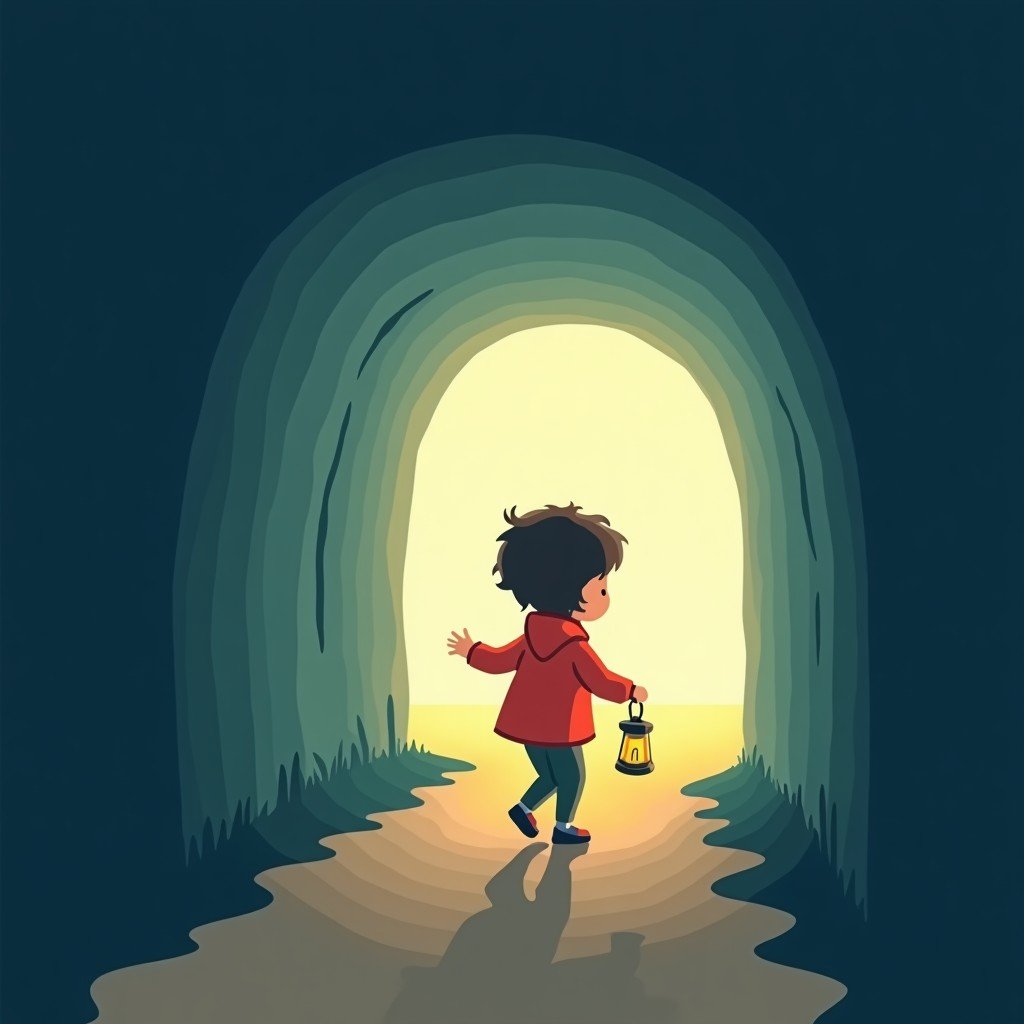
Walking bravely towards the light. A general picture of facing fear.
What the lesson is about
This story opens at almost noon, when the jungle is very still and silent. Heat waves shimmer along the railway embankment, where it cuts a path through tall evergreen trees. The railway lines are two straight black serpents disappearing into the tunnel in the hillside. Suraj, a boy who has cycled out of the town, left his cycle in a small village, and walked over a low scrub-covered hill, stands near the cutting, waiting — not to catch a train, but to watch the midday train come roaring out of the tunnel.
First he hears the engine's shrill whistle in the distance, then a sound like distant thunder from the tunnel. A second or two later, the steam engine shoots out, snorting and puffing like some green, black, and gold dragon, a beautiful monster out of Suraj's dreams, showering sparks left and right and roaring a challenge to the jungle.
About fifteen metres from the tunnel entrance stands the watchman's hut, with marigolds in front and a small vegetable patch at the back. The watchman, Sunder Singh, has the duty of inspecting the tunnel and keeping it clear of obstacles. Suraj walks through the tunnel — it is very dark inside — and when he comes out, he thinks he sees an animal up on the hill, moving off quickly. 'It was a leopard you saw,' says the watchman. 'My leopard.' He does not lend the leopard to the Government, he adds: it is a leopard that minds its own business and comes to this range for a few days every month.
Sunder Singh's famous line about the tunnel comes when Suraj asks, 'Your tunnel?' 'It is,' says the watchman. 'It is truly my tunnel, since no one else will have anything to do with it. I have only lent it to the Government.' The two become unlikely friends: the watchman invites Suraj to come back in the evening for the night mail, which comes through at about nine o'clock. 'It is safer in the jungle than in the town,' Sunder Singh says — nothing happens to him out here, but last month, when he went into town, he was almost run over by a bus. Then, with a banana leaf over his face to keep away the flies, he takes his afternoon nap, while Suraj walks back to the village.
That evening, towards dusk, as flying foxes swoop silently out of the trees, Suraj returns. Sunder Singh has watered his small garden, a kettle boils on a small oil stove, and they drink hot tea while waiting for the train, listening to the tailorbird and the chatter of birds. The watchman's system for safety is simple and regular: every day, before the train comes through, he walks the length of the tunnel to check it, and if he finds danger, he waves his lamp to warn the locomotive driver.
Story / lesson in order
- At noon, Suraj waits by the tunnel cutting to watch the midday train.
- The engine shoots out like a green, black, and gold dragon, showering sparks.
- Suraj meets watchman Sunder Singh at his hut, fifteen metres from the entrance.
- Suraj walks through the dark tunnel and glimpses an animal on the hill — Sunder Singh's leopard.
- Sunder Singh calls it truly his tunnel, only lent to the Government, and invites Suraj for the night mail.
- Suraj returns at dusk; they drink tea, and the watchman explains his safety walk and lamp signal.
Chart / Table: People and places in the story
| Item | What it means |
|---|---|
| Suraj | A boy from the town; cycles out to watch trains; becomes Sunder Singh's friend |
| Sunder Singh | The tunnel watchman; inspects the tunnel, waves his lamp if there is danger |
| The tunnel | Cut through the hillside; dark inside; 'lent to the Government' |
| The leopard | Comes to the range a few days every month; minds its own business |
| The night mail | Comes through at about nine o'clock at night |
Key Terms
- Embankment — A stone wall made to carry the railway over low ground.
- Cutting — A narrow valley cut through a hill to make space for a railway line.
- Scrub-covered — Covered with short trees and bushes.
- Obstacle — Something that blocks the way — the watchman keeps the tunnel clear of them.
- Would (habitual past) — Used for actions done regularly in the past, as in 'every day he would walk the length of the tunnel'.
Remember
- Suraj waits to watch the train, not to catch it.
- The engine is compared to a green, black, and gold dragon.
- Sunder Singh's hut is fifteen metres from the tunnel entrance.
- The tunnel is 'truly his', only lent to the Government.
- His safety system: walk the tunnel before the train, wave the lamp if there is danger.
The old note called the tunnel a symbol of frightening unknowns. The story is warmer than that: a boy's delight in trains, a watchman's pride in his tunnel and leopard, and an unlikely friendship. Fear is not the theme; wonder and friendship are.
NCERT language points — Let us learn
- Phrases from the text: complete sentences with drifting smoke, approaching engine, sawing sound, and flickering lights — for example, hearing the approaching engine long before the train is seen.
- Sound words: match creaking (long low sound when wood moves), chatter (repeated short high sounds of birds or monkeys), hissing (a long 's' sound), rustle (soft dry sound of leaves or paper), and puffing (blowing with short, quick blasts, as the wind) — then fill blanks with their correct forms.
- Habitual 'would': notice 'every day, before the train came through, he would walk...' — use 'would' to write five sentences about Sunder Singh's daily duties.
- Train comparisons: Suraj compares the train to a magical creature. Pick the phrases that convey this — green, black, and gold dragon, beautiful monster, showering sparks, roaring a challenge.
- Tunnel safety flow chart: complete the book's flow chart — walk the length of the tunnel, check for danger, rest or nap, and wave the lamp to warn the driver if danger is found.
NCERT activities — listen, speak, write, explore
- Let us listen: a museum treasure hunt. Listen to the audio guide and mark your map with the route — library, auditorium, musical instruments hall, weapon room, art gallery, museum shop, decorative art gallery, entrance hall, museum office, cafe, toilets, and store.
- Let us speak: Anju calls a tour manager for directions to a trekking site. In pairs, practise asking for and giving directions clearly, step by step.
- Let us write: write a descriptive paragraph about a train journey — boarding, the whistle, passenger chatter, wheels clattering, scenery outside, and your feelings.
- Let us explore: the Atal Tunnel is 9.02 kilometres long under the Rohtang Pass on the Manali–Leh Highway, built in freezing temperatures and difficult terrain. Find out more about long tunnels and how they are kept safe.
- Discussion: the book asks why Sunder Singh is called a 'firefly'. Think about his lamp, moving in the dark tunnel and jungle at night, and discuss your answer — the book leaves this as a question to reason about, not a stated fact.
Suraj comes to watch a dragon of a train burst from a hillside tunnel, and finds a friend: Sunder Singh, who inspects his tunnel, loves his leopard, lends his tunnel to the Government, and keeps every train safe with a walk and a lamp.
Practice set — try it yourself
- Why does Suraj stand near the tunnel at noon?
Hint: Think about watching, not catching, a train. - What does the engine look like to Suraj?
Hint: Think about a dragon's colours. - What is Sunder Singh's duty at the tunnel?
Hint: Think about inspecting and clearing obstacles. - Why does Sunder Singh say the tunnel is truly his?
Hint: Think about who else will have anything to do with it. - Why is it 'safer in the forest than in the town', according to Sunder Singh?
Hint: Think about a bus last month.
Questions with Answers
- What does Sunder Singh convey by saying he has lent his tunnel to the Government?
Pride and possession: he has cared for the tunnel so long, and alone, that it feels truly his. The Government only uses what his daily work keeps safe — the line is both a joke and a claim of belonging. - 'It is safer in the forest than in the town.' What example does he give, and what does it tell us about him?
Last month in town he was almost run over by a bus, while nothing ever happens to him in the jungle. It tells us he is at home in nature, calm about wild animals, and amused by town dangers — a man whose world is upside down from a town dweller's. - How has Sunder Singh become part of jungle life?
He lives by the tunnel in a hut with marigolds and a vegetable patch, naps with a banana leaf over his face, knows the leopard's monthly visits, and follows the jungle's rhythm — tea at dusk, birdsong, flying foxes — as his own daily life. - What draws Sunder Singh and Suraj together into an unlikely friendship?
A shared love of trains and the jungle: Suraj's wonder at the engine meets Sunder Singh's pride in the tunnel. Age, work, and home differ, but curiosity and kindness bridge them — tea, talk, and an invitation to return. - Do you think Suraj is an adventure-loving boy? Give reasons.
Yes. He cycles out of town alone, walks a scrub hill to a tunnel, waits to watch a roaring engine, walks through a dark tunnel, and returns at dusk for the night mail — each step chosen for wonder, not for comfort.
Questions with Answers — Extension (NCERT exercise types)
- (True / False) Suraj waits at the tunnel to catch the midday train. — False. He waits to watch it come roaring out.
- (Fill in the blank) The watchman's hut stands about _______ metres from the tunnel entrance. — Fifteen.
- (Extract-based MCQ) Sunder Singh says the tunnel is _______. (damp and sticky inside / lent to the Government) — Lent to the Government; it is truly his tunnel.
- (Matching) Match: embankment — stone wall carrying the railway; cutting — narrow valley through a hill; scrub-covered — short trees and bushes; obstacle — something blocking the way.
- (Analogy) Tunnel : Sunder Singh :: leopard : _______. — The range; the leopard comes to this range a few days every month.
- (Order) Put in order: (a) Suraj returns at dusk for tea (b) The midday engine bursts out (c) Suraj walks through the dark tunnel (d) Sunder Singh invites him for the night mail. — (b), (c), (d), (a).
- (Sound words) Match: creaking — wood moving; chatter — birds or monkeys; hissing — long 's' sound; rustle — leaves or paper; puffing — short, quick blasts.
- (Vocabulary) What does 'would' show in 'he would walk the tunnel every day'? — A regular past habit.
- (Reason) Why does the watchman wave his lamp? — To warn the locomotive driver of danger found in the tunnel.
- (Summary — choose the correct word) Sunder Singh feels safer in the (town / jungle). — Jungle, where nothing happens to him.
How to use this page: Read the summary, say the Key Terms in your own words, then try the practice set without looking. Use the Questions with Answers to check yourself afterwards. Ask your teacher or parent to check your answers.