

Chapter 9: Performance
Performance — plan, prepare and perform, from song list to final show.
Original notes — ready CBSE (NCERT, English Medium) • Class 7 • Arts • Book: Kriti
Performance — EG's own notes, in simple words
Book: Kriti (CBSE, Class 7) | Chapter 9 | Medium: English
Section: All Art Forms
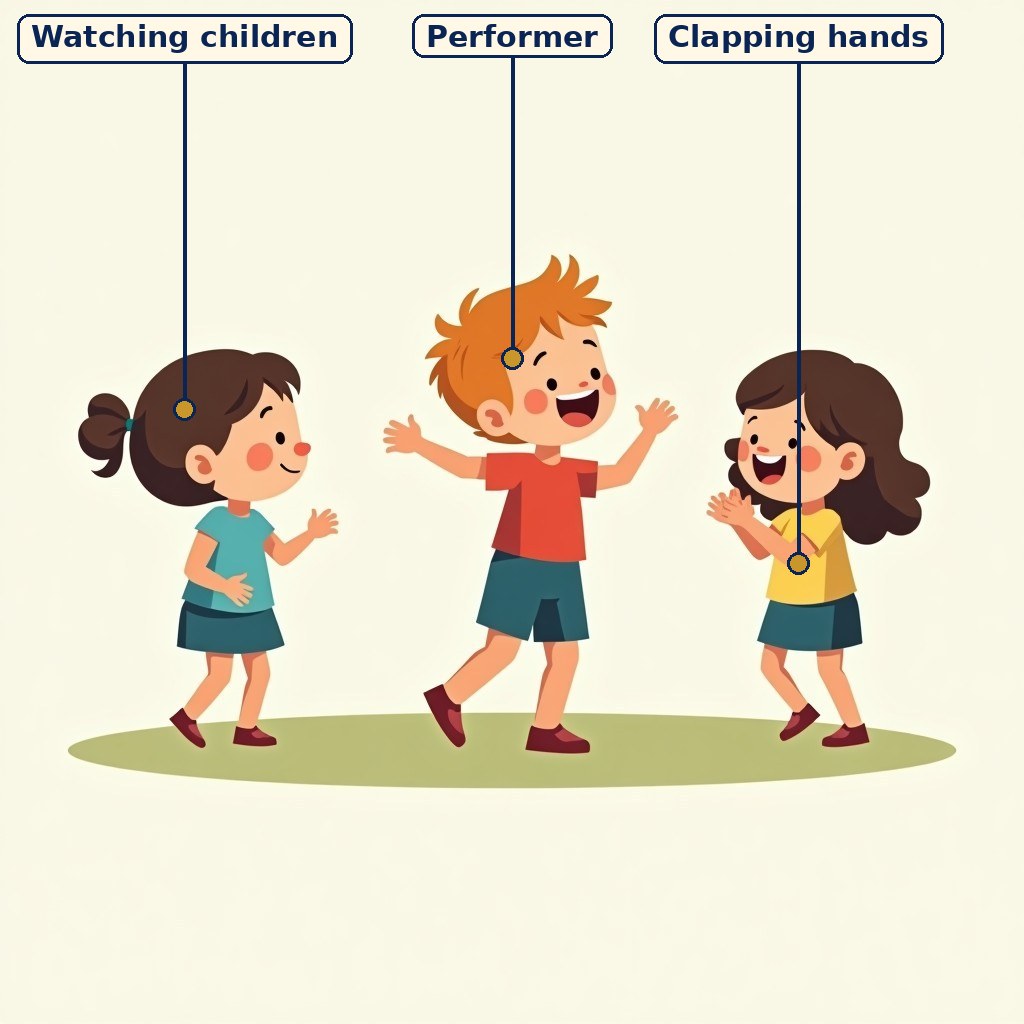
Diagram (labels are printed on the image): A child dancing while two children watch and clap. A general teaching picture; it is not a picture from the book.

A young dancer bowing while children clap. A general picture about live performance; no book picture is copied here.
What the chapter is about
There are many steps that lead to a successful performance, and it is helpful to remember that there is more to it than singing and playing: there is a lot to contribute even if you are not on stage. This chapter is divided into three parts to help you build a successful performance — Plan, Prepare and Perform!
Part A: Plan. Planning is the most important phase of putting a performance together. Activity 9.1, Visualise a Performance, asks you to think through: when will it be, where will it be, how long will it be, who will be your audience, is it intended for a particular event or occasion, will it have a theme and title, and are there elements from other performances you particularly enjoyed and would like to incorporate? Activity 9.2, Create a Song List, asks you to work with your teacher to list songs that could be used — everyone contributes songs they know and like that would work well, chosen from this book and from songs you already know. The chapter gives one song you can sing as an invocation or welcome song: “Swagatham shubha swagatham”, composed by the renowned sitar maestro Pandit Ravi Shankar and sung at the inauguration ceremony of the 1982 Asian Games, an international sporting event held in New Delhi. Its words welcome with joy and auspiciousness — “Anand mangala mangalam” — and speak of India’s constant, ever-new humanity, equality and affection, of new blossoming wishes and fragrant efforts, of friendship in the playground, and of eternal, well-developed auspiciousness.
Activity 9.3, Including Folk Music, asks you to look for a folk song from a tradition other than your own — researched online, or learnt from musicians and music educators you know, or chosen from what you have already learnt. The chapter’s example is an Odia folk song of the tribals of Koraput, Odisha, sung widely during the celebration of Chaita Paraba, about coming together and celebrating the festival with love and enthusiasm: “Ee la ya lori la la la lori, Lori danguda lori bulai de”, with verses about Sita kaniya and Lakhmi kaniya being brought with eastern customs (“Puruba neeti”). The chapter’s pictures also show dances from Chhattisgarh.
Part B: Prepare. Activity 9.4, Rehearsal and Feedback, sets the routine: once you have chosen your song or set of songs, practise it; when performing with a group, practise together so everyone works well; use elements learnt earlier, such as singing in parts or in canon, or using body percussion and synchronisation. When ready, perform for your teacher or a friend and ask for feedback, to enhance your strengths and work on your weaknesses, then make a practice plan based on that feedback. Vocalists should think about the lyrics and the emotion and story they are conveying; instrumentalists should think about dynamics and feeling, and know when they are the lead and when they are supporting others. Find musical parts for all performers, so each person uses their strengths to make the performance better; if you do not have instruments, find other ways to support it — sometimes you can even use a stick to keep the beat. The chapter’s picture shows an orchestra from Assam at Kala Utsav.
Activity 9.5, Production, Promotion and Support, covers everything beyond the music: how can you design the stage in a way relevant to your theme, are lights and sound equipment required, how can you best use the performance space, do you require props, would you need an anchor to announce and engage the audience, are chairs needed for the audience, and what else is needed? Plan out every step and prepare. Promotion is part of it too: how will you let people know or advertise the performance — eye-catching posters around your school, using ideas from Visual Art classes, and content to promote it on social media?
Part C: Perform. Activity 9.6, Final Performance, is the show itself: on the day, welcome the audience and introduce the show, present the performance, and end it with a thank-you message. Try to record the performance. After it ends, get constructive feedback from your audience and discuss it with your team. Congratulations — you are now a young performer! The chapter also asks students to maintain a journal through the preparation period, and its summative examples include: choosing and presenting a song on a given theme; creating a story and embellishing it with sound and music; presenting a simple classical composition with its arohana and avarohana while keeping tala; and, as a class, preparing and presenting a performance incorporating songs learnt through the year.
What you should learn
- Plan a performance: when, where, how long, audience, occasion, theme and title, borrowed elements.
- Create a song list with your teacher, including an invocation song and a folk song from another tradition.
- Rehearse as a group, use parts, canon, body percussion and synchronisation, and turn feedback into a practice plan.
- Handle production, promotion and support: stage, lights, sound, props, anchor, seating, posters, social media.
- Perform, record, thank the audience, gather feedback, and keep a journal through the preparation.
Key Terms
- Invocation / Welcome song — An opening song that welcomes the audience, such as “Swagatham shubha swagatham”.
- Repertoire / Song list — The set of songs chosen for a performance.
- Rehearsal — Practising together so a group works well, before performing for feedback.
- Body percussion — Using the body — claps, taps, stamps — to keep rhythm and support a performance.
- Synchronisation — Performing together in time, so a group sounds and looks as one.
- Dynamics — How loud or soft music is played, used by instrumentalists with feeling.
- Anchor — The person who announces and engages the audience during a performance.
- Production — Everything beyond the music that makes a show work: stage, lights, sound, props, seating.
- Promotion — Letting people know about a performance: posters, social media and other advertising.
The chapter says so directly: follow all the steps in the planning stage to think about what your final performance can be. A show planned well is already half performed.
Perform for a teacher or friend, ask for feedback, enhance strengths, work on weaknesses, and then make a new practice plan from that feedback. Rehearsal without feedback is only repetition.
If you do not play or sing the lead, find your part: support with body percussion, keep the beat with a stick, anchor, design, promote, or manage the stage. A performance fails without its off-stage contributors too.
Try it: Visualise and list (Activities 9.1–9.2)
- Answer the planning questions: when, where, how long, who is the audience, which event or occasion, what theme and title, and which elements from other performances would you like to incorporate?
- With your teacher, make a song list: everyone contributes songs they know and like, from this book and beyond.
- Learn “Swagatham shubha swagatham” (Pandit Ravi Shankar, 1982 Asian Games inauguration, New Delhi) as your invocation or welcome song.
Try it: Include folk music from another tradition (Activity 9.3)
- Look for a folk song from a tradition other than your own — online, from musicians and music educators, or from what you have already learnt.
- Learn the chapter’s Odia example: the Koraput tribals’ Chaita Paraba song, “Ee la ya lori la la la lori”, about coming together in love and enthusiasm.
- Notice its repeated calls and eastern customs (“Puruba neeti”) in the verses about Sita kaniya and Lakhmi kaniya.
Try it: Rehearse, produce, promote, perform (Activities 9.4–9.6)
- Practise your chosen songs together, using parts, canon, body percussion and synchronisation.
- Perform for your teacher or a friend, collect feedback, and make a practice plan from it; vocalists focus on lyrics, emotion and story, instrumentalists on dynamics, feeling, and lead-versus-support roles.
- Plan production: theme-relevant stage design, lights and sound, best use of space, props, anchor, audience chairs, and anything else needed.
- Promote: eye-catching posters around school (using Visual Art ideas) and social-media content.
- On the day: welcome the audience, introduce the show, perform, end with thanks, record the performance, then gather audience feedback and discuss it with your team. Keep a journal through the whole preparation.
Chart / Table: Plan, Prepare, Perform — the chapter’s three parts
| Part | What happens |
|---|---|
| A: Plan | Visualise: when, where, how long, audience, occasion, theme, title. Create a song list with your teacher. |
| B: Prepare | Rehearse together (parts, canon, body percussion, synchronisation); feedback → practice plan; production, promotion, support. |
| C: Perform | Welcome and introduce, present, thank, record; gather audience feedback and discuss with your team. |
Remember
- Three parts: Plan, Prepare, Perform — planning is the most important phase.
- Song list: everyone contributes; invocation song “Swagatham shubha swagatham” (Pandit Ravi Shankar, 1982 Asian Games, New Delhi).
- Folk inclusion: a song from another tradition — chapter example: Odia Koraput tribals’ Chaita Paraba song.
- Rehearsal: together, with parts, canon, body percussion, synchronisation; feedback becomes a practice plan.
- Vocalists: lyrics, emotion, story. Instrumentalists: dynamics, feeling, lead vs support. No instrument? Keep the beat — even with a stick.
- Production + promotion: stage, lights, sound, props, anchor, chairs, posters, social media.
- Final day: welcome, introduce, perform, thank, record, feedback, journal.
Exam Tip / Common Mistake
Common mistake: describing only the singing. In answers, always walk through all three parts — Plan (questions + song list), Prepare (rehearsal + feedback + production + promotion), Perform (welcome, present, thank, record, feedback) — and name the invocation song and its composer and occasion.
Practice set — try it yourself
- List the planning questions from Activity 9.1.
Hint: Hint: When, where, how long, audience, occasion, theme and title — plus borrowed elements. - Who composed “Swagatham shubha swagatham”, and where was it sung?
Hint: Hint: A sitar maestro, at a 1982 sporting inauguration in New Delhi. - What is the chapter’s folk-song example, and when is it sung?
Hint: Hint: Odia tribals of Koraput, at Chaita Paraba. - What should a vocalist and an instrumentalist each think about in rehearsal?
Hint: Hint: Lyrics, emotion, story — versus dynamics, feeling, lead or support. - What happens after the final performance ends?
Hint: Hint: Feedback from the audience, discussed with the team — and a journal kept throughout.
Questions with Answers
- What are the three parts of building a successful performance?
Plan, Prepare and Perform. Planning — visualising the performance and creating a song list — is the most important phase; preparation covers rehearsal, feedback, production, promotion and support; performance is the final show itself. - Describe the chapter’s invocation song.
“Swagatham shubha swagatham”, composed by renowned sitar maestro Pandit Ravi Shankar, was sung at the inauguration ceremony of the 1982 Asian Games in New Delhi. It welcomes with joy and auspiciousness (“Anand mangala mangalam”) and speaks of India’s constant humanity, equality and affection, new blossoming wishes, friendship, and eternal auspiciousness. - How does Activity 9.3 include folk music?
Students look for a folk song from a tradition other than their own — online, from musicians and educators, or from earlier learning. The chapter’s example is an Odia song of the Koraput tribals, sung widely at Chaita Paraba, about coming together and celebrating with love and enthusiasm, with verses about Sita kaniya and Lakhmi kaniya brought with eastern customs (“Puruba neeti”). - What is the rehearsal-and-feedback routine?
Practise chosen songs, together as a group, using parts, canon, body percussion and synchronisation. Perform for a teacher or friend, ask for feedback to enhance strengths and work on weaknesses, and make a practice plan based on it. Vocalists focus on lyrics, emotion and story; instrumentalists on dynamics, feeling, and knowing when they lead and when they support; everyone gets a musical part suited to their strengths. - What must be planned beyond the music itself?
Stage design relevant to the theme, lights and sound equipment, best use of space, props, an anchor to announce and engage the audience, chairs for the audience, and promotion — eye-catching posters around school using Visual Art ideas, and social-media content. On the day: welcome and introduce, present, end with thanks, record the performance, then gather audience feedback and discuss it with the team.
Extension Questions — for deeper understanding
- Why does the chapter insist planning comes before practising?
Because planning decides what the final performance can be: its time, place, length, audience, occasion, theme and title, and its song list. Practising without those decisions wastes rehearsal on songs and staging that may not fit the occasion at all. - How would you choose songs for a school annual-day performance using Activities 9.2 and 9.3?
With the teacher, list songs everyone knows and likes that fit the occasion, from this book and beyond; open with the invocation song “Swagatham shubha swagatham”; and include at least one folk song from a tradition other than your own, such as the Koraput Chaita Paraba song, so the performance celebrates more than one tradition. - A group member has no instrument and a weak singing voice. What part can they play?
Many: body percussion, keeping the beat with a stick, anchoring and engaging the audience, stage design, props, promotion through posters and social media, or audience management. The chapter’s point is that a successful performance has contributions even from those not on stage singing or playing. - What does the chapter’s summative assessment ask of individuals and of the class?
Individuals may be asked to choose and present a song on a given theme, create a story embellished with sound and music, or present a simple classical composition with arohana and avarohana while keeping tala. The class prepares a performance including planning, repertoire, promotion and event planning, and presents songs learnt through the year — judged on pitch and rhythm, correct raga notes and tala, creativity, expression, presentation, coordination, teamwork and enthusiasm. - Why keep a journal through the preparation period?
Because preparation is assessed, not only the final show: the journal records planning decisions, rehearsal progress, feedback received and practice plans made from it, so both student and teacher can see growth — and the team can discuss audience feedback against what actually happened. - How do the chapter’s pictures support its message?
Dances from Chhattisgarh illustrate folk traditions beyond one’s own; the Assam orchestra at Kala Utsav shows a large group performance working together; and a musical performance in progress shows production — stage, space and audience — as part of the show, not an afterthought.
- Plan → Prepare → Perform; planning is the most important phase.
- Invocation: “Swagatham shubha swagatham” (Ravi Shankar, Asian Games 1982, New Delhi).
- Folk: Koraput tribals’ Odia Chaita Paraba song — another tradition, deliberately included.
- Rehearse together, feedback → practice plan; production + promotion complete the show.
- Perform, thank, record, gather feedback, discuss — and keep your journal.
How to use this page: Read the summary, say the Key Terms in your own words, then try the practice set without looking. Check your answers against Questions with Answers, and ask your teacher or parent to check your work.