

Chapter 2: Say More without Speech
Mime — saying more without speech, through face, body and imagination.
Original notes — ready CBSE (NCERT, English Medium) • Class 7 • Arts • Book: Kriti
Say More without Speech — EG's own notes, in simple words
Book: Kriti (CBSE, Class 7) | Chapter 2 | Medium: English
Section: Theatre
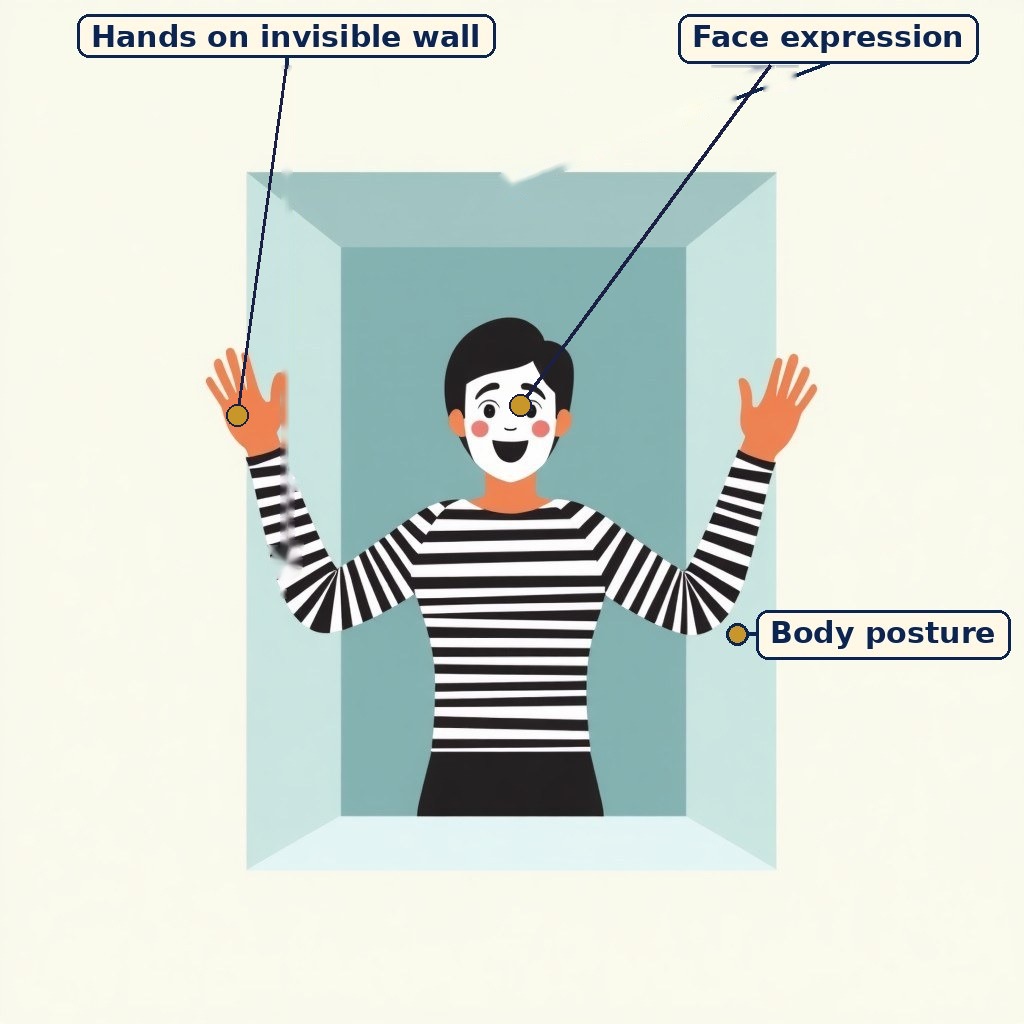
Diagram (labels are printed on the image): A mime artist showing an invisible box with hands and face. A general teaching picture; it is not a picture from the book.

Children guessing a mime game in class. A general picture about learning mime through play; no book picture is copied here.
What the chapter is about
Mime is acting without words or sound. In India it is called Mukaabhinaya. Imagine you are at an important event where nobody may talk, and you must ask a friend near the door to fetch the umbrella you left outside: you would do it with actions and expressions alone. That silent communication is miming, and the person who performs it is also called a mime.
Mime rests on three simple ideas. Facial expression is the emotion and reaction shown on the face. Body language is hand gestures, body postures and actions. Energy is the intensity and focus behind each action. A mime show may be a small part of a bigger play with dialogues, while a pantomime is a larger theatrical performance with many actors and music, mostly comedy, in which the audience is often made a part of the illusion — this is called interactive performance.
The first rule of mime is: do not become the object — use the object. Show how you hold a pair of scissors; do not turn your fingers into the scissors themselves. If fingers became the object, how would you show something large like a train, a car or a fridge? The second rule is to establish the space, size and weight of the object: a cricket ball, a basketball and a balloon are held and handled in very different ways, and the audience must believe each one.
Any successful mime show needs three pillars, practised both alone and as a group. Imagination is the most crucial: unless the audience also imagines the objects, situations and environment, the show cannot succeed — it is a give-and-take between actor and audience. Exaggeration makes movement, actions and expressions larger than life, so that even subtle details are visible to a large audience; it is close to the Natyadharmi, stylised style from Chapter 1, using slow motion, repetition and over-expression. Costume and make-up in mime are mainly neutral — a black shirt and trousers against a white backdrop, or black-and-white stripes, gloves, socks or suspenders, with highlighted facial features in contrasting white, black and red, so expressions stay visible and characters differ only subtly.
Mime is a universal language for equality. Because there is no speech, it breaks every language barrier: emotions are universal, so a mime scene from any state or country can be understood anywhere in the world. Because the costume is the same black-and-white for everyone, it also removes the bias that comes from judging people by their clothes — a scene of women carrying heavy loads underground, for example, can break gender stereotypes. Mime is even used to help people come out of trauma, because it lets them express and share without fear of being judged.
What you should learn
- Define mime, Mukaabhinaya and pantomime, and explain how mime differs from drama.
- Apply the two basic rules: use the object (do not become it), and show its size, space and weight.
- Name and explain the three pillars of a mime show: imagination, exaggeration, costume and make-up.
- Explain why mime is called a universal language for equality.
- Plan and perform a group mime, removing sets and then props step by step, with instrumental background music only.
Key Terms
- Mime — A form of acting that uses no words or sound. It may stand alone or be part of a bigger play with dialogues.
- Mukaabhinaya — The Indian name for mime — acting through face and body without speech.
- Pantomime — A theatrical performance with multiple actors and music, mostly comedy, in which acting is the main element.
- Facial expression — The emotion and reaction shown on the face.
- Body language — Hand gestures, body postures and actions that communicate meaning.
- Energy — The intensity and focus behind each action.
- Exaggeration — Making movement, actions and expressions larger than life so subtle details stay visible.
- Interactive — Bringing the audience into the performance so they become a part of the illusion.
Do not become the object. Show a pair of scissors by how you hold and use them — never by turning your fingers into the scissors. The same rule applies to a gun, a ball, or anything you mime.
Imagination is not the actor’s job alone. If the audience does not picture the invisible pencil box, the heavy suitcase or the melting ice cube, the show fails — so act clearly enough for them to see it too.
Background music may suit the situation of your act, but it must be instrumental music with no lyrics and no speech, so the silence of the mime is never broken.
Try it: Individual activity — the invisible object (Activity 2.1)
- Imagine an everyday object, such as your pencil box, and pretend to hold it, remembering its exact size and shape.
- Now mime the same pencil box filled with iron, then completely empty — show the change in weight in your hands, arms and face.
- Try other objects: a cricket ball, a basketball and a balloon, each held in its own way.
- Check yourself: are you using the object, or have you accidentally become the object?
Try it: Team activity — pass the invisible object (Activity 2.2)
- Sit in a circle. One volunteer starts with an imaginary object and shows it clearly in shape, size and weight.
- Pass it to the next person, who receives it, adds a new action nobody has done before, and passes it on — all without sound or speech, and nobody announces the object’s name.
- Basic version: use everyday objects such as a pen, scissors or a watch.
- Advanced version: let the object change as it passes — a huge ice cube that melts with time, or a handful of sand that keeps slipping away.
Try it: Group mime — remove the sets, then the props (Activity 2.3)
- In groups of 5 to 10, take a scene and first enact it as a regular play, with all the sets and properties you need.
- Mark the set placements in your minds, remove the chairs, tables and other sets, and enact the whole scene again without them. Hand props such as a walking stick or a bow and arrow may still be used.
- Once you know the scene well, remove the props too, and enact it with no sets and no props at all.
- Practise your daily routine in mime, from waking up in the morning to going to bed at night, remembering the small details.
- Try the make-up magic task in pairs: show expressions for opening a stuck jar lid, lifting a heavy suitcase, eating a sour lemon and pulling a heavy rope; draw your partner’s expression, noting eyebrows, forehead, cheeks and eyes, and discuss how to exaggerate it more.
Chart / Table: The three pillars of a mime show
| Pillar | What it means |
|---|---|
| Imagination | Actor and audience together picture the invisible objects, situations and environment. |
| Exaggeration | Movements, actions and expressions made larger than life — slow motion, repetition, over-expression. |
| Costume and make-up | Mainly neutral: black or black-and-white costume; white, black and red make-up highlighting the face. |
Remember
- Mime = no words, no sound; Mukaabhinaya is its Indian name; pantomime adds many actors and music, mostly comedy.
- Rule 1: use the object, do not become it. Rule 2: show its space, size and weight.
- Three pillars: imagination, exaggeration, and neutral costume and make-up.
- Costume is usually black, or black-and-white stripes with gloves, socks or suspenders; make-up is white, black and red.
- Mime breaks language barriers and clothing-based bias — it is a universal language for equality.
- Group mime is built in steps: with sets, then without sets, then without props either.
Exam Tip / Common Mistake
Common mistake: describing mime as “acting without props” and stopping there, or saying the mime “becomes” the object. In answers, give the full definition — no words or sound — plus the two rules and the three pillars, and mention that background music, if used, must be instrumental only.
Practice set — try it yourself
- What is mime, and what is it called in India?
Hint: Hint: Think of acting without words, and the Indian name beginning with M. - Show a cricket ball, a basketball and a balloon in mime. What must change each time?
Hint: Hint: Think of size, weight and the way you hold each one. - Why is it wrong to turn your fingers into a pair of scissors?
Hint: Hint: Remember the first rule — use the object. - Name the three pillars of a mime show.
Hint: Hint: One is about picturing, one about enlarging, one about dress and face. - Mime your morning routine from waking up to leaving for school, without speaking.
Hint: Hint: Keep the small details — brushing, bag, shoes — and exaggerate each action.
Questions with Answers
- What is mime? How is it different from a pantomime?
Mime is acting that uses no words or sound; the performer is also called a mime, and mime may be part of a bigger play with dialogues. A pantomime is a theatrical performance with multiple actors and music, mostly comedy, in which acting is the main element. - What are the two basic rules for showing an object in mime?
First, use the object — do not become it: show how you hold a pair of scissors rather than turning your fingers into scissors. Second, establish the space, size and weight of the object, so a cricket ball, a basketball and a balloon are each handled believably and differently. - Explain the three pillars of a mime show.
Imagination: actor and audience together picture the invisible objects, situations and environment — without the audience’s imagination the show cannot succeed. Exaggeration: movements, actions and expressions are made larger than life, using slow motion, repetition and over-expression, close to the Natyadharmi style. Costume and make-up: mainly neutral, black or black-and-white costume with white, black and red make-up highlighting the face, so expressions stay visible. - Why is mime called a universal language for equality?
It has no speech, so it breaks all language barriers — emotions are universal and a scene from anywhere can be understood anywhere. Its common black-and-white costume also removes bias from judging people by their clothes, and it can break gender stereotypes, for example by showing women carrying heavy loads in mining or construction scenes. - Describe the steps of the group mime activity.
First enact the scene as a regular play with sets and properties. Then mark the set placements in your minds, remove the sets, and enact it again, keeping hand props. Finally remove the props too and enact the whole scene with no sets and no props, with instrumental background music only.
Extension Questions — for deeper understanding
- In the team circle activity, what is the difference between the basic and advanced versions?
In the basic version, everyday objects like a pen, scissors or a watch are passed on, with each person adding a new action. In the advanced version, the object itself changes as it passes — a huge ice cube melts with time, or a handful of sand keeps reducing as it slips through the fingers — so later actions differ from the first ones. - Why does mime costume stay neutral instead of showing the character directly?
Unlike drama or dance, mime costume and make-up do not directly depict the character. They stay neutral, with only subtle differences to show variation in character, so the story is told purely through face, body and imagination. - How can mime help people come out of trauma?
Mime gives people freedom to express and share bad experiences without words and without fear of being judged, since nothing is spoken aloud and the expression happens through the body. - What should you observe when drawing a partner’s expression in the make-up magic task?
The details of eyebrows, forehead, cheeks and eyes, and how the whole body’s actions help the expression communicate better — then discuss how to exaggerate the expression further. - A friend says mime is easier than drama because “you do not have to speak”. How would you answer?
Mime is harder in one way: without speech, sets or props, every meaning must be carried by face, body, energy, imagination and exaggeration, and the audience must be made to picture an invisible world. That is why its three pillars need practice both alone and as a group. - Give one example of a mime scene that breaks a stereotype, and explain why it works.
A scene showing women carrying heavy loads underground in mining, or in building construction, works because the common mime costume is the same for everyone, so the audience judges the action and the story, not the clothes or the gender of the performer.
- Mime = Mukaabhinaya: acting with no words or sound.
- Use the object, never become it; always show its size, space and weight.
- Three pillars: imagination, exaggeration, neutral costume and make-up.
- No speech means no language barrier; one costume means no clothing bias.
- Build group mime in steps: sets → no sets → no props, music instrumental only.
How to use this page: Read the summary, say the Key Terms in your own words, then try the practice set without looking. Check your answers against Questions with Answers, and ask your teacher or parent to check your work.