

Chapter 2: Biodiversity Register
Record the living world around you — carefully, honestly, and without disturbing it.
Original notes — ready CBSE (NCERT, English Medium) • Class 6 • Vocational Education • Book: Kaushal Bodh
Biodiversity Register — EG's own notes, in simple words
Book: Kaushal Bodh (CBSE, Class 6) | Chapter 2 | Medium: English
Section: Part 1 – Work with Life Forms
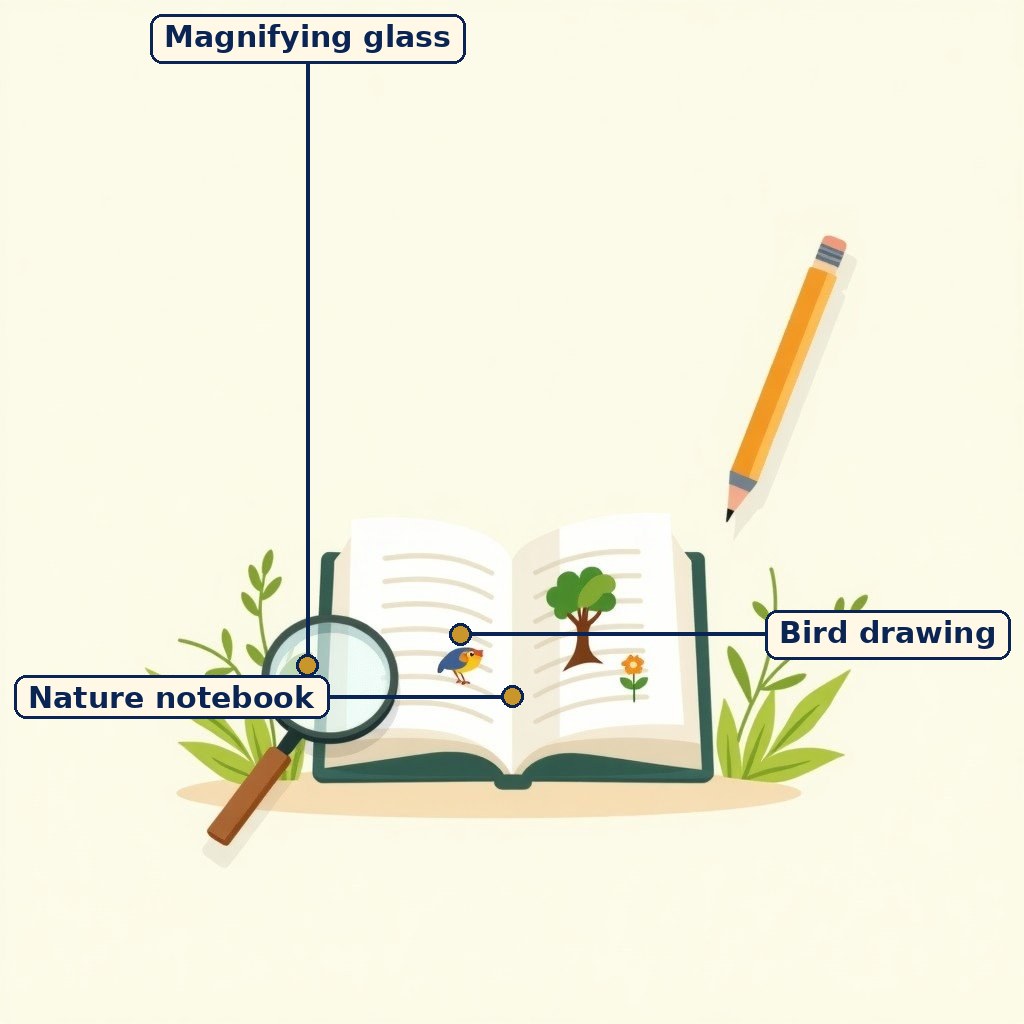
Diagram (labels are printed on the image): An open nature notebook with drawings of a bird, tree and flower, and a magnifying glass. A general teaching picture; the notebook shows drawings, not readable entries.

Children observing birds carefully in a garden. A general picture about nature observation; no real children are pictured.
What the chapter is about
Biodiversity is the diversity of living things — the variety of life forms on earth, including plants, animals, birds, fish, insects and even microorganisms found everywhere, including soil. A biodiversity register is used for documenting the diversity of living things in an area. It contains information about habitat — which includes landscape and types of soil — scientific and local names of living things, what animals eat, living things that may harm others, and other kinds of information.
Recording biodiversity is crucial because, as habitats transform through land clearance for construction or agriculture, or shifts in climate, many species face extinction or become endangered. Because living things are interconnected, the loss of any plant or species affects ecosystems, including humans. Registers also give useful information: local knowledge about crop plants and animals, plants with medicinal value, pests that affect plants, when to plant crops, and more. You will create your own 'mini' biodiversity register by systematically recording the biodiversity around yourself.
What you will be able to do
- Learn about biodiversity and identify places in which to record it.
- Record biodiversity in different places, using different sources to gather information.
- Analyse information to present your understanding of the biodiversity around yourself.
- Prepare a presentation on biodiversity.
What you will need
- A notebook, pen, eraser, measuring scale and sharpener.
- A handheld magnifying glass or lens, to observe details of plants or insects.
- A camera or smartphone (borrowed from your teacher or parents/guardians) for photographs and video and audio recordings — but you must still make sketches of whatever you include in your register.
- A smartphone for identification of living things.
Wear shoes for field visits and cover your arms and legs to prevent mosquito bites. Be careful while observing wild plants, insects, birds and animals; do not disturb any animal, bird or insect, and do not damage any plant. Do not leave any garbage behind — it is harmful for living things. On the Internet: ask your teacher for help, do not upload or download anything without checking for safety, and do not share personal information anywhere.
Before you start: what is around us, and meet an expert
Activity 1 — What is around us? Look around: each plant supports a tiny cosmos full of insects, spiders, squirrels, birds and other creatures that feed on it and shelter among its leaves and branches. First complete a table of living things you often observe and where you see them (near a water body, in a farmland, or in a park), with names in as many languages as you can, for insects, birds, animals and worms. A sketch or photograph may be added; this helps you plan your surveys.
Activity 2 — Meet an expert. Invite experts to speak about biodiversity: a forest officer, a farmer, a conservationist (who works for the protection of plants and animals), or a Vaid or Vaidya — a practitioner of Ayurvedic or traditional tribal medicine who uses medicinal herbs and related plants. Prepare questions first, for example: where can we find different kinds of plants in our locality; how do we know whether local plants have been there a long time or were brought from other places; are there plants no longer found in the locality; which plants should we grow more to support biodiversity; is there any plant we should not grow because it harms biodiversity; and what tips do you have as we start documenting our register?
Surveying: places, schedule and filling the register
Activity 3 — Identify places to survey. Choose places you can reach quickly, so you can go back to check observations: around school, around water bodies, near your home, around farms, parks, gardens or a nursery, near a religious place, and near a market — for example ponds, forests, farms and parks. Ask: what types of habitats exist around you (forests, wetlands, grasslands, urban areas); are there areas where more plants grow than elsewhere; which birds, mammals and insects have you observed; are specific efforts made to protect plants and animals in certain areas (for example conservation of some species, or permission to enter an area); and which places do you plan to visit?
Activity 4 — Scheduling visits. Consult local experts, biologists and conservationists; divide into groups of at most 5 students; and plan visits to the identified areas at different times of the school year, so you can observe changes across seasons. Write the schedule in a table, and carry binoculars, a magnifying lens, cameras, field guides and notebooks.
Activity 5 — Filling in the biodiversity register. For each place, head every set of tables with date of observation, location, habitat type, weather condition and observations. Fill in as many rows as possible, add rows in discussion with your teacher and peers, and make new tables for living things around you (for example flowering and fruit trees in a colony garden in a big city). Share observations with each other — you may have missed something a friend saw — add new information on every visit, sketch or photograph insects, worms, birds, plants and animals that are new to you (this helps identification later, by showing them to others or using an AI tool), and speak to your teacher before leaving any part blank.
The five register tables (with NCERT's worked examples)
| Table | Fields | NCERT example |
|---|---|---|
| 2.3 Crops | Crop name, local name, scientific name, variety name, planting method, special features (cropping and harvesting season), uses, sketch/photograph | Onion — Kanda (Marathi), Vengayam (Tamil), Pyaaz (Hindi); Allium cepa; variety Pachaganga; direct seeding / bulbs / transplants; can be planted and harvested in different seasons; eaten raw or after cooking. |
| 2.4 Fruit plants | Plant name, local name, scientific name, variety name, planting method, special features (fruiting season, aroma), uses, sketch/photograph | Mango — Mango (Amba); Mangifera indica; variety Alphonso; grafting or seeding; fruiting season summer, distinct intense and pleasant aroma; eaten raw or as fruit pulp or juice. Alphonso mangoes have the Geographical Indication (GI) tag, authenticating their origin from specific regions in Maharashtra, particularly Ratnagiri and Sindhudurg. |
| 2.5 Fodder plants | Plant name, local name, scientific name, variety name, planting method, special features (sowing time), uses, sketch/photograph | Napier grass / Elephant grass — Hatti govat (Marathi); Pennisetum purpureum; variety Pusa giant; cuttings of stem or splits; sowing time February to March; used as forage for livestock, and as habitat and shelter for wildlife. |
| 2.6 Weed plants | Plant name, local name, scientific name, variety name, found in crops as a weed, special features, uses, sketch/photograph | Bermuda grass — Haral (Marathi); Cynodon dactylon; variety Pusa giant; found in sugarcane, cotton, grassland and fruit-tree orchards; highly tolerant to heat and drought; provides habitat and food for insects and wildlife; used in playgrounds, sports fields and high-traffic areas. |
| 2.7 Pests | Plant name, local name, scientific name, pest name, scientific name of pest, habitat, special features, time/season of attack, sketch/photograph | Potato — Aloo (Hindi); Solanum tuberosum; pest aphid: Myzus persicae (green peach aphid) and Aphis gossypii (cotton aphid); found on undersides of leaves and on tender shoots and buds; winged and wingless forms; attack after winter, as temperature starts rising. |
On the SeasonWatch website you can register a tree in your neighbourhood, upload photographs every week, and track trees in other areas. India is home to several Biodiversity Heritage Sites — areas recognised for unique biodiversity, protected so biodiversity survives and traditional cultural practices linked to nature are recognised. Examples: Nallur Tamarind Grove (Karnataka), with tamarind trees over 400 years old; Gogabeel (Bihar), a paradise for bird lovers with over 90 bird species, many travelling from far away like Central Asia; Tonglu (West Bengal), with plants found nowhere else in the world; Ameenpur Lake (Hyderabad), home to over 200 bird species even in the middle of a busy city; Majuli (Assam), the biggest river island on the planet, with monasteries called Satras; Myristica swamps (Kerala), home to ancient nutmeg (Jayaphala) trees; Kali Tiger Reserve (Karnataka), a safe haven for Bengal tigers, elephants and other big animals; Chilkigarh Kanak Durga Sacred Grove (West Bengal), with special plants used in traditional medicine, protected by local people; Ziro Valley (Arunachal Pradesh), where people grow rice and fish together; and Mawphlang Sacred Grove (Meghalaya), protected by local tribes and full of rare plants and medicinal herbs.
Identifying the 'unknown' and presenting your register
Activity 6 — Identifying 'unknown' living things. If information is missing, ask an expert or a knowledgeable person in the community, use the school library, or use an AI tool. Google Lens is an image-recognition technology using machine learning and OCR (Optical Character Recognition) to analyse objects, text, landmarks and more from a camera; it can identify objects, read text, translate languages, scan barcodes and QR (Quick Response) codes, and work with Google services. To use it: download and open the Google Lens app on the smartphone, tap the Google Lens icon in the search bar, point the camera at the plant, insect or image and tap the shutter button to search — then add the missing information (scientific names, diseases and other details) to the register.
Activity 7 — Presentation of your biodiversity register. Present the biodiversity of each place you visited using only your observations and gathered information, with charts, diagrams, models or whatever else you think of — highlighting that variations between places and living things are exactly what biodiversity is about. Part 1 summarises all tables for an imaginary visitor: which plants grow around you; which grow in all seasons and which are seasonal; can all crops and fruits be harvested in the same season; do all plants flower in the same season; are plants useful, and how; is the same fodder available all year or only in some seasons; are all plants affected by weeds; are some weeds useful (name some and describe their use); are all plants affected by pests; are plants affected by some pests more in some seasons than others; and what did you learn from people in the community (uses of plants as medicine, as fodder, sacred plants, and so on). Part 2 goes beyond: did you observe more living things in one place than another; how many varieties of plants and pests did you see; did you see the same insects, pests or worms in more than one place; did you use any AI tool, which one and how; did you use any other source; and what conclusion or reflection would you like to share?
What did I learn from others? Discuss with experts which measures can preserve biodiversity in the area, and decide what you think will work. Talk to community members — a farmer, nursery worker, gardener or others — and write how biodiversity changed in the area over the last 10 or 20 years. Also record roughly how many periods each activity took, on a timeline. What else can I do? Keep observing at home and in places you visited, and document it in a nature journal or digital scrapbook. Note that city animals such as kites (birds) and mongoose are 'urban wildlife'. Observe birds visiting your home — how they look and behave — find their local and scientific names, and ask family members and elders which birds and animals they could see when they were young.
Key Terms
- Biodiversity — The variety of living things (life forms) in a place, from plants and animals to microorganisms in soil.
- Biodiversity register — A systematic written record documenting the diversity of living things in an area.
- Habitat — The place and conditions where a living thing lives, including landscape and soil types.
- Species — A kind of living thing, for example a sparrow.
- Local name / scientific name — The name used locally (which differs by language) and the scientific name shared everywhere, for example Allium cepa for onion.
- Variety — A named type within a species, for example Alphonso mango or Pachaganga onion.
- Fodder — Plants grown as food (forage) for livestock.
- Weed — A plant growing where it is not wanted, for example Bermuda grass in a crop field.
- Pest — A living thing that harms plants, for example the aphid on potato.
- Extinction / endangered — A species dying out completely, or at risk of doing so.
- Conservationist — A person who works for the protection of plants and animals.
- Geographical Indication (GI) tag — A tag authenticating a product's origin from a specific region, for example Alphonso mangoes from Ratnagiri and Sindhudurg.
- Urban wildlife — Wild animals living in cities, such as kites and mongoose.
- Record date, location, habitat type, weather and observations for every place — and revisit places across seasons.
- Use the five tables: crops, fruit plants, fodder plants, weed plants and pests — with local names, scientific names, varieties and sketches.
- Never disturb or damage: observe from a safe distance, leave no garbage, and ask your teacher before leaving anything blank.
- Identify unknowns through experts, books, the library and tools such as Google Lens — then present only what you actually observed.
Practice set — try it yourself
- What is a biodiversity register?
Hint: Think about a record of living things. - What four things must each entry record?
Hint: Think name, place, date, number. - Why must you not disturb nests?
Hint: Think about safety for animals. - How does a register protect nature?
Hint: Think about noticing disappearance. - Make five register entries for your school ground.
Hint: Observe slowly and record honestly.
Questions with Answers
- What is a biodiversity register?
A biodiversity register is a notebook record of the living things around a school or home — trees, birds, insects, flowers and animals — like a census of nature. - What is biodiversity?
Biodiversity is the variety of living things in a place — many different plants, animals and insects living together. - What must each register entry record?
The name of the living thing, where it was seen, when it was seen, and how many were seen, plus a drawing or photo if possible. - Why must observers not disturb nests or pick rare flowers?
Because disturbing nests harms animals and picking rare flowers can damage species that are already few in number. - How does a register help protect nature?
When we know what lives near us, we can notice if something disappears and tell others why it matters, so action can be taken.
Questions with Answers — extension (NCERT tables, presentation and Think and Answer types)
- Why is recording biodiversity crucial?
Because habitats change through land clearance for construction or agriculture and shifts in climate, many species face extinction or become endangered; since living things are interconnected, losing any plant or species affects ecosystems, including humans. - What does a register entry set begin with, and what do the five tables cover?
Every set begins with date of observation, location, habitat type, weather condition and observations. The five tables cover crop plants, fruit plants, fodder plants, weed plants and pests. - Give NCERT's worked examples for a crop, a fruit and a fodder plant.
Crop: onion — Pyaaz in Hindi, Allium cepa, variety Pachaganga. Fruit: mango — Mangifera indica, variety Alphonso, fruiting in summer. Fodder: Napier grass / Elephant grass — Pennisetum purpureum, variety Pusa giant, sown February to March, used as livestock forage. - Give NCERT's worked examples for a weed and a pest.
Weed: Bermuda grass (Haral in Marathi), Cynodon dactylon, heat- and drought-tolerant, found in sugarcane, cotton, grassland and fruit-tree orchards. Pest: aphid on potato (Solanum tuberosum) — Myzus persicae (green peach aphid) and Aphis gossypii (cotton aphid), on leaf undersides and tender shoots and buds, attacking after winter as temperature rises. - How do you identify a living thing you do not recognise?
Talk to teachers, elders, family members or experts; look in library books; search on the Internet with a computer; or use a mobile-phone app — for example Google Lens, which uses machine learning and OCR to identify a plant, insect or pest from a photograph. - What safety rules apply on field visits?
Wear shoes, cover arms and legs against mosquito bites, be careful with wild plants, insects, birds and animals, disturb no animal, bird or insect, damage no plant, and leave no garbage behind. - Can all crops be harvested, or all plants flower, in the same season?
No — that is one of the presentation's guiding questions, and your own tables will show it: different plants have different cropping, harvesting, fruiting and flowering seasons, and fodder and pest pressure also change with season. - Name two Biodiversity Heritage Sites and why they matter.
Gogabeel in Bihar, with over 90 bird species including migrants from Central Asia; and Nallur Tamarind Grove in Karnataka, with tamarind trees over 400 years old. Both are recognised for unique biodiversity and for traditional cultural practices linked to nature. - What is 'urban wildlife'?
Wild animals that live in cities, such as kites (birds) and mongoose — scientists have started using this term for them. - Which jobs are related to this project?
Forest officer, scientist and conservationist.
How to use this page: Read the summary, say the Key Terms in your own words, then try the practice set without looking. Check your answers against Questions with Answers, and ask your teacher or parent to check your work.