

Chapter 10: Living Creatures: Exploring Their Characteristics
What makes something alive — and how life grows, moves and changes.
Original notes — ready CBSE (NCERT, English Medium) • Class 6 • Science • Book: Curiosity
Living Creatures: Exploring Their Characteristics — EG's own notes, in simple words
Book: Curiosity (CBSE, Class 6) | Chapter 10 | Medium: English

Diagram (labels are printed on the image): A plant in a pot under sunlight, with a watering can beside it. The plant grows towards the light — a response to a stimulus. A general teaching picture.

Living things of many kinds, all growing, feeding and responding. A general picture about life.
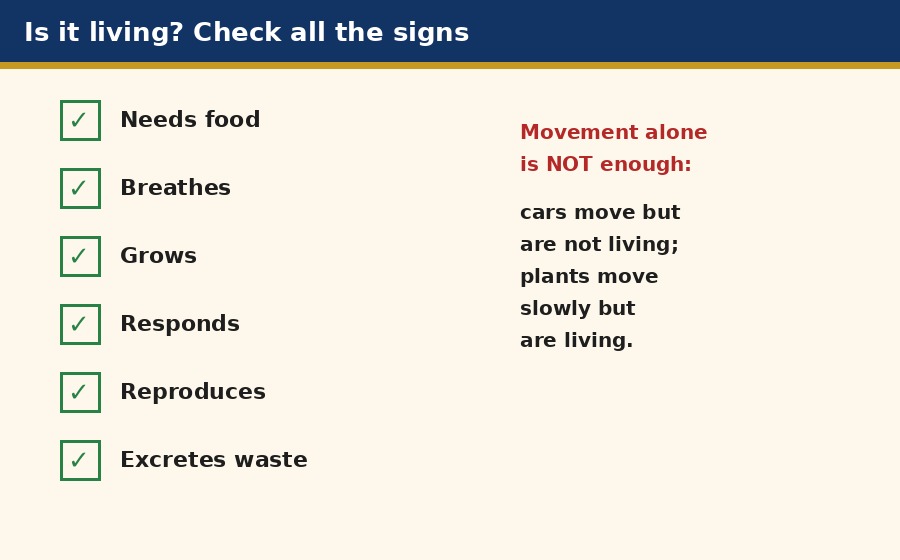
Diagram (labels are printed on the image): Do not judge by movement alone. Check the full set: food, breathing, growth, response, reproduction and excretion. A thing that shows these is living.
What the chapter is about
How do we know something is alive? Compare yourself with a car. A car moves, but it does not grow, does not need food, does not breathe, and cannot produce young ones like itself. Movement alone cannot decide: plants do not move from place to place, yet they are living, and cars move yet are not. We must check the whole set of characteristics that living beings share.
Living beings grow. A child grows larger and cannot fit into a dress from four years ago; a seed grows into a plant; a puppy grows into a dog. Growth means an increase in size that comes from within, not by adding parts from outside. Living beings need food (nutrition) for growth and development. Plants make their own food, while animals eat plants or other animals.
All living beings respire. Breathing is part of respiration, the process that releases energy from food. Notice how your breaths per minute rise after a run compared with after a walk — the body needs more energy, so it breathes faster. Animals breathe through lungs, gills or skin; plants also respire, taking air in and out through tiny pores on leaves called stomata.
Living beings excrete, removing waste products from the body. In humans, sweat (water and salts) and urine are excreted wastes; the white patches on shirts around the armpits in summer are dried sweat. Plants also excrete — excess water and minerals appear as small droplets on leaves, for example on grasses and roses.
Living beings respond to stimuli. A stimulus is anything or any event that prompts a response: stepping on a thorn, touching a hot cup, a sudden sound. Plants respond too, even though they stay in one place. Touch-me-not (mimosa, chhui-mui) folds its leaves when touched; some plants fold their leaves after sunset; flowers open; climbers wind around a nearby support; and the insectivorous plant Drosera moves its sticky hairs inward to trap an insect. A seed that looks dead is a good test of the whole set: it shows no movement, yet given water, air and warmth it germinates and grows — it was alive all along, resting.
For a seed to germinate, it needs suitable conditions together: water, air and warmth (a suitable temperature). Take away any one of them and germination fails or stalls. That is why grains and pulses are stored dry, cool and in airtight containers — storage denies the seed the water and warmth it needs to sprout, so it stays safe for months.
Plants also grow and move in fixed directions. In a pot kept on its side, the shoot still grows upwards towards light and the root grows downwards into the soil, whatever the pot's position. This directed growth is part of how plants survive: shoots reach light for making food, roots reach water and minerals.
Every living being has a life cycle — stages from birth to adult to producing the next generation. A plant's life cycle runs: seed → seedling → young plant → adult plant → flower → fruit → seed again. An animal's life cycle differs by animal. A mosquito passes through egg → larva (wriggler in water) → pupa → adult mosquito. A frog passes through egg → tadpole (with a tail for swimming) → froglet (legs appear, tail shrinks) → adult frog. The tadpole's tail is an advantage in water, where it swims; on land the adult frog needs legs instead, so the tail disappears. Comparing life cycles shows both similarities (all begin young, grow, and reproduce) and differences (different stages, different times, different homes).
What you should learn
- List the characteristics of living beings and test any object against the full set, not movement alone.
- Explain respiration, excretion and response to stimuli with plant and animal examples.
- State the three conditions for seed germination and link them to grain storage.
- Describe shoot-up/root-down growth in plants.
- Compare life cycles of a plant, a mosquito and a frog, naming stages in order.
When you are unsure whether something is living, compare it with yourself: do you grow, eat, breathe, excrete and respond? A car fails most of the list. A seed passes the list once it gets water, air and warmth.
A log is made of wood from a tree, but the log itself does not grow, breathe, eat or reproduce. Being made from something once living does not make a thing living now — just as a leather bag is not a living animal.
Key Terms
- Living thing — A thing that shows life processes like growth, breathing and reproduction.
- Non-living thing — A thing that shows none of the life processes.
- Stimulus — Anything or any event that prompts a living being to respond.
- Response — The reaction of a living being to a stimulus.
- Respiration — The process of releasing energy from food by breathing; all living beings respire.
- Excretion — Removal of waste products from the body.
- Germination — The start of growth of a seed into a young plant.
- Life cycle — The series of stages in the life of an organism, from birth (or seed/egg) to adult to reproduction.
- Stomata — Tiny pores on the surface of leaves that help plants take air in and out.
- Metamorphosis — A big change in body form during growth, as in a tadpole becoming a frog.
Remember
- Living signs: growth, food, respiration (breathing), excretion, response to stimuli, reproduction.
- Movement alone decides nothing: plants move slowly, cars move but are not living.
- Plants respire through stomata; plants excrete droplets on leaves.
- Stimulus examples: thorn, hot cup, touch on touch-me-not, light for a shoot.
- Germination needs water + air + warmth together.
- Shoot grows up (towards light), root grows down (into soil).
- Mosquito: egg → larva → pupa → adult. Frog: egg → tadpole → froglet → adult.
Exam Tip / Common Mistake
Common mistake: calling something living only because it moves, or non-living only because it does not move. In answers, always run through the full list of characteristics and give the evidence for each.
Chart / Table: Living or non-living? Check the signs
| Sign of life | Plant example |
|---|---|
| Needs food | Makes food by photosynthesis |
| Breathes | Takes in air through leaves |
| Grows | Seedling grows into a tree |
| Responds | Bends towards light |
| Reproduces | Makes seeds |
Table: Living or non-living? Check the signs
| Characteristic | Living things | Non-living things |
|---|---|---|
| Growth | Grow from within | Do not grow |
| Food | Need food for energy and growth | Need no food |
| Respiration | Breathe, release energy from food | Do not respire |
| Excretion | Remove wastes (urine, sweat, leaf droplets) | No excretion |
| Response | Respond to stimuli | No response |
| Reproduction | Produce young ones of their kind | Do not reproduce |
Table: Life cycles in order
| Organism | Stages in order |
|---|---|
| Plant | Seed → seedling → young plant → adult → flower → fruit → seed |
| Mosquito | Egg → larva → pupa → adult |
| Frog | Egg → tadpole → froglet → adult frog |
Practice set — try it yourself
- List five characteristics of living things.
Hint: Think about food, breathing, growth, response, reproduction. - Why is a seed living although it does not move?
Hint: Think about growth under the right conditions. - How do plants and animals differ in getting food?
Hint: Think about making food versus eating. - A car moves, makes smoke and needs fuel. Why is it still non-living?
Hint: Check growth and reproduction. - Give one example of a plant responding to a stimulus.
Hint: Think about light or touch.
Questions with Answers
- List the characteristics of living things and explain any two.
Living things need food, breathe (respire), grow, respond to stimuli, reproduce, and excrete waste. For example, growth means a seedling increases in size and becomes a plant, and response means a living thing reacts to a change, like a plant bending towards light. - How do plants and animals differ in nutrition?
Plants are autotrophs: they make their own food using sunlight, water and carbon dioxide in photosynthesis. Animals are heterotrophs: they cannot make their own food, so they eat plants or other animals. - Why is a seed considered living even though it looks still and dry?
A seed is dormant, not dead. When it gets water, air and warmth, it germinates and grows into a plant, showing growth and other life processes. Stillness alone does not mean non-living. - A car moves, uses fuel and gives out smoke. Why is it not living?
A car shows movement and uses fuel, but it does not grow, reproduce, or respond on its own, and it has no life processes like respiration or excretion. Movement alone is not a sign of life. - What is excretion? Why is it necessary?
Excretion is the removal of waste materials produced inside the body. It is necessary because wastes, if kept inside, would harm the body, just as garbage left in a house makes it unhealthy.
More NCERT-exercise questions — extra practice
- List similarities and differences in the life cycles of plants and animals.
Similarities: both start young (seed or egg), grow through stages, become adults, and reproduce to start the next generation. Differences: plants grow from seeds and stay in one place, making flowers and fruits; animals like frogs and mosquitoes pass through very different stages (tadpole, larva, pupa), often change form greatly (metamorphosis), and move from place to place. - Study this table: (1) grows? No, respires? No. (2) No, Yes. (3) Yes, No. (4) Yes, Yes. Give an example for each, or explain why an example is not possible.
(1) No/No: a stone or a chair — non-living, neither grows nor respires. (2) No/Yes: no ordinary example — every living thing grows at some stage of its life, so a thing that respires but never grows does not fit the pattern of life. (3) Yes/No: not possible — growth in a living thing needs energy from respiration, so growth without respiration cannot happen. (4) Yes/Yes: a plant or an animal, e.g. a growing seedling or a puppy. - How can knowledge of germination conditions help in proper storage of grains and pulses?
Germination needs water, air and warmth together. Grains are stored dry (no water), cool (low warmth) and in airtight containers (little air), so the seeds cannot germinate and stay safe for months instead of sprouting and spoiling. - A tadpole has a tail but the adult frog does not. What is the advantage of the tail in the tadpole stage?
The tadpole lives in water and swims, and the tail works like a propeller for swimming. The adult frog lives partly on land and moves by jumping with legs, so the tail is no longer useful and disappears as legs grow. - Charan says a wooden log is non-living because it cannot move. Charu says it is living because it is made of wood from trees. Give arguments for and against each.
Charan's reason is weak but his conclusion is right: movement alone cannot decide, yet the log is indeed non-living because it does not grow, breathe, eat, excrete or reproduce. Charu's reason is wrong: being made from something once living does not make a thing living now — the log shows none of the life processes. - What are the similarities and differences in the life cycles of a mosquito and a frog?
Similarities: both start from eggs, pass through a young water-living stage, change form greatly, and become flying or land adults that lay eggs. Differences: the mosquito goes egg → larva → pupa → adult (four stages, ending as a flying insect), while the frog goes egg → tadpole → froglet → adult (ending as an amphibian that lives on land and in water). - A plant is kept in a pot lying on its side, with light from above. After a week, what will you see in the shoot and the root, and why?
The shoot will bend and grow upwards towards the light, and the root will grow downwards into the soil. Shoots grow towards light to make food, and roots grow downwards to find water and minerals, whatever the pot's position. - Two students set up seeds with and without water, keeping everything else the same. What do they want to find out, and how will they know if they are correct?
They want to find out whether water is needed for germination. If only the seeds with water sprout, water is needed; if both sprout, water is not the deciding factor. Keeping everything else the same makes the comparison fair. - Design an experiment to check whether temperature affects seed germination.
Take three equal sets of the same seeds. Give all three the same water, air, light and containers, but keep one set in a cold place, one at room temperature and one in a warm place (not hot enough to kill them). Count how many seeds sprout in each set over a week. If the sets differ, temperature affects germination; the set with the most sprouting shows the best temperature.
- Living = growth + food + respiration + excretion + response + reproduction. Movement alone proves nothing.
- Plants: stomata for breathing, droplets for excretion, touch-me-not and Drosera for response.
- Germination needs water + air + warmth; grain storage denies them.
- Shoot up to light, root down to soil — always.
- Plant: seed → seedling → adult → flower → fruit → seed. Mosquito: egg → larva → pupa → adult. Frog: egg → tadpole → froglet → adult.
How to use this page: Read the summary, say the Key Terms in your own words, then try the practice set without looking. Use the Questions with Answers to check yourself afterwards. Ask your teacher or parent to check your answers.