

Original notes — ready
Chapter 4: We the Travellers — II
CBSE (NCERT, English Medium) • Class 5 • Mathematics • Book: Math Mela
We the Travellers — II — EG's own notes, in simple words
Book: Math Mela (CBSE, Class 5) | Chapter 4 | Medium: English
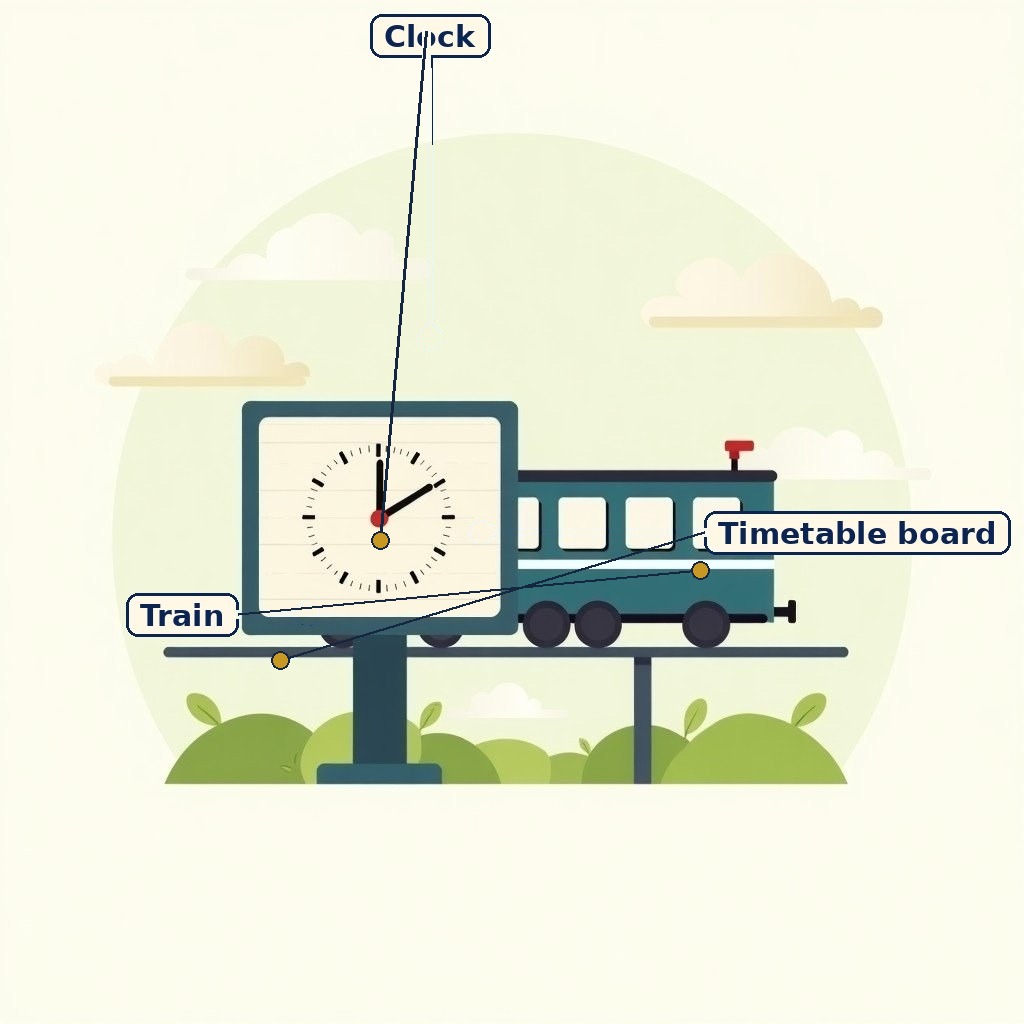
Diagram (labels are printed on the image): A train, a timetable board and a clock. A general teaching picture about journey times.

A family reading a station timetable. A general picture about travel planning.
What the chapter is about
This chapter continues the journey theme with timetables and longer trips. A timetable tells us when a bus or train leaves, when it arrives, and how long the journey takes.
To find journey time, subtract the departure time from the arrival time. For example, a train leaving at 8:00 and arriving at 11:30 takes 3 hours 30 minutes.
Sometimes a journey has two parts — for example, a bus ride and then a walk. The total time is the sum of both parts plus any waiting time in between.
Timetables also teach planning backwards. If school starts at 8:00 and the journey takes 25 minutes, you must leave by 7:35. Finding a start time from an end time is the same subtraction, done with a purpose.
What you should learn
Work with time carefully: 60 minutes make an hour, so 11:30 minus 8:00 is not 3:30 by simple subtraction of digits — count hours, then minutes.
Key Terms
- Timetable — A table showing departure and arrival times.
- Departure — The time a journey starts.
- Arrival — The time a journey ends.
- Journey time — Arrival time minus departure time.
- Waiting time — Time spent waiting between two parts of a journey.
- Schedule — A plan that lists the times of buses or trains.
Remember
- Journey time = arrival − departure.
- 1 hour = 60 minutes — never treat time like ordinary numbers.
- Total journey = travel parts + waiting time.
- Read timetables row by row, not column by column.
Exam Tip / Common Mistake
Common mistake: writing 11:30 − 8:00 = 3:30 by subtracting digits (11−8=3, 30−0=30 works here, but 11:15 − 8:45 needs borrowing an hour). Practise borrowing 60 minutes.
Chart / Table: A sample journey
| Part | Time |
|---|---|
| Bus leaves | 8:00 |
| Bus arrives | 10:30 |
| Wait | 30 minutes |
| Walk | 20 minutes |
| Total | 3 hours 20 minutes |
Think and try
A train leaves at 6:00 and takes 2 hours 45 minutes. When does it arrive? Work it out in two steps: first add 2 hours, then add 45 minutes. Why is adding in steps easier than adding all at once?
Practice set — try it yourself
- A bus leaves at 9:15 and arrives at 12:45. How long is the journey?
Hint: Subtract departure from arrival. - A train leaves at 7:00 and takes 4 hours 20 minutes. When does it arrive?
Hint: Add the time. - A trip has a 2-hour bus ride and a 45-minute wait. What is the total?
Hint: Add both parts. - Convert 150 minutes into hours and minutes.
Hint: Divide by 60. - Plan a journey: home to school takes 25 minutes. If school starts at 8:00, when must you leave?
Hint: Subtract 25 minutes from 8:00.
How to use this page: Read the summary, say the Key Terms in your own words, then try the practice set without looking. Ask your teacher or parent to check your answers.