

Original notes — ready
Chapter 7: Gilli Danda
CBSE (NCERT, English Medium) • Class 5 • English • Book: Santoor
Gilli Danda — EG's own notes, in simple words
Book: Santoor (CBSE, Class 5) | Chapter 7 | Medium: English

Diagram (labels are printed on the image): A player striking the gilli with the danda. A general picture of the game; it is not a scene from the chapter.
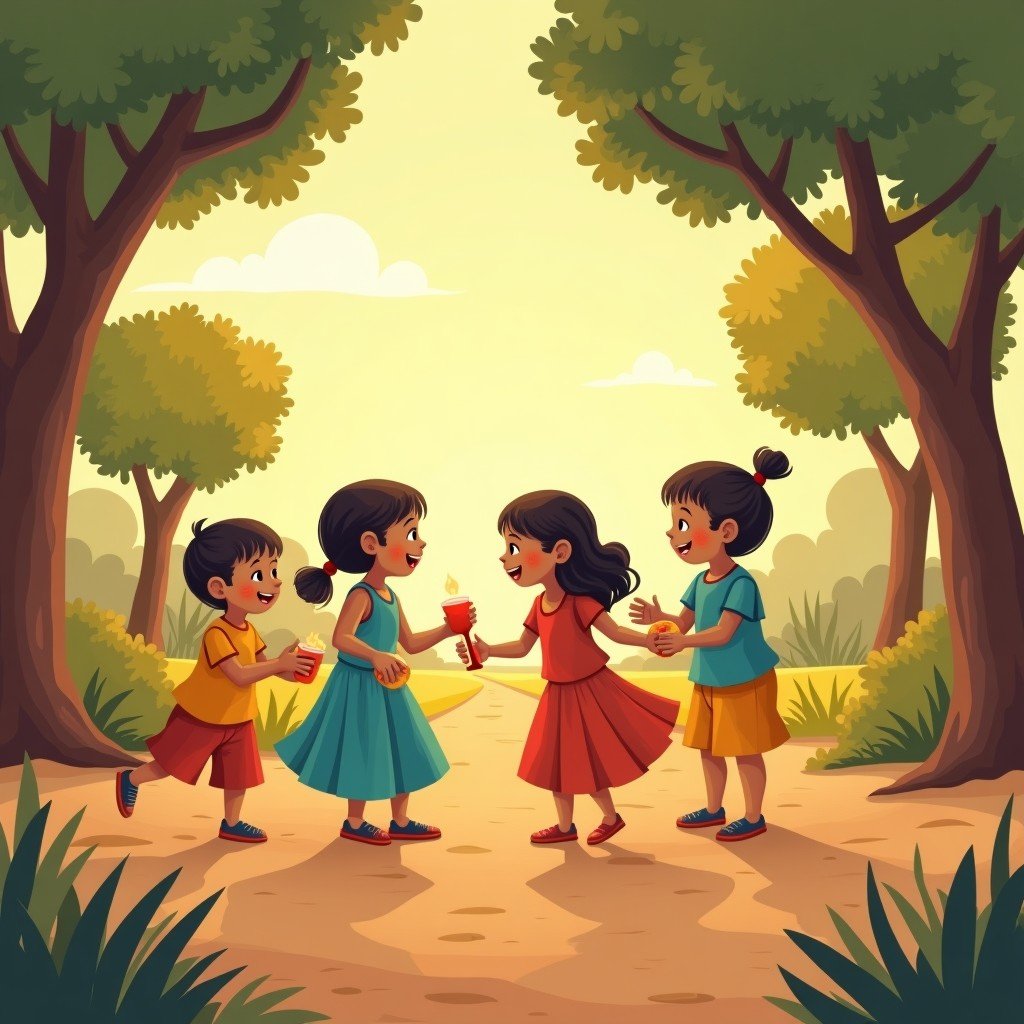
Children playing gilli danda. A general picture of a traditional game.
What the chapter is about
This chapter celebrates Gilli Danda, a traditional Indian outdoor game played for generations in villages and towns. It is played with two sticks: a long danda and a small gilli.
The player balances the gilli on the ground, lifts it with the danda, and then hits it as far as possible. Fielders try to catch it. Points are scored by measuring the distance with the danda itself.
The chapter reminds us that games need no costly equipment. Traditional games keep us fit, teach teamwork and fair play, and connect us to the childhood of our grandparents.
Traditional games are passed down like stories: grandparents teach parents, and parents teach children. The rules may change a little from place to place, but the fun stays the same — quick eyes, fast feet and honest play.
What you should learn
Notice the action words in the chapter — lift, strike, catch, measure. Games chapters are full of verbs, and verbs help you picture the game.
Key Terms
- Gilli — A small, pointed wooden stick used in the game.
- Danda — The long wooden stick used to strike the gilli.
- Traditional game — A game played by people for many generations.
- Fielder — A player who tries to catch the gilli.
- Fair play — Playing honestly and by the rules.
- Teamwork — Working together with others so that everyone can enjoy the game.
Remember
- Gilli Danda needs only two sticks.
- The gilli is lifted and hit with the danda.
- Distance is measured with the danda.
- Traditional games keep us fit and teach fair play.
Exam Tip / Common Mistake
Common mistake: describing only the sticks. Good answers explain how the game is played step by step — lift, hit, catch, measure.
Chart / Table: Steps of the game
| Step | What happens |
|---|---|
| 1. Place | Gilli rests on the ground |
| 2. Lift | Danda flicks the gilli up |
| 3. Strike | Player hits it far |
| 4. Catch or measure | Fielders catch, or distance is measured |
Think and try
Play the steps in order without a gilli: place, lift, strike, measure. Say each step aloud as you mime it. Why does the order matter — what would go wrong if you struck before you lifted?
Practice set — try it yourself
- What two things are needed to play Gilli Danda?
Hint: Think about the two sticks. - How is the score measured?
Hint: Think about the danda as a measuring rod. - What does the fielder try to do?
Hint: Think about catching. - Why are traditional games valuable?
Hint: Think about fitness and heritage. - Describe any traditional game you know in four lines.
Hint: Start with its name and what is needed.
How to use this page: Read the summary, say the Key Terms in your own words, then try the practice set without looking. Ask your teacher or parent to check your answers.