

Original notes — ready
Chapter 5: The Frog
CBSE (NCERT, English Medium) • Class 5 • English • Book: Santoor
The Frog — EG's own notes, in simple words
Book: Santoor (CBSE, Class 5) | Chapter 5 | Medium: English
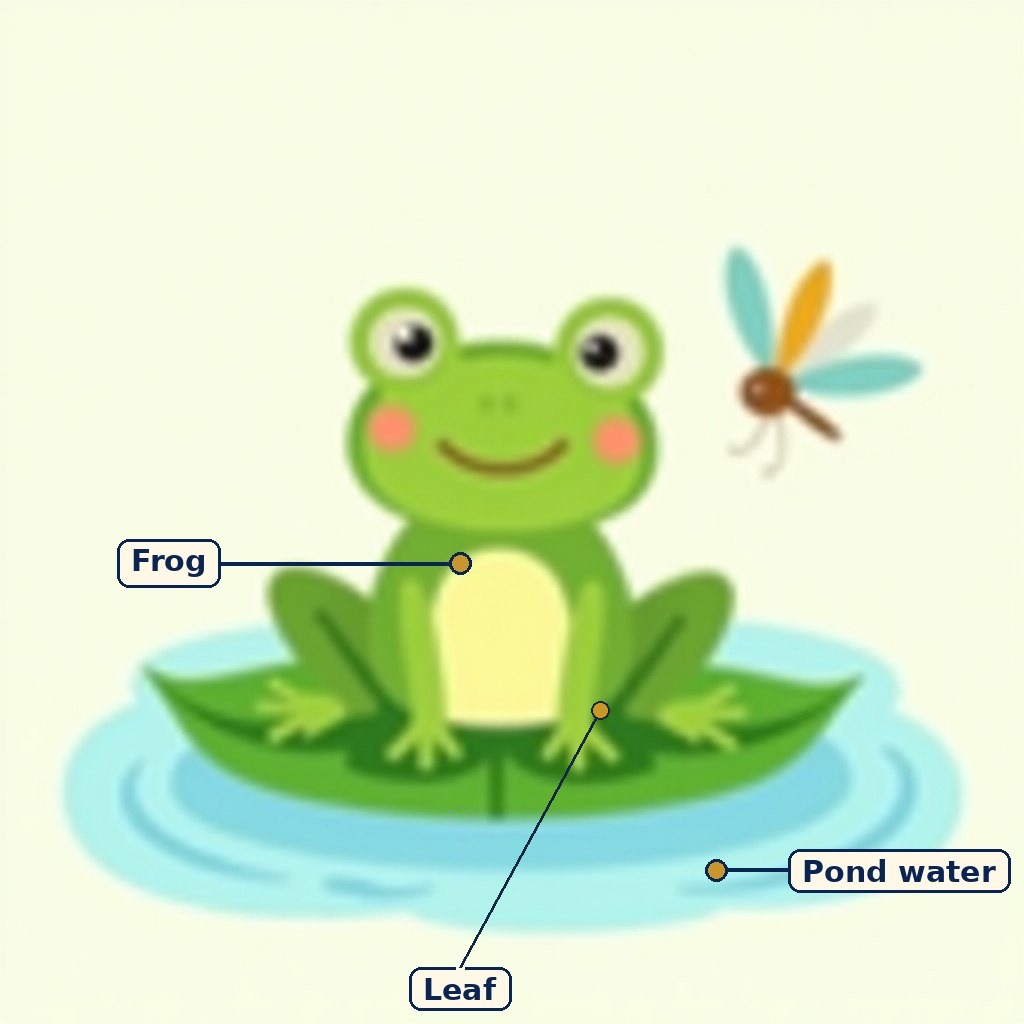
Diagram (labels are printed on the image): A frog on a leaf in a pond. A general picture of the poem's world; it is not copied from the book.
Frogs near a pond at sunset. A general nature picture for the poem.
What the chapter is about
This is a playful poem about a frog and its happy life in a pond. The frog swims, jumps, catches flies and sings in its own funny way.
The poem uses simple, lively words that sound like the frog's movements — hopping, splashing and croaking. When you read it aloud, you can almost hear the pond come alive.
The poem teaches us to enjoy small creatures and their world. Every animal, even a small frog, has its own busy and interesting life.
Sound words make a poem fun to say aloud. Words like hop, splash and croak sound a little like the actions themselves. When you read them, try to say them the way the frog would move — quick for a hop, soft for a splash.
What you should learn
Read the poem aloud and listen to the sound words. Poets choose words that sound like the action they describe.
Key Terms
- Pond — A small body of still water.
- Croak — The deep sound a frog makes.
- Hop — To jump on one or both feet.
- Lively — Full of life and energy.
- Stanza — A group of lines in a poem, like a paragraph.
- Sound word — A word that sounds like the action or noise it describes, such as croak or splash.
Remember
- The frog lives in a pond.
- It hops, swims and croaks.
- The poem uses sound words and action words.
- Small creatures also have busy, interesting lives.
Exam Tip / Common Mistake
Common mistake: treating each line as a separate idea. Read a stanza as one complete picture — the frog's world in that part of the poem.
Chart / Table: The frog's day
| Activity | Where |
|---|---|
| Swimming | In the pond |
| Hopping | On the bank |
| Catching flies | Near the water |
| Croaking | At night |
Think and try
Read the frog's actions aloud, one by one: hop, swim, catch, croak. Now clap once for each action word. Which word sounds most like a real frog to you, and why?
Practice set — try it yourself
- Where does the frog live?
Hint: Think about a small water body. - Name two things the frog does in the poem.
Hint: Think about hop, swim, croak. - What sound does a frog make?
Hint: Think about its special sound word. - Why is the poem fun to read aloud?
Hint: Think about sound words. - Write four lines about any small animal you like.
Hint: Start with where it lives.
How to use this page: Read the summary, say the Key Terms in your own words, then try the practice set without looking. Ask your teacher or parent to check your answers.