

Chapter 5: Magnetism and Matter
Bar magnets, Gauss's law for magnetism, magnetisation, and the three classes of magnetic materials.
Original notes — ready CBSE (NCERT, English Medium) • Class 12 • Physics • Book: Physics — Part I
Magnetism and Matter — EG's own notes, in simple words
Book: Physics — Part I (CBSE, Class 12) | Chapter 5 | Medium: English
Why does a compass point north, and why does a magnet lose its power when heated? This chapter answers both by looking inside materials: tiny atomic currents make every atom a small magnet, and how those atomic magnets line up decides whether a material is diamagnetic, paramagnetic or ferromagnetic.
It is a short chapter, but it carries easy marks: the three classes of materials, hysteresis, and the Earth's magnetism with its three elements.

Diagram (labels on the image): Diagram (labels on the image): a bar magnet with field lines looping from north to south outside the magnet — the lines never cross and are closest together near the poles.

The Earth as a giant magnet, with a compass needle on its surface pointing towards magnetic north.
1. The bar magnet and magnetic field lines
A bar magnet has two poles of equal strength, north and south, which always come in pairs — cut a magnet in half and you get two smaller magnets, each with both poles. There is no such thing as an isolated magnetic pole.
Magnetic field lines leave the north pole and enter the south pole outside the magnet, and run south to north inside it, forming closed loops. The magnetic moment of a bar magnet is m = M × 2l, where M is the pole strength and 2l the separation between poles.
2. Torque, potential energy and the magnetic dipole
A magnetic dipole in a uniform field B feels a torque τ = m × B, magnitude mB sin θ, turning it towards the field. Its potential energy is U = −m · B, lowest when the dipole aligns with the field (θ = 0°) and highest when it points against it (θ = 180°).
A small current loop is also a magnetic dipole, with moment m = NIA along the loop's normal. That single fact connects this chapter to the previous one: a loop, a coil and a bar magnet all behave as dipoles.
3. Diamagnetic, paramagnetic and ferromagnetic materials
Diamagnetic materials have no permanent atomic dipoles; an applied field induces weak dipoles opposing the field, so they are feebly repelled. Examples: bismuth, copper, water. Their susceptibility χ is small and negative, and it does not change with temperature.
Paramagnetic materials have permanent atomic dipoles that are randomly oriented until a field aligns them, so they are feebly attracted. Examples: aluminium, platinum, oxygen. Their susceptibility is small and positive and falls as temperature rises (Curie's law, χ ∝ 1/T).
Ferromagnetic materials have strong interactions that align whole domains of atoms, so they are strongly attracted and stay magnetised. Examples: iron, nickel, cobalt. Above the Curie temperature they become paramagnetic.
4. Hysteresis
When a ferromagnetic material is magnetised, then the field is removed, some magnetisation remains — retentivity. A reverse field called coercivity is needed to wipe it out. Plotting magnetisation against magnetising field traces a loop, the hysteresis loop.
The area of the loop is the energy lost as heat in each cycle. Soft iron has a narrow loop (easy to magnetise and demagnetise — good for electromagnets); steel has a wide loop (hard to demagnetise — good for permanent magnets).
5. The Earth as a magnet and magnetic elements
The Earth behaves like a giant magnet, probably because of electric currents in its molten outer core. Its magnetic axis is tilted about 11.3° from its geographic axis, and the magnetic north pole sits in the geographic south region.
Three elements describe the Earth's field at a place: declination (angle between geographic and magnetic north), inclination or dip (angle the field makes with the horizontal) and the horizontal component B_H of the field. At the magnetic equator the dip is 0°, and at the poles it is 90°.
Going further — complete NCERT coverage
NCERT section map. 5.1 Introduction, 5.2 The Bar Magnet (including the bar magnet as a solenoid and torque/potential energy), 5.3 Magnetism and Gauss's Law, 5.4 Magnetisation and Magnetic Intensity, 5.5 Magnetic Properties of Materials.
Bar magnet and Gauss's law. A bar magnet behaves like a solenoid: its axial field matches a dipole's, B = (μ0/4π)(2m/r3) on the axis (m = magnetic moment) and B = (μ0/4π)(m/r3) on the equator. Torque τ = m × B and potential energy U = −m·B, exactly paralleling the electric dipole. Gauss's law for magnetism: ∮B·dS = 0 — magnetic field lines are closed loops because isolated magnetic poles (monopoles) do not exist; cutting a magnet always gives two new magnets, each with both poles.
Materials. Magnetisation M = magnetic moment per unit volume; magnetic intensity H satisfies B = μ0(H + M); susceptibility χm = M/H and relative permeability μr = 1 + χm. Diamagnetic (χ small, negative): weakly repelled, e.g. bismuth, copper, water — the effect comes from induced orbital changes and is present in all materials. Paramagnetic (χ small, positive): weakly attracted, e.g. aluminium, platinum — atomic dipoles align partially with the field. Ferromagnetic (χ large, positive): strongly attracted, e.g. iron, nickel, cobalt — domains align, giving a hysteresis loop: retentivity (magnetism left at zero field) and coercivity (reverse field needed to erase it). Soft iron (narrow loop) suits electromagnets; steel (wide loop) suits permanent magnets.
Syllabus note: the magnetic elements of the Earth (declination, inclination, horizontal component) do not appear in the rationalised Chapter 5 — the Earth-as-magnet detail in section 5 of this page is background. The board topics are the bar magnet, Gauss's law, magnetisation, and material classes.
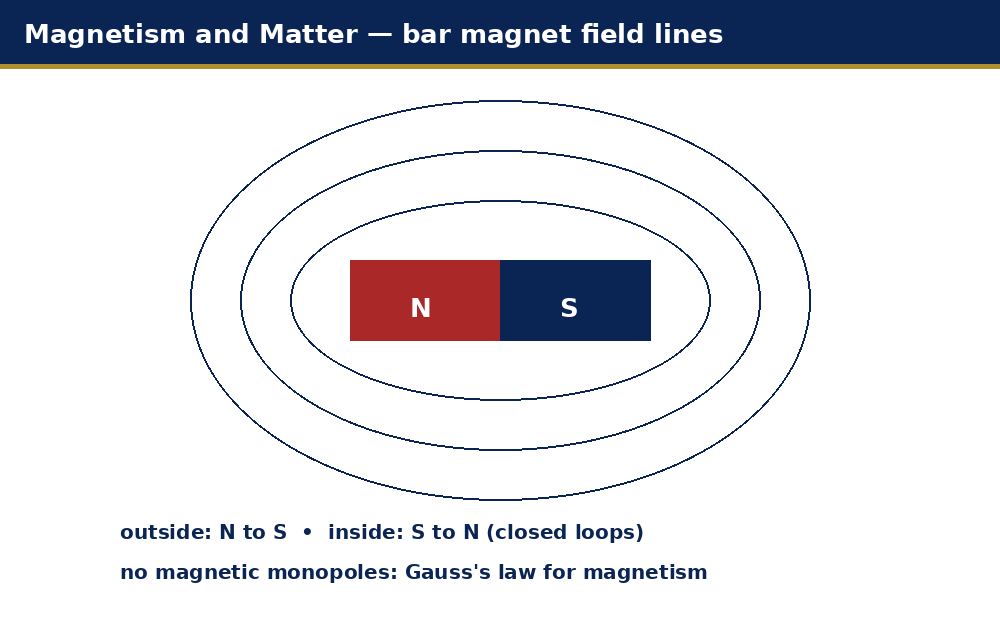
Diagram (labels on the image): New PIL schematic: a bar magnet's field lines — outside from N to S, inside from S to N, forming closed loops with no start or end.
Chart / Table — at a glance
| Property | Diamagnetic | Paramagnetic | Ferromagnetic |
|---|---|---|---|
| Susceptibility χ | Small, negative | Small, positive | Large, positive |
| Effect of temperature | Independent | χ ∝ 1/T | Becomes paramagnetic above Curie temperature |
| Examples | Bismuth, copper | Aluminium, platinum | Iron, nickel, cobalt |
| Behaviour in a field | Feebly repelled | Feebly attracted | Strongly attracted |
Key Terms / Important Terms
- Magnetic pole — Region of a magnet where its strength is concentrated; poles always occur in pairs.
- Magnetic moment — m = pole strength × separation, or NIA for a loop.
- Diamagnetic — Feebly repelled by a magnet; χ small and negative.
- Paramagnetic — Feebly attracted by a magnet; χ small and positive.
- Ferromagnetic — Strongly attracted; retains magnetisation; domains aligned.
- Susceptibility — χ = M/H, how easily a material magnetises.
- Retentivity — Magnetisation left behind when the magnetising field is removed.
- Coercivity — Reverse field needed to reduce magnetisation to zero.
- Hysteresis loop — Loop traced by magnetisation against magnetising field.
- Declination — Angle between geographic north and magnetic north.
Remember
- There are no magnetic monopoles — every magnet has both poles.
- Diamagnetic χ is negative; paramagnetic and ferromagnetic χ are positive.
- Soft iron: narrow loop, good electromagnet. Steel: wide loop, good permanent magnet.
- Dip is 0° at the magnetic equator and 90° at the magnetic poles.
- The Earth's magnetic axis is tilted about 11.3° to its geographic axis.
Exam Tip / Common Mistake
Common mistake: saying a diamagnetic material is 'not magnetic'. It is magnetic — just weakly, and in the opposite sense: it is repelled rather than attracted. Another slip is mixing up retentivity and coercivity: retentivity is what remains, coercivity is what removes it.
Practice set — try it yourself
- Why can you never isolate a north pole by cutting a magnet? Hint: Think about what happens at the cut faces.
- A magnetic dipole of moment 2 A m² sits at 60° to a 0.5 T field. Find its torque. Hint: Use τ = mB sin θ.
- Classify copper, aluminium and iron as diamagnetic, paramagnetic or ferromagnetic. Hint: Recall one example of each class.
- Why does heating a ferromagnetic material above its Curie temperature destroy its ferromagnetism? Hint: Think about what heat does to aligned domains.
- What is the angle of dip at the magnetic equator? Why? Hint: At the equator the Earth's field is horizontal.
Questions with Answers — full answers
- Define magnetic susceptibility and state its sign for diamagnetic and paramagnetic materials. Answer: Answer: Susceptibility χ = M/H, the ratio of magnetisation to magnetising field. It is small and negative for diamagnetic materials, small and positive for paramagnetic materials.
- Distinguish between diamagnetic and paramagnetic materials on any three points. Answer: Answer: (i) Diamagnetic materials are feebly repelled, paramagnetic feebly attracted. (ii) Diamagnetic χ is negative, paramagnetic χ is positive. (iii) Diamagnetic χ is independent of temperature, paramagnetic χ falls as 1/T.
- What is hysteresis? Explain retentivity and coercivity with reference to the loop. Answer: Answer: Hysteresis is the lagging of magnetisation behind the magnetising field, giving a loop. Retentivity is the magnetisation remaining when H returns to zero; coercivity is the reverse field needed to bring magnetisation to zero.
- Why is soft iron preferred for electromagnets while steel is preferred for permanent magnets? Answer: Answer: Soft iron has a narrow hysteresis loop: it magnetises and demagnetises easily with little energy loss. Steel has a wide loop with high retentivity and coercivity, so it stays magnetised.
- Define the three elements of the Earth's magnetism. Answer: Answer: Declination: angle between geographic meridian and magnetic meridian. Inclination (dip): angle between the Earth's field and the horizontal. Horizontal component: the horizontal part of the Earth's field, B_H = B cos δ.
Extension Questions — go further
- Compare the magnetic field of a bar magnet on its axis and on its equator at the same distance r. Answer: Axial: B = (μ0/4π)(2m/r3); equatorial: B = (μ0/4π)(m/r3). The axial field is twice as strong, and the two point in opposite senses relative to the moment direction.
- Why can a bar magnet never be cut into an isolated north pole? Answer: Gauss's law for magnetism, ∮B·dS = 0, says the net magnetic flux through any closed surface is zero — there are no magnetic charges. Every piece of a cut magnet develops both poles, so field lines stay closed loops.
- Classify bismuth, aluminium, and iron as diamagnetic, paramagnetic, or ferromagnetic, with the sign of χ in each case. Answer: Bismuth: diamagnetic, χ < 0 (small). Aluminium: paramagnetic, χ > 0 (small). Iron: ferromagnetic, χ > 0 (large).
- A ferromagnetic material has a wide hysteresis loop, another has a narrow one. Which suits a permanent magnet, and which an electromagnet core? Answer: Wide loop (large retentivity and coercivity, e.g. steel) suits a permanent magnet — it keeps its magnetism. Narrow loop (e.g. soft iron) suits an electromagnet core — it magnetises and demagnetises easily with little energy loss.
- What are retentivity and coercivity, read off a hysteresis loop? Answer: Retentivity is the magnetisation left when the magnetising field returns to zero (the intercept on the M axis). Coercivity is the reverse field needed to bring the magnetisation to zero (the intercept on the H axis).
Board Exam Questions — board-pattern practice
These questions are written by Educational Galaxy in board-exam style for practice. They are not claimed to be real past-year questions.
- A bar magnet of magnetic moment 1.5 A m² is placed in a 0.2 T field at 30° to the field. Find its torque and potential energy. Answer: Answer: Torque τ = mB sin θ = 1.5 × 0.2 × 0.5 = 0.15 N m. Potential energy U = −mB cos θ = −1.5 × 0.2 × cos 30° ≈ −0.26 J.
- A paramagnetic sample obeys Curie's law. If its susceptibility is 4 × 10⁻⁴ at 300 K, what is it at 600 K? Answer: Answer: χ ∝ 1/T, so doubling T halves χ: χ = 2 × 10⁻⁴.
- Explain why a ferromagnetic material's hysteresis loop area matters for a transformer core. Answer: Answer: The loop area is the energy lost as heat per cycle. A transformer core cycles many times per second, so a narrow-loop material like soft iron keeps losses small.
- At a place the horizontal component of the Earth's field is 3.6 × 10⁻⁵ T and the dip is 60°. Find the total field. Answer: Answer: B_H = B cos δ, so B = B_H/cos 60° = 3.6 × 10⁻⁵/0.5 = 7.2 × 10⁻⁵ T.
- A compass needle points slightly away from true north at your town. Which element of Earth's magnetism does this describe, and why does it happen? Answer: Answer: Declination — the angle between geographic north and magnetic north — because the Earth's magnetic axis is tilted from its geographic axis, so magnetic north is not true north.
- Bar magnet ≈ solenoid: axial field twice the equatorial field.
- τ = m × B, U = −m·B — the electric-dipole parallel.
- Gauss for magnetism: ∮B·dS = 0 — no monopoles, field lines are closed loops.
- B = μ₀(H + M); χ = M/H; μ_r = 1 + χ.
- Dia: χ < 0 small. Para: χ > 0 small. Ferro: χ > 0 large, hysteresis loop.