

Chapter 5: Government Budget and the Economy
Introductory Macroeconomics • Original EG notes in simple English
Original notes — ready CBSE (NCERT, English Medium) • Class 12 • Economics • Book: Introductory Macroeconomics
Chapter 5: Government Budget and the Economy — EG's own notes, in simple words
Book: Introductory Macroeconomics (CBSE, Class 12) | Chapter 5 | Medium: English
What you should learn
- State the four objectives of a government budget.
- Classify receipts and expenditure as revenue or capital using the liability/asset test.
- Define revenue deficit, fiscal deficit and primary deficit and interpret a zero primary deficit.
- Explain how a budget reduces inequality and reallocates resources.
- Explain the dangers of financing a fiscal deficit and the balanced-versus-deficit debate.
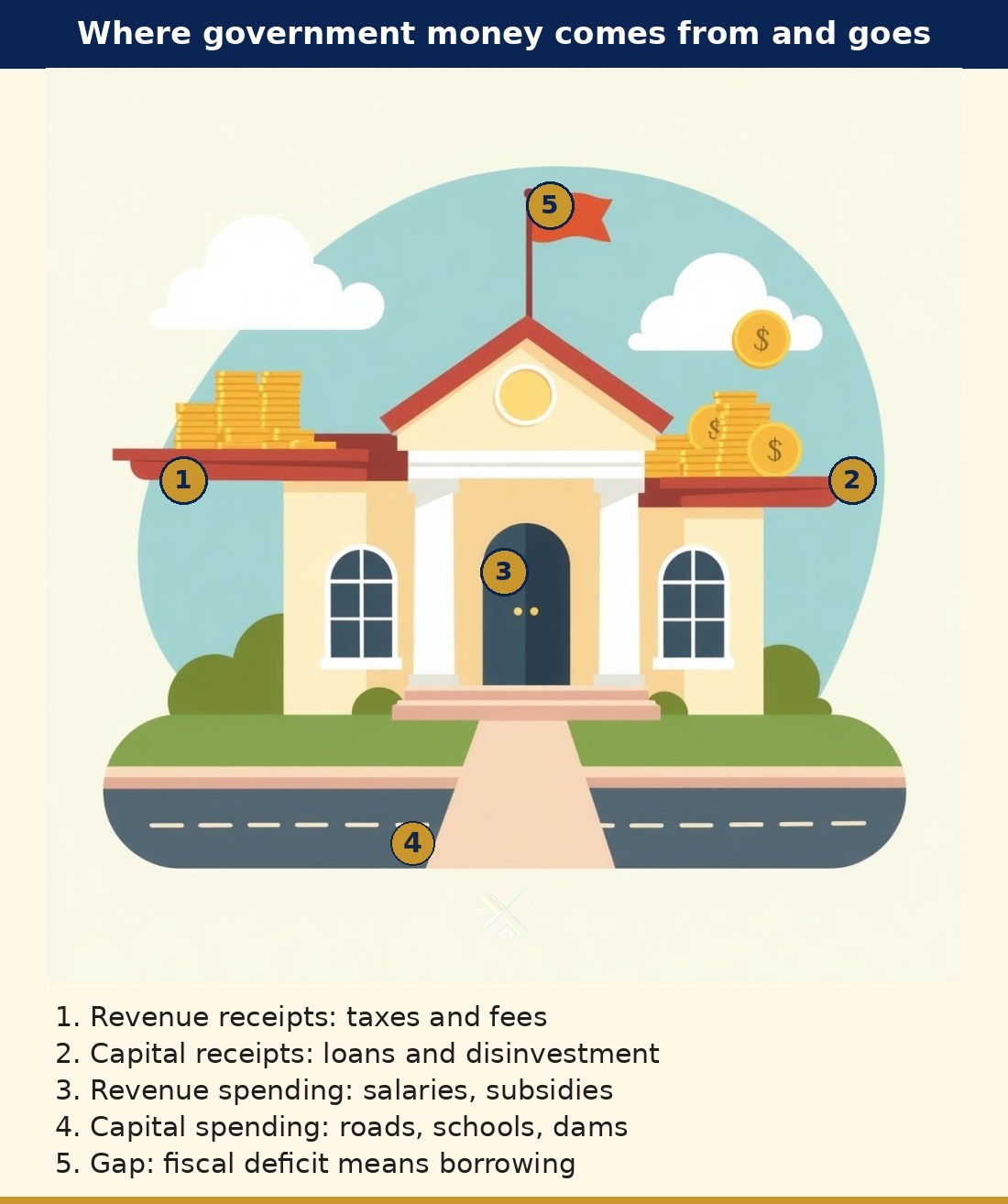
Diagram (labels on the image): Where government money comes from and goes — numbered labels on the image name each part; the list under the image explains them.

1. What a government budget is
A government budget is a statement of the government's expected receipts and expected expenditure for one financial year (1 April to 31 March in India). It is presented in Parliament by the Finance Minister. It is not just an accounts statement — it is the government's main tool of economic policy.
The budget has three objectives: to reallocate resources (providing public goods like roads and defence that markets under-supply), to redistribute income (taxing the rich more and spending on the poor), and to stabilise the economy (raising spending in a slowdown, reducing it when inflation is high).
2. Receipts: revenue and capital
Revenue receipts neither create a liability nor reduce an asset: tax revenue (income tax, GST) and non-tax revenue (fees, fines, profits of public enterprises, interest received). Capital receipts either create a liability or reduce an asset: borrowings, recovery of loans, and disinvestment (sale of government shares in public enterprises).
The test is simple: does the receipt oblige the government to repay, or does it sell off an asset? Borrowing creates a liability, so it is capital. Tax creates no liability, so it is revenue.
3. Expenditure: revenue and capital
Revenue expenditure neither creates an asset nor reduces a liability: salaries, pensions, subsidies, interest payments and defence running costs. Capital expenditure either creates an asset or reduces a liability: building roads, schools and dams, and repaying loans.
A useful check: building a school is capital expenditure (asset created); paying teachers' salaries is revenue expenditure (no asset created). Repaying a loan is capital expenditure (liability reduced); paying interest on it is revenue expenditure.
4. The three deficits
Revenue deficit = revenue expenditure − revenue receipts: the government is borrowing to pay for day-to-day expenses, which is unhealthy if it persists. Fiscal deficit = total expenditure − total receipts excluding borrowings: it shows the government's total borrowing need.
Primary deficit = fiscal deficit − interest payments: it shows current borrowing excluding the burden of past debt. A zero primary deficit means the government borrows only to pay interest on old loans. Persistent fiscal deficits raise public debt and interest burden, but a deficit used for productive investment (roads, schools) can raise future income and repay itself.
Going further — full chapter coverage
Objectives, with one example each. A budget reallocates resources (taxing tobacco heavily discourages it; subsidising merit goods like education encourages them), redistributes income (progressive income tax plus subsidies and welfare for the poor), stabilises the economy (higher spending and lower taxes in a recession; the reverse in a boom), and promotes growth (spending on infrastructure, health and education raises productive capacity). A four-objective answer with one example each is the safest full-marks structure.
The classification test that never fails. A receipt is capital if it creates a liability or reduces an asset: borrowings create a liability; disinvestment reduces an asset (selling government shares). Everything else is revenue: taxes, fees, fines, profits of public enterprises, grants. An expenditure is capital if it creates an asset or reduces a liability: building a dam creates an asset; repaying a loan reduces a liability. Salaries, subsidies, interest payments and pensions are revenue expenditure — they create neither. Apply the test item by item; never memorise lists blindly, because examiners love borderline items like "recovery of loans" (capital receipt — it reduces an asset, the loan).
Three deficits, read carefully. Revenue deficit = revenue expenditure − revenue receipts: borrowing to meet daily expenses. Fiscal deficit = total expenditure − total receipts excluding borrowings: the government's total borrowing need. Primary deficit = fiscal deficit − interest payments: borrowing for current needs other than interest. A zero primary deficit means the government borrows only to pay interest on past debt — new borrowing adds nothing beyond interest. A falling primary deficit is therefore a sign of improving fiscal health even if the fiscal deficit looks large.
Is a fiscal deficit always bad? The honest answer. Borrowing that builds roads, schools and power plants creates assets and future income that help repay the debt — a productive deficit. Borrowing to pay salaries and subsidies creates no asset and piles up interest — a dangerous deficit that can crowd out private investment (government borrowing pushes interest rates up) and, if financed by printing money, cause inflation. The examiner wants this distinction, not a one-sided "deficits are bad".
At a glance — chart / table
At a glance — budget classification test
| Item | Revenue or capital? | Test |
|---|---|---|
| Income tax received | Revenue receipt | No liability created |
| Borrowing from the public | Capital receipt | Liability created |
| Building a highway | Capital expenditure | Asset created |
| Interest payment on loans | Revenue expenditure | No asset, no liability reduction |
| Sale of government shares (disinvestment) | Capital receipt | Asset reduced |
Key Terms / Important Terms
- Government budget — Statement of expected government receipts and expenditure for a financial year.
- Revenue receipts — Receipts that create no liability and reduce no asset, e.g. taxes.
- Capital receipts — Receipts that create a liability or reduce an asset, e.g. borrowings.
- Revenue expenditure — Spending that creates no asset and reduces no liability, e.g. salaries, subsidies.
- Capital expenditure — Spending that creates an asset or reduces a liability, e.g. roads, loan repayment.
- Revenue deficit — Revenue expenditure minus revenue receipts.
- Fiscal deficit — Total expenditure minus total receipts excluding borrowings.
- Primary deficit — Fiscal deficit minus interest payments.
Remember
- Receipts test: liability or asset reduction = capital; otherwise revenue.
- Expenditure test: asset creation or liability reduction = capital; otherwise revenue.
- Fiscal deficit = the government's borrowing requirement.
- Primary deficit = fiscal deficit − interest payments.
Exam Tip / Common Mistake
Common mistake: calling loan repayment a revenue item, or interest payment a capital item. It is the reverse: repaying a loan reduces a liability, so it is capital expenditure; interest is a running cost with no asset or liability effect, so it is revenue expenditure.
Practice set — try it yourself
- Classify: (a) GST collected, (b) loan taken from the public, (c) salaries of government staff, (d) construction of a dam. Hint: Hint: Apply the liability/asset test to each item.
- Total expenditure Rs 900 crore, total receipts excluding borrowings Rs 700 crore, interest payments Rs 100 crore. Find fiscal deficit and primary deficit. Hint: Hint: Fiscal = 900 − 700; primary = fiscal − interest.
- Why is a revenue deficit considered more worrying than a fiscal deficit used for building roads? Hint: Hint: Borrowing for daily expenses leaves no asset; borrowing for roads creates future income.
- State three objectives of a government budget. Hint: Hint: Reallocation of resources, redistribution of income, economic stability.
- Disinvestment receipts rise. Does the fiscal deficit rise or fall? Why? Hint: Hint: Disinvestment is a receipt (excluding borrowings), so higher receipts mean lower borrowing need.
Questions with Answers
- What is a government budget? State its three objectives. Answer: A statement of expected receipts and expenditure for a financial year. Objectives: reallocate resources toward public goods, redistribute income in favour of the poor, and stabilise the economy against slowdowns and inflation.
- Distinguish between revenue receipts and capital receipts with two examples of each. Answer: Revenue receipts create no liability and reduce no asset: taxes, fees. Capital receipts create a liability or reduce an asset: borrowings, disinvestment proceeds.
- Define fiscal deficit and primary deficit. What does a zero primary deficit mean? Answer: Fiscal deficit = total expenditure − total receipts excluding borrowings. Primary deficit = fiscal deficit − interest payments. Zero primary deficit means borrowing only to pay interest on past debt.
- Why is interest payment a revenue expenditure but loan repayment a capital expenditure? Answer: Interest payment creates no asset and reduces no liability, so it is revenue. Loan repayment reduces a liability, so it is capital.
- How can a budget reduce inequality? Answer: By taxing higher incomes at higher rates (progressive taxation) and spending on the poor — subsidies, free schooling, health care and employment programmes — transferring resources from rich to poor.
Extension Questions with Answers
Board-style extension practice, written by Educational Galaxy. These are practice questions, not real past-year questions.
- Classify and justify: (a) disinvestment receipts, (b) interest received on loans given by the government, (c) purchase of shares by the government, (d) grants given to states. Answer: (a) Capital receipt — selling shares reduces a government asset. (b) Revenue receipt — interest is regular income, creates no liability and reduces no asset. (c) Capital expenditure — buying shares creates an asset. (d) Revenue expenditure — grants create no asset for the giving government.
- Fiscal deficit is Rs 800 crore and interest payments are Rs 300 crore. Find primary deficit. What would a primary deficit of zero mean here? Answer: Primary deficit = 800 − 300 = Rs 500 crore. A zero primary deficit would mean the government borrows Rs 300 crore only to pay interest — no fresh borrowing for other spending.
- Revenue deficit is Rs 200 crore while fiscal deficit is Rs 900 crore. What does the gap between them tell you about how the borrowing is used? Answer: The gap (Rs 700 crore) is borrowing used for capital purposes (or to cover the capital account gap). Only Rs 200 crore of borrowing funds daily revenue spending; the rest finances asset creation or loan repayment — a healthier pattern than a revenue deficit equal to the fiscal deficit.
- How can a budget reduce inequality? Name two instruments on the tax side and two on the spending side. Answer: Tax side: progressive income tax (higher rates on higher incomes) and wealth/capital-gains taxes. Spending side: subsidies on food, education and health for the poor, and welfare transfers like pensions and employment schemes.
- A government borrows heavily and interest rates rise, so private firms invest less. Name this effect and explain the chain in two steps. Answer: Crowding out. Step 1: heavy government borrowing raises demand for funds, pushing interest rates up. Step 2: dearer borrowing discourages private investment, so growth slows.
Board Exam Questions — board-pattern practice
These questions are written by Educational Galaxy in board-exam style for practice. They are not claimed to be real past-year questions.
- Revenue expenditure Rs 600 crore, revenue receipts Rs 450 crore, capital expenditure Rs 300 crore, capital receipts excluding borrowings Rs 100 crore. Find revenue deficit and fiscal deficit. Answer: Revenue deficit = 600 − 450 = Rs 150 crore. Fiscal deficit = (600 + 300) − (450 + 100) = 900 − 550 = Rs 350 crore.
- Fiscal deficit is Rs 500 crore and interest payments are Rs 200 crore. Find primary deficit and explain its meaning. Answer: Primary deficit = 500 − 200 = Rs 300 crore. It is the borrowing needed for current-year spending, excluding interest on past debt — a cleaner measure of the current year's fiscal stance.
- Classify and justify: (a) recovery of a loan given to a state, (b) profits of a public enterprise, (c) pension payments, (d) purchase of machinery for a government factory. Answer: (a) Capital receipt — asset (loan) reduced. (b) Revenue receipt — no liability, no asset reduction. (c) Revenue expenditure — no asset created. (d) Capital expenditure — asset created.
- 'A fiscal deficit is always bad for the economy.' Do you agree? Give reasons. Answer: Not always. A deficit that funds productive assets (roads, schools, irrigation) can raise growth and future revenue. It is harmful when it funds wasteful current spending, raises debt and interest burden, and fuels inflation.
- Explain how the government budget can be used to fight a recession. Answer: The government can raise spending and cut taxes, increasing aggregate demand and, through the multiplier, income and employment. The resulting fiscal deficit is acceptable if it restores jobs and growth.
Recap — the chapter in five lines
- Budget objectives: reallocation, redistribution, stability, growth.
- Capital receipt/expenditure = creates liability / reduces asset, or creates asset / reduces liability. All else is revenue.
- Revenue deficit = revenue expenditure − revenue receipts. Fiscal deficit = total expenditure − receipts excluding borrowings.
- Primary deficit = fiscal deficit − interest payments; zero primary means borrowing only to pay interest.
- Productive deficits build assets; unproductive deficits crowd out investment and risk inflation.