

Chapter 4: Laws of Motion
Original notes — ready CBSE (NCERT, English Medium) • Class 11 • Physics • Book: Physics — Part I
Laws of Motion — EG's own summary, in simple words
Book: Physics — Part I (CBSE, Class 11) | Chapter 4 | Medium: English
Why do things move the way they do? Newton's three laws answer that question, and almost all of mechanics rests on them. They connect force, mass and motion, and they explain everything from a cricket ball being caught to a rocket lifting off.
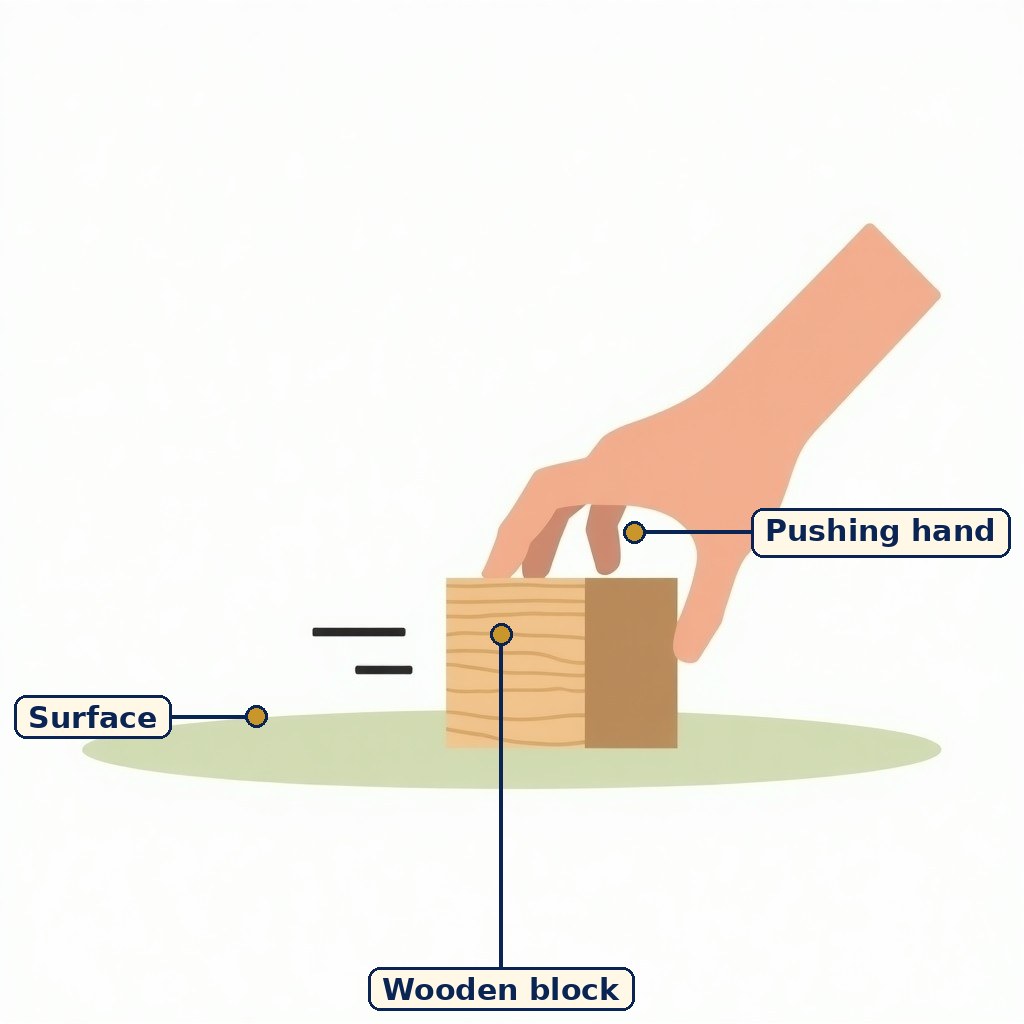
Diagram (labels on the image): Pushing a block: the hand applies the force, the block moves, and friction from the surface opposes the motion. The motion lines mark the direction of movement. Weight acts downwards and the surface's normal reaction upwards on the same block.
1. Newton's first law — inertia
The first law says a body stays at rest or in uniform motion unless a net external force acts on it. This property of resisting change is called inertia. Inertia grows with mass: a loaded truck is harder to start and harder to stop than a bicycle. Everyday examples are everywhere — passengers lurch forward when a bus stops suddenly, and a tablecloth can be pulled out from under dishes because the dishes resist moving. The first law also defines what a force is: whatever changes, or tries to change, a body's state of rest or motion.
2. Newton's second law — F = ma
The second law says the rate of change of momentum of a body is proportional to the applied force, and acts in the direction of the force. In the familiar form, F = ma: net force equals mass times acceleration. Momentum itself is p = mv (mass × velocity), and the law can also be written as F = change in momentum ÷ time. This form explains why catching a fast ball with hands pulled back hurts less — increasing the time of contact reduces the force. It also explains why a small mass gets a large acceleration from the same force.
3. Newton's third law — action and reaction
The third law says every action has an equal and opposite reaction. When you push a wall, the wall pushes you back with equal force. When a rocket throws gas downwards, the gas pushes the rocket upwards. Action and reaction act on different bodies, so they never cancel each other — that is the point students most often get wrong. Walking works because your foot pushes the ground backwards and the ground pushes you forwards.
4. Friction — friend and enemy
Friction opposes relative motion between surfaces in contact. Static friction acts before motion starts and adjusts itself up to a maximum value; kinetic friction acts once sliding begins and is usually slightly smaller. Friction lets us walk, grip and drive, but it also wears machines and wastes energy as heat. Its size depends on how rough the surfaces are and how hard they are pressed together, but not on the area of contact — a surprising result that is worth remembering.
5. Circular motion and banking
A body in circular motion needs a centripetal force towards the centre. On a flat road, friction provides it for a turning car; that is why cars skid on icy roads. Roads are often banked — raised on the outside of the bend — so that part of the normal reaction also points towards the centre, reducing the need for friction. The same idea holds a cyclist leaning into a bend and keeps satellites in orbit, where gravity supplies the centripetal force.
Chart / Table — The three laws — one-line summary
| Law | Says | Key idea |
|---|---|---|
| First | No net force → no change in motion | Inertia |
| Second | F = ma (or F = Δp/Δt) | Force causes acceleration |
| Third | Action = opposite reaction | Forces come in pairs, on different bodies |

Caption: A batsman striking the ball: the bat applies a large force for a short time, changing the ball's momentum — force × time (impulse) equals the change in momentum. The same idea explains why a fielder pulls his hands back while catching.
Practice set — try it yourself
- A 2 kg mass is pushed by a net force of 10 N. What is its acceleration? Hint: Use F = ma and solve for a.
- Why does a fielder pull his hands back while catching a fast ball? Hint: Think about force, time and change in momentum.
- A book rests on a table. Name the action-reaction pair for the book's weight. Hint: Weight acts on the book; the reaction acts on the Earth, not on the table.
- Why is it harder to push a heavy box to start moving than to keep it moving? Hint: Compare static and kinetic friction.
- A car turns on a flat road. What provides the centripetal force, and what happens on an icy road? Hint: Identify the centre-pointing force in each case.
Key Terms / Important Terms
- Inertia — resistance of a body to a change in its state of rest or motion.
- Force — a push or pull that changes, or tries to change, a body's motion.
- Momentum — mass × velocity (p = mv).
- Net force — the total unbalanced force acting on a body.
- Static friction — friction acting before sliding starts; adjusts up to a maximum.
- Kinetic friction — friction acting while surfaces slide over each other.
- Centripetal force — the force towards the centre needed for circular motion.
- Banking — raising the outer edge of a curved road so the normal reaction helps turning.
- Impulse — force × time of contact, equal to change in momentum.
- Free-body diagram — a diagram showing all forces acting on one body.
Remember
- First law = inertia; second law = F = ma; third law = equal, opposite, on different bodies.
- Impulse = change in momentum: longer contact time means smaller force.
- Static friction adjusts itself; kinetic friction is roughly constant and usually smaller.
- Friction depends on roughness and pressing force, not on contact area.
- Circular motion always needs a centre-pointing force — find what supplies it.
Exam Tip / Common Mistake
Common mistake: saying action and reaction cancel each other. They cannot cancel, because they act on different bodies — the rocket's push acts on the gas, the gas's push acts on the rocket. When drawing forces, always ask: on which body does this force act? Only forces on the same body can be added together.
Questions with Answers — full answers
- State Newton's three laws in your own words. Answer: First: a body keeps its state of rest or uniform motion unless a net force acts. Second: net force equals mass times acceleration (F = ma). Third: every action has an equal and opposite reaction on a different body.
- A force of 20 N acts on a 4 kg body for 3 s, starting from rest. Find its final velocity. Answer: a = F/m = 5 m/s². v = u + at = 0 + 5 × 3 = 15 m/s.
- Explain why a gun recoils when a bullet is fired. Answer: The gun pushes the bullet forward (action); the bullet pushes the gun backward with equal force (reaction). Because the gun is heavier, its backward velocity is smaller, but the momentum changes are equal and opposite.
- Why do we slip when we step on a banana peel? Answer: The peel makes the surface very smooth, so friction between foot and ground becomes too small to provide the forward push needed for walking.
- A 5 kg block is pulled on a rough surface by a 30 N force and accelerates at 4 m/s². What is the frictional force? Answer: Net force = ma = 20 N. Applied force minus friction = net force, so friction = 30 − 20 = 10 N.