

Chapter 2: Emerging Trends
Original notes — ready CBSE (NCERT, English Medium) • Class 11 • Computer Science • Book: Informatics Practices
Chapter 2: Emerging Trends — EG's own notes, in simple words
Book: Informatics Practices (CBSE, Class 11) | Chapter 2 | Medium: English
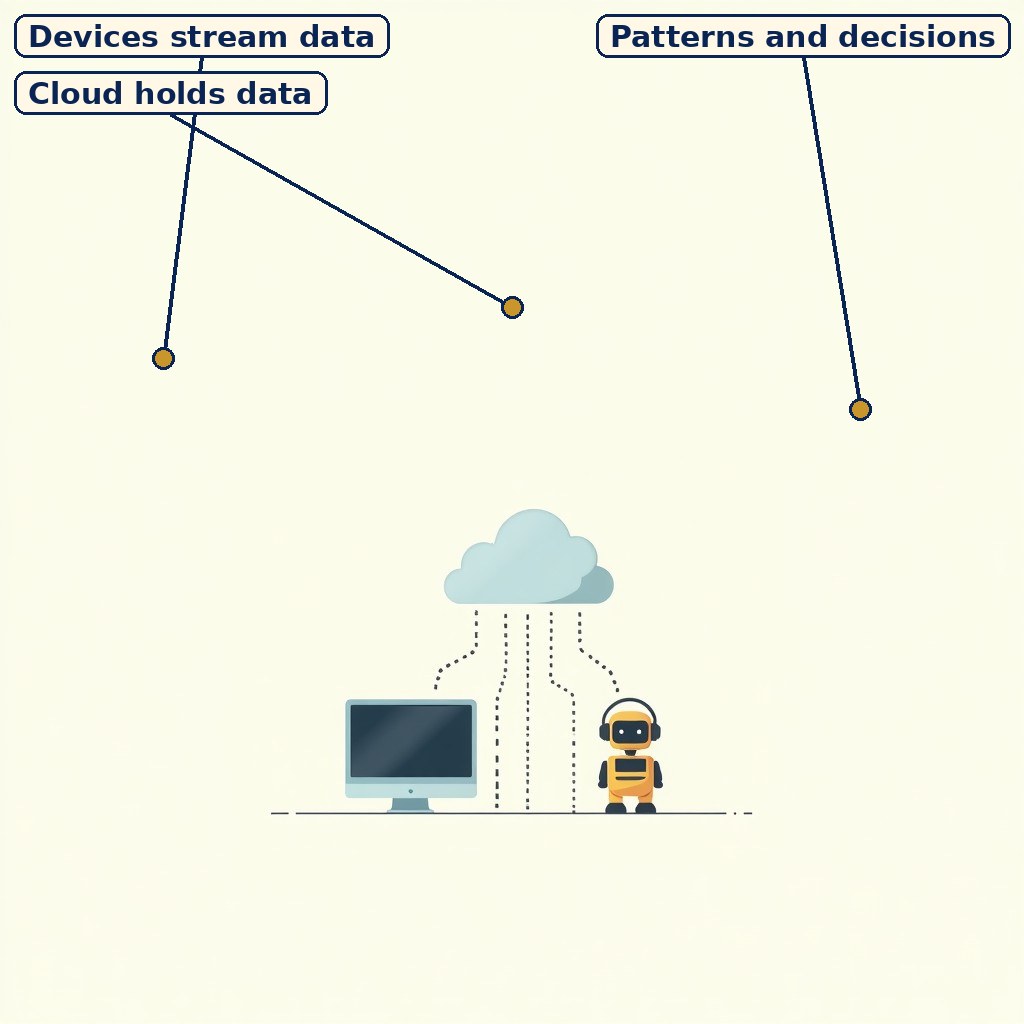
Diagram (labels on the image): Diagram (labels on the image): new trends as data flows — devices stream data, the cloud holds it, and patterns support decisions.

Augmented reality: a digital layer over a real plant, not a replacement of it.
1. 1. Why trends matter to data students
Emerging trends change how data is created, moved and used. For an Informatics Practices student, the key question about each trend is: what new data does it create, who uses that data, and what can go wrong with it? A trend answer without its data angle is incomplete in this subject.
The trends in this chapter are artificial intelligence, the Internet of Things, cloud computing, big data, blockchain, robotics, and immersive technologies such as augmented and virtual reality.
2. 2. AI, IoT and the data they create
Artificial intelligence lets machines do intelligent tasks (recognise speech, predict outcomes), and machine learning lets systems improve from examples. In a school, AI might personalise practice questions; in farming, it might predict crop disease from weather data.
The Internet of Things connects everyday objects — meters, health bands, soil sensors — to the internet. Each device streams data continuously, which is why IoT and big data grow together: more devices mean more data to store and analyse.
3. 3. Cloud, big data and blockchain
Cloud computing delivers storage and software over the internet, so a small school can use the same tools as a large company without buying servers. Big data means datasets too large, fast or varied for ordinary tools; their value lies in patterns, such as spotting a disease outbreak early from many records.
Blockchain is a shared, tamper-resistant chain of records: changing one block requires changing all later blocks. It suits records that many parties must trust, such as certificates or supply chains.
4. 4. Robotics, AR/VR and responsible use
Robotics combines machines, sensors and programs for physical tasks, from warehouse arms to cleaning robots. Augmented reality adds digital information to the real world (directions on a camera view), while virtual reality replaces the world with a simulated one (a virtual science lab).
Responsible use means protecting privacy (whose data is collected?), checking bias (is the AI fair to all groups?), and keeping humans in charge of important decisions.
At a glance — chart / table
| Trend | Data angle | Example |
|---|---|---|
| Artificial intelligence | Learns patterns from data | Personalised practice questions |
| Internet of Things | Devices stream continuous data | Smart electricity meter |
| Cloud computing | Data stored and processed online | School records on the cloud |
| Big data | Huge datasets reveal patterns | Disease outbreak tracking |
| Blockchain | Shared records many parties trust | Certificate verification |
| Augmented reality | Digital layer over the real world | Directions on a camera view |
Key Terms / Important Terms
- Artificial intelligence — Machines performing intelligent tasks.
- Machine learning — AI improving from examples.
- Internet of Things — Everyday objects connected online, sensing and sharing data.
- Cloud computing — Storage and software delivered over the internet.
- Big data — Very large, fast or varied datasets analysed for patterns.
- Blockchain — A shared, tamper-resistant chain of records.
- Augmented reality — Digital information added to a view of the real world.
- Virtual reality — A fully simulated environment replacing the real world.
Remember
- IP trend question: what data, who uses it, what can go wrong?
- IoT creates continuous data streams; big data analyses them.
- Cloud = services over the internet, no local servers needed.
- AR adds to the real world; VR replaces it — do not swap them.
Exam Tip / Common Mistake
Common mistake: swapping augmented reality and virtual reality. AR keeps the real world and adds a digital layer; VR removes the real world and substitutes a simulation.
Practice set — try it yourself
- A soil sensor streams readings every hour. Which two trends does this involve, and why? Hint: Hint: Connected devices plus huge, continuous datasets.
- Distinguish AR from VR with one example each. Hint: Hint: One adds to reality, the other replaces it.
- Why does blockchain suit certificate verification? Hint: Hint: Many parties must trust a record nobody can secretly change.
- Give one data-privacy concern for a school using AI attendance cameras. Hint: Hint: Whose images are collected, stored and for how long?
- A small school uses cloud software instead of buying servers. Name two benefits. Hint: Hint: Cost and maintenance are two.
Questions with Answers
- Why does an Informatics Practices student study emerging trends through data? Answer: Answer: Because every trend creates, moves or analyses data. Understanding the data angle — what data is created, who uses it and what can go wrong — is what makes the trend relevant to informatics.
- Explain IoT and its link with big data. Answer: Answer: IoT connects everyday objects to the internet so they sense and stream data continuously. Those streams quickly become very large and fast-changing, which is exactly the big data that needs special tools to analyse.
- What is cloud computing, and why does it help small schools? Answer: Answer: Cloud computing delivers storage and software over the internet on demand. Small schools benefit because they can use powerful tools without buying, running and maintaining their own servers.
- Distinguish augmented reality from virtual reality. Answer: Answer: Augmented reality adds digital information to a view of the real world, such as directions over a camera image. Virtual reality replaces the real world with a simulated environment, such as a virtual laboratory.
- Name two responsible-use concerns for AI in schools. Answer: Answer: Privacy — students' data must be collected and stored only with proper safeguards; and bias — an AI trained on unfair data can treat some groups unfairly, so its decisions must be checked by humans.