

Chapter 8: Organic Chemistry: Some Basic Principles and Techniques
Original notes — ready CBSE (NCERT, English Medium) • Class 11 • Chemistry • Book: Chemistry — Part II (Part II, Chapter 4)
Chapter 8: Organic Chemistry: Some Basic Principles and Techniques — EG's own summary, in simple words
Book: Chemistry — Chemistry — Part II (CBSE, Class 11) | Chapter 8 | Medium: English
How organic compounds are named, why they react, and how chemists purify and analyse them.
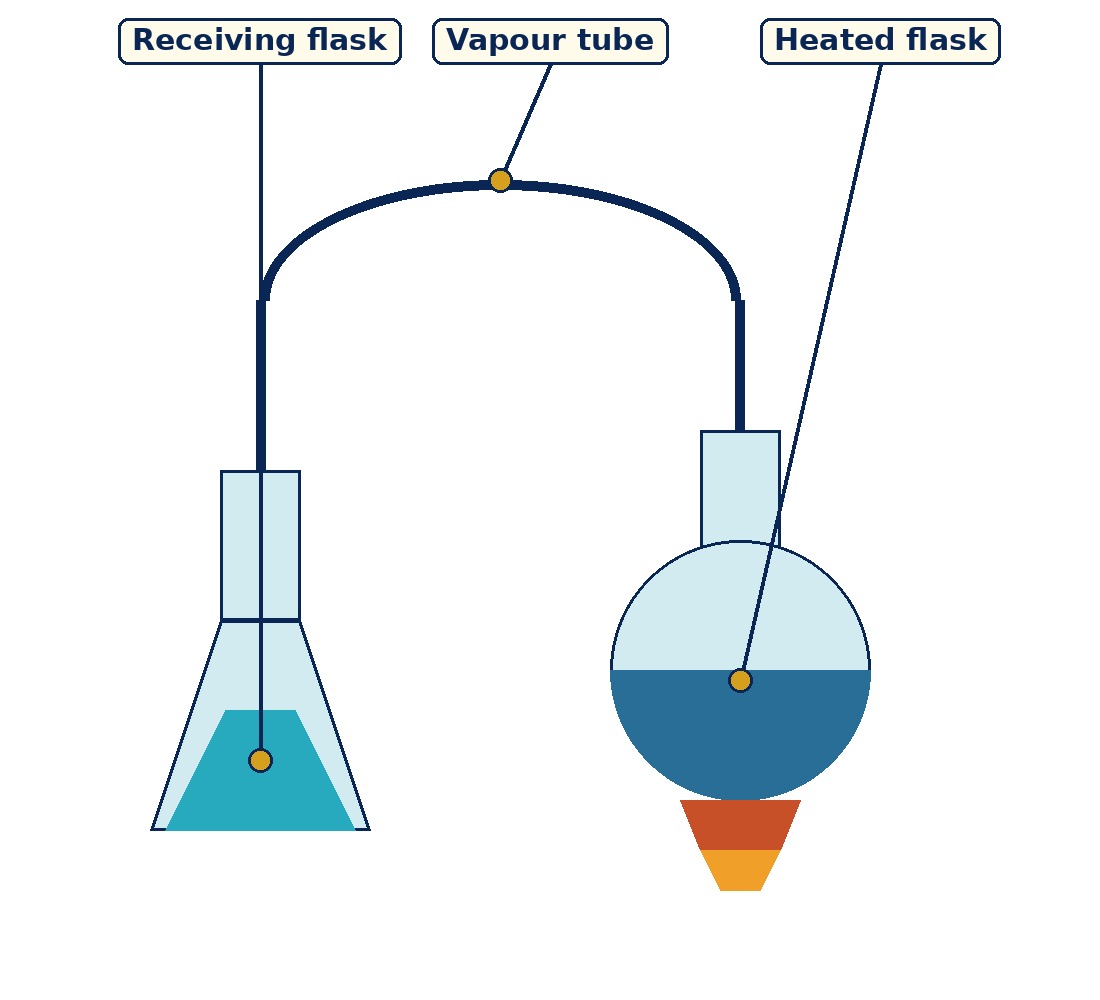
Diagram (labels on the image): Receiving flask, Vapour tube, Heated flask. This is an Educational Galaxy schematic drawn for this chapter; the second image below is a general illustration, not a textbook figure.
What you should learn
- Explain why carbon forms millions of compounds through catenation and multiple bonds.
- Draw organic structures in complete, condensed, bond-line and wedge-dash notations.
- Classify compounds by skeleton and functional group, and name them by IUPAC rules.
- Distinguish structural and stereo isomerism, including cis/trans and optical isomerism.
- Use inductive, resonance, electromeric and hyperconjugation effects to explain reactivity.
- Purify organic compounds and analyse them qualitatively and quantitatively.
Coverage map (NCERT): §8.1 is the introduction section; §8.2–§8.3 are Going further 1; §8.4 is the classification part of the introduction section; §8.5 is the nomenclature section; §8.6 is the isomerism section; §8.7 is the electronic-effects section plus Going further 2; §8.8–§8.10 are the purification and analysis section. Every numbered section of the rationalised chapter is covered, and nothing here comes from outside it.
1. 1. What makes a compound organic?
Organic chemistry is the chemistry of carbon compounds, especially those with carbon–hydrogen bonds. Carbon is special because it forms four strong covalent bonds, bonds to itself in chains and rings (catenation), and forms single, double and triple bonds. That is why millions of organic compounds exist from one element.
Compounds are classified by their carbon skeleton (open chain or cyclic) and by their functional group — the atom or group that decides the compound's characteristic reactions. Alcohols (–OH), aldehydes (–CHO), ketones (C=O), carboxylic acids (–COOH), amines (–NH2) and halides (–X) are the groups to recognise first. A homologous series is a family with the same functional group, where each member differs from the next by –CH2– and shows a regular trend in properties.
2. 2. IUPAC nomenclature — naming by rules, not memory
IUPAC names are built, not memorised. Find the longest chain containing the principal functional group — that gives the root word (meth, eth, prop, but, pent …). Number the chain so the principal group gets the lowest number. Name substituents as prefixes (methyl, ethyl, chloro, bromo) in alphabetical order, ignoring multiplicative prefixes like di- and tri-. Add the suffix for the principal group: –ol for alcohols, –al for aldehydes, –one for ketones, –oic acid for carboxylic acids.
Two common traps: the suffix changes the root's ending (for example, a three-carbon aldehyde is propanal, not propane-al), and the principal functional group outranks double and triple bonds in numbering. Practise by naming from the structure and drawing from the name — both directions appear in exams.

Caption: An originally generated illustration for this chapter — a general scene for the topic, not a photograph of a real experiment or a copy of a textbook figure. The labelled diagram above is the one to study for the named parts.
3. 3. Isomerism: same formula, different compound
Structural isomers have the same molecular formula but different connectivity: chain isomers differ in the carbon skeleton, position isomers in where a group sits, and functional-group isomers in which group is present (an alcohol and an ether can share a formula).
Stereoisomers have the same connectivity but different spatial arrangement: geometrical isomers differ across a double bond (cis/trans), and optical isomers are non-superimposable mirror images, possible when a carbon carries four different groups. Optical activity — rotation of plane-polarised light — is the experimental test.
4. 4. Why organic reactions happen: electronic effects
Reactions happen because electrons move. The inductive effect is the pull of electrons along sigma bonds by an electronegative atom or group; it weakens with distance. The resonance (mesomeric) effect is delocalisation of pi electrons or lone pairs through a conjugated system, which spreads charge and stabilises ions. Hyperconjugation is the delocalisation of sigma electrons of C–H bonds into an adjacent empty or partially filled p orbital — it is why more substituted carbocations are more stable.
Attacking reagents are of two kinds. Electrophiles are electron-loving (electron-deficient, like H+ or Br+); nucleophiles are nucleus-loving (electron-rich, like OH− or CN−). Bonds break in two ways: homolytic fission gives free radicals (one electron each), favoured by light or heat; heterolytic fission gives ions, favoured by polar conditions. Carbocations are planar and stabilised by electron-donating groups; carbanions carry a negative charge and a lone pair; free radicals have one unpaired electron.
5. 5. Purification and analysis — finding what is in the compound
Purification depends on the property that differs: filtration for insoluble impurities, crystallisation for soluble solids, distillation for liquids (simple for large boiling-point differences, fractional for close ones, steam distillation for substances that decompose on heating or are steam-volatile), and chromatography for small amounts and close mixtures.
Qualitative analysis finds which elements are present. In Lassaigne's test, the compound is fused with sodium so elements become sodium salts: nitrogen gives cyanide, sulphur gives sulphide, halogens give halides. Prussian blue confirms nitrogen; a black precipitate with lead acetate confirms sulphur; a silver halide precipitate confirms halogens.
Quantitative analysis measures how much: carbon and hydrogen by Liebig's combustion method (CO2 and H2O weighed), nitrogen by Kjeldahl's method (converted to ammonia, then titrated) or Duma's method (nitrogen gas measured), halogens by Carius's method (silver halide weighed), and sulphur and phosphorus similarly as barium sulphate and ammonium phosphomolybdate. Kjeldahl's method fails for compounds where nitrogen is in a ring or in nitro/azo groups, because that nitrogen is not converted to ammonia.
Functional groups — the ones to recognise instantly
| Functional group | Suffix / prefix | Example family |
|---|---|---|
| –OH | –ol | Alcohols |
| –CHO | –al | Aldehydes |
| C=O | –one | Ketones |
| –COOH | –oic acid | Carboxylic acids |
| –NH2 | –amine | Amines |
| –X (F, Cl, Br, I) | halo– | Haloalkanes |
Going further 1 — Drawing organic molecules: four notations and shapes (NCERT §8.2–§8.3)
The same molecule can be written four ways, and exams use all four. The complete structural formula shows every atom and bond; the condensed formula groups atoms, as CH3CH2OH; the bond-line formula draws only lines, with a carbon at every vertex and line-end and hydrogens on carbon omitted; the three-dimensional wedge-dash formula shows depth, with a solid wedge coming out of the page and a dashed bond going behind it. Reading a bond-line formula means counting hydrogens from carbon's valency of four — a vertex with one line drawn carries three hydrogens.
Shapes follow hybridisation: tetrahedral carbon (sp3) has angles near 109.5°, as in methane; trigonal planar carbon (sp2) has 120°, as in ethene; linear carbon (sp) has 180°, as in ethyne. A double bond holds two carbons and their four groups in one plane, which is why geometrical isomerism exists for alkenes but not for single bonds, where free rotation averages the positions out.
Exam note: in a bond-line formula, never draw hydrogens on carbon — and never forget to count them when you need a molecular formula.
Going further 2 — The electromeric effect and the four reaction patterns (NCERT §8.7)
The electromeric effect is the temporary shift of π electrons that happens only when a reagent attacks. Under attack, the π pair of a double bond moves completely to one atom — to the more electronegative atom if the attacker is an electrophile — creating a positive centre where the electrophile then bonds. Unlike the permanent inductive and resonance effects, the electromeric effect vanishes when the reagent leaves, which is why it is called a temporary effect.
With the effects understood, organic reactions fall into four patterns. Substitution replaces one group with another, as chlorine replaces hydrogen in methane. Addition adds across a multiple bond, as bromine adds to ethene. Elimination removes a small molecule and creates a multiple bond, as ethanol loses water to give ethene. Rearrangement moves an atom or group within the molecule, usually through a carbocation shifting to a more stable form. Naming the pattern is often the first mark in a mechanism question.
Exam note: electromeric effect needs a π bond and an attacking reagent — with no reagent present, there is nothing to shift.
Practice set — try it yourself
- Name the compound CH3–CH2–CH(OH)–CH3 by IUPAC rules, explaining each step of your naming.
- Explain the difference between the inductive effect and the resonance effect, giving one example of each.
- Why is a tertiary carbocation more stable than a primary carbocation? Use hyperconjugation in your answer.
- A compound gives a Prussian blue colour in Lassaigne's test. What element does this confirm, and what sodium salt formed during fusion?
- Why does Kjeldahl's method fail for a compound containing nitrogen in a nitro group?
Key Terms / Important Terms
- Catenation — Carbon's ability to bond to itself in chains and rings.
- Functional group — The atom or group that gives a compound its characteristic reactions.
- Homologous series — A family with the same functional group, members differing by –CH2–.
- IUPAC name — A systematic name built from chain length, substituents and functional group.
- Isomer — A compound with the same molecular formula but a different structure or arrangement.
- Inductive effect — Electron pull along sigma bonds by an electronegative group.
- Resonance effect — Delocalisation of pi electrons or lone pairs through a conjugated system.
- Electrophile — An electron-deficient species that accepts an electron pair.
- Nucleophile — An electron-rich species that donates an electron pair.
- Carbocation — A positively charged carbon with only six valence electrons.
- Electromeric effect — The temporary shift of π electrons to one atom under attack by a reagent.
- Bond-line formula — A structure drawn as lines only, with carbons at vertices and line-ends.
- Wedge-dash representation — A 3D drawing with solid wedges out of the page and dashed bonds behind it.
Remember
- Number the chain to give the principal functional group the lowest number — not the first substituent.
- Substituent prefixes are listed alphabetically, ignoring di-, tri- and tetra-.
- Electrophiles accept electrons; nucleophiles donate them. The names describe what they love, not what they are.
- Kjeldahl's method does not work for nitrogen in rings or in nitro and azo groups.
- Homologous series members differ by –CH2– and show a gradual trend in physical properties.
- In bond-line formulas, every vertex and line-end is a carbon; hydrogens on carbon are not drawn — count them from valency 4.
Exam Tip / Common Mistake
The numbering trap is the most common: students number from the end nearest a substituent when the principal functional group is at the other end. The functional group always wins the lowest number; double and triple bonds come next; substituents come last. If two numberings tie on the functional group, choose the one giving substituents the lowest set of numbers.
Questions with Answers — full answers
- What is a functional group? Give two examples with their suffixes. Answer: A functional group is the atom or group of atoms in a molecule that determines its characteristic chemical reactions. Examples: the hydroxyl group –OH, suffix –ol (alcohols); the aldehyde group –CHO, suffix –al (aldehydes).
- Distinguish structural isomers from stereoisomers. Answer: Structural isomers have the same molecular formula but different connectivity of atoms — different skeletons, positions or functional groups. Stereoisomers have the same connectivity but differ in the spatial arrangement of atoms, as in cis/trans or optical isomerism.
- Define electrophile and nucleophile, with one example of each. Answer: An electrophile is an electron-deficient species that accepts an electron pair, for example H+ or the bromonium ion Br+. A nucleophile is an electron-rich species that donates an electron pair, for example the hydroxide ion OH− or cyanide CN−.
- Why is carbon able to form millions of compounds? Answer: Carbon forms four strong covalent bonds, bonds readily to itself in long chains, branches and rings (catenation), and forms single, double and triple bonds with itself and other elements. These three properties together generate an enormous variety of structures.
- How is nitrogen detected in an organic compound? Answer: By Lassaigne's test: the compound is fused with sodium metal, converting nitrogen to sodium cyanide. Adding iron(II) sulphate and iron(III) chloride and acidifying gives Prussian blue (ferric ferrocyanide), which confirms nitrogen.
Extension Questions with Answers — going further
- Describe the bond-line formula of 2-methylpropane. Answer: A central vertex with three lines radiating from it: one line-end is one methyl group, and the other two lines end in methyl groups. Four carbons in total, none drawn as letters, with nine hydrogens understood — three on each outer carbon and one on the central carbon.
- Name CH3CH2CH(CH3)CH2CH3 by IUPAC rules. Answer: The longest chain containing no functional group is five carbons, pentane, with a methyl substituent on carbon 3: 3-methylpentane. Numbering from either end gives 3, so there is no tie to break.
- Why is (CH3)3C+ more stable than CH3+? Answer: The tertiary carbocation has nine α-hydrogens whose C–H sigma bonds hyperconjugate into the empty p orbital, spreading the positive charge. CH3+ has no α-hydrogen and no alkyl donation at all, so it is far less stable.
- A compound gives a white precipitate with silver nitrate in Lassaigne's test, soluble in ammonium hydroxide. Which halogen does this confirm? Answer: Chlorine. Silver chloride is white and dissolves in ammonium hydroxide; silver bromide is pale yellow and only partly soluble, and silver iodide is yellow and insoluble.
- Why does Kjeldahl's method fail for pyridine? Answer: Kjeldahl's method converts nitrogen to ammonia by digestion, but nitrogen in a ring — like pyridine — is not converted to ammonia under those conditions. The method also fails for nitro and azo groups for the same reason.
Board-pattern Questions with Answers
- Name CH3–CH=CH–CH3 by IUPAC rules. Answer: Four carbons with a double bond starting at carbon 2: but-2-ene. Numbering from either end gives 2, and the suffix -ene marks the double bond.
- Why can but-2-ene show cis/trans isomerism but but-1-ene cannot? Answer: Geometrical isomerism needs two different groups on each carbon of the double bond. In but-2-ene each double-bond carbon carries a methyl and a hydrogen, so cis and trans forms exist. In but-1-ene one carbon carries two hydrogens, so swapping gives the same molecule.
- What is the next member of the homologous series after C3H7OH? Answer: C4H9OH, butan-1-ol (or a butanol isomer). Members of a homologous series differ by –CH2–, with the same functional group and a regular trend in properties.
- Classify BF3, NH3, CN− and AlCl3 as electrophiles or nucleophiles. Answer: Electrophiles (electron-pair acceptors): BF3 and AlCl3, both with incomplete octets. Nucleophiles (electron-pair donors): NH3 and CN−, both with a lone pair to donate.
- In nitrogen estimation, which method measures nitrogen gas directly, Duma's or Kjeldahl's? Answer: Duma's method: the compound is heated with copper oxide, nitrogen oxides are reduced to nitrogen gas over copper, and the gas volume is measured. Kjeldahl's method measures ammonia after digestion and titration.
Recap — the chapter in five lines
- Carbon's catenation and multiple bonds make millions of compounds.
- Four notations describe one molecule; bond-line hides hydrogens but not carbons.
- IUPAC names are built from chain, substituents and suffix — not memorised.
- Electronic effects explain why reactions happen where they do.
- Purification separates by a differing property; analysis finds elements and amounts.