

Chapter 4: Chemical Bonding and Molecular Structure
Original notes — ready CBSE (NCERT, English Medium) • Class 11 • Chemistry • Book: Chemistry — Part I (Part -I, Chapter 4)
Chapter 4: Chemical Bonding and Molecular Structure — EG's own summary, in simple words
Book: Chemistry — Chemistry — Part I (CBSE, Class 11) | Chapter 4 | Medium: English
Why atoms join, what shapes molecules take, and why some bonds are stronger than others.
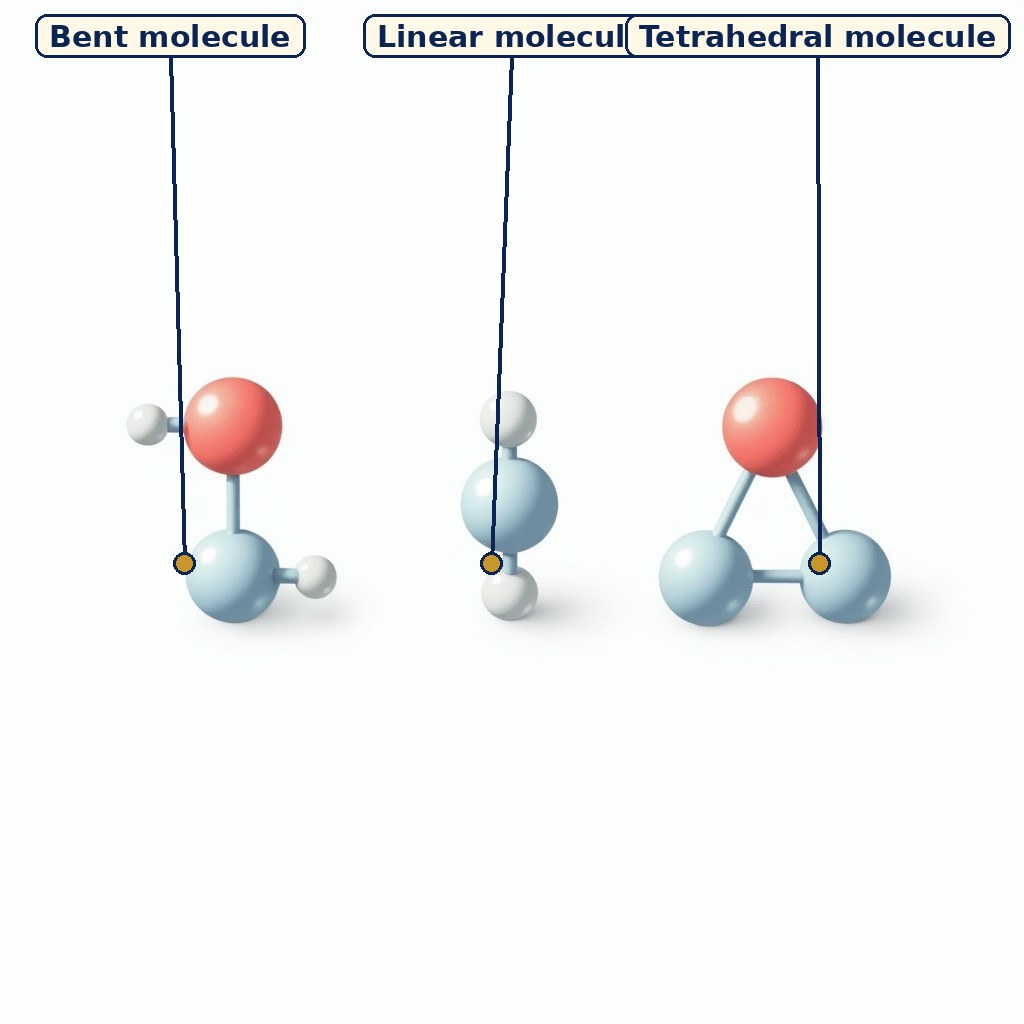
Diagram (labels on the image): Bent molecule, Linear molecule, Tetrahedral molecule. Labels were added by Educational Galaxy on an originally generated illustration; see the caption below the second image for an honest note on what the picture shows.
What you should learn
- Draw Lewis structures and use formal charge to pick the best one.
- Explain ionic bonding with lattice energy, and use Fajans' ideas for covalent character.
- Use bond parameters — length, angle, enthalpy and order — to compare bonds.
- Predict molecular shapes with VSEPR, giving geometry and shape separately when lone pairs exist.
- Apply valence bond theory, hybridisation and molecular orbital theory to real molecules.
- Explain hydrogen bonding through boiling points, ice floating and solubility.
Coverage map (NCERT): §4.1 is the octet/Lewis section; §4.2 is the ionic section; §4.3 is Going further 1; §4.4 is the VSEPR section; §4.5–§4.6 are the valence-bond/hybridisation section; §4.7–§4.8 are Going further 2; §4.9 is the hydrogen-bonding section. Every numbered section of the rationalised chapter is covered, and nothing here comes from outside it.
1. 1. Why atoms bond at all
Atoms bond to reach a lower energy and a more stable electron arrangement — usually an octet, eight electrons in the outer shell, like a noble gas. This is the octet rule. It explains a great deal, but it has limits: hydrogen is stable with two electrons, and elements like phosphorus and sulphur can expand beyond eight because they have d orbitals.
Kossel and Lewis gave the first clear picture. In the ionic model, an electropositive atom transfers electrons to an electronegative one, and the ions attract. In the Lewis model, atoms share electron pairs, drawn as dots and crosses around the symbols. A single bond is one shared pair, a double bond two, a triple bond three.
2. 2. Ionic bonding and its properties
Ionic compounds form between metals and non-metals: sodium gives its electron to chlorine, giving Na+ and Cl−, held by strong electrostatic attraction. The energy balance matters: ionisation energy is spent, electron gain releases energy, and lattice energy — released when ions pack into a crystal — usually decides whether the compound is stable.
Because of their strong lattice, ionic compounds have high melting points, conduct electricity only when molten or dissolved (when ions are free to move), and are usually soluble in water but not in organic solvents. Fajans' rules explain the exceptions: a small, highly charged cation polarises a large anion, pulling the bond towards covalent character — that is why aluminium chloride behaves more covalently than sodium chloride.

Caption: An originally generated illustration for this chapter — a general scene for the topic, not a photograph of a real experiment or a copy of a textbook figure. The labelled diagram above is the one to study for the named parts.
3. 3. Covalent bonding: polarity, dipole moment, formal charge
In a covalent bond, electrons are shared. If the two atoms are identical, sharing is equal and the bond is non-polar. If they differ in electronegativity, the shared pair shifts towards the more electronegative atom and the bond is polar, with partial charges δ+ and δ−. The dipole moment (charge × distance) measures this polarity and is a vector — in a symmetrical molecule like carbon dioxide, the two bond dipoles cancel and the molecule is non-polar overall.
Formal charge is a bookkeeping tool for Lewis structures: formal charge = valence electrons − (non-bonding electrons + half the bonding electrons). The best Lewis structure is the one with formal charges closest to zero, with any negative charge on the most electronegative atom. Resonance happens when one Lewis structure is not enough: ozone and the carbonate ion are drawn as several structures, and the real molecule is a hybrid of them all, with bonds of equal length.
4. 4. VSEPR theory — predicting shapes
VSEPR theory says electron pairs around a central atom repel each other and arrange themselves as far apart as possible. Lone pairs repel more strongly than bond pairs, so they squash the angles: the order of repulsion is lone pair–lone pair > lone pair–bond pair > bond pair–bond pair.
The shapes to know: 2 pairs linear (180°), 3 pairs trigonal planar (120°), 4 pairs tetrahedral (109.5°). With lone pairs the geometry stays but the shape changes: water has 4 pairs (2 bond + 2 lone) so it is bent, with an angle of about 104.5°; ammonia has 3 bond + 1 lone pair so it is pyramidal, about 107°. Always state both the electron-pair geometry and the molecular shape when lone pairs are present.
5. 5. Valence bond theory, hybridisation and molecular orbitals
Valence bond theory says a covalent bond forms when atomic orbitals overlap. Sigma (σ) bonds form by head-on overlap and are strong; pi (π) bonds form by sideways overlap of p orbitals and are weaker. A double bond is one σ plus one π; a triple bond is one σ plus two π.
Hybridisation is the mixing of atomic orbitals to explain observed shapes: sp gives linear (as in BeCl2 and acetylene), sp2 gives trigonal planar (as in BF3 and ethene), sp3 gives tetrahedral (as in methane and ammonia). Count sigma bonds plus lone pairs around the central atom to find the hybridisation: 2 → sp, 3 → sp2, 4 → sp3.
Molecular orbital theory goes further: atomic orbitals combine into bonding and antibonding molecular orbitals spread over the whole molecule. Bond order = (bonding electrons − antibonding electrons) ÷ 2. It explains why oxygen is paramagnetic — it has two unpaired electrons in antibonding π orbitals — something the simple Lewis picture cannot do.
6. 6. Hydrogen bonding and intermolecular forces
A hydrogen bond is a strong attraction between a hydrogen atom already bonded to fluorine, oxygen or nitrogen and a lone pair on another fluorine, oxygen or nitrogen atom. It is much weaker than a covalent bond but far stronger than ordinary attractions between molecules.
Hydrogen bonding explains why water has an unusually high boiling point, why ice floats (its hydrogen-bonded structure holds molecules apart, so ice is less dense than water), and why alcohols and sugars dissolve in water. Weaker van der Waals forces and dipole attractions hold other molecular substances together and explain trends in boiling points among similar molecules.
Shapes from VSEPR — the ones to memorise
| Electron pairs (bond + lone) | Example | Shape | Bond angle |
|---|---|---|---|
| 2 + 0 | BeCl2 | Linear | 180° |
| 3 + 0 | BF3 | Trigonal planar | 120° |
| 4 + 0 | CH4 | Tetrahedral | 109.5° |
| 3 + 1 | NH3 | Pyramidal | 107° |
| 2 + 2 | H2O | Bent (angular) | 104.5° |
Going further 1 — Bond parameters: the numbers that describe a bond (NCERT §4.3)
Four numbers describe any covalent bond. Bond length is the equilibrium distance between the two nuclei, measured in picometres. Bond angle is the angle between two bonds at one atom — 180° in BeCl2, 120° in BF3, 109.5° in CH4. Bond enthalpy is the energy needed to break one mole of that bond in the gaseous state; the H–H bond, for example, needs 435.8 kJ/mol. Bond order is the number of shared pairs: 1 for single, 2 for double, 3 for triple.
The four are linked: as bond order rises, bond length falls and bond enthalpy rises — a triple bond is shorter and stronger than a double bond, which is shorter and stronger than a single bond between the same atoms. Resonance averages them: in ozone and carbonate, all the bonds of one kind are equal in length, between single and double values, because the real structure is a hybrid. When a question gives bond enthalpies, the reaction enthalpy is (energy to break reactant bonds) minus (energy released making product bonds).
Exam note: bond enthalpy is defined for gaseous molecules; do not apply it to ionic lattices or to bonds in solids.
Going further 2 — Molecular orbitals of H2, N2, O2 and F2 (NCERT §4.7–§4.8)
Molecular orbital theory fills orbitals that belong to the whole molecule: bonding orbitals below, antibonding above, each holding two electrons. Bond order is (bonding electrons − antibonding electrons) ÷ 2, and it decides whether a species exists and how strong it is. Hydrogen fills σ1s^2, so H2 has bond order 1; helium would fill σ1s^2 σ*1s^2, bond order 0 — which is why He2 does not exist.
For nitrogen, the valence filling is σ2s^2 σ*2s^2 π2p^4 σ2p^2: bonding 8, antibonding 2, bond order 3, diamagnetic. Oxygen fills σ2s^2 σ*2s^2 σ2p^2 π2p^4 π*2p^2: bonding 8, antibonding 4, bond order 2, with two unpaired electrons in the π* orbitals — the paramagnetism Lewis theory cannot explain. Fluorine adds two more π* electrons, giving bond order 1 and a diamagnetic molecule. Note the ordering swap: up to nitrogen the π2p orbitals lie below σ2p, but from oxygen onwards σ2p is below π2p.
Exam note: removing an electron from an antibonding orbital raises the bond order — so O2+ (bond order 2.5) is stronger than O2, while O2− (bond order 1.5) is weaker.
Practice set — try it yourself
- Sodium chloride has a high melting point but does not conduct electricity as a solid. Explain both facts.
- Use VSEPR theory to predict and explain the shapes of ammonia and water, including their bond angles.
- Carbon dioxide has polar bonds but is a non-polar molecule. Explain, using the idea of dipole cancellation.
- Why is oxygen paramagnetic, and why can the Lewis structure not explain this? Use molecular orbital ideas in your answer.
- Why does ice float on water? Explain using hydrogen bonding and density.
Key Terms / Important Terms
- Octet rule — Atoms tend to gain, lose or share electrons to reach eight outer electrons.
- Ionic bond — Bond formed by transfer of electrons and attraction between opposite ions.
- Covalent bond — Bond formed by sharing electron pairs between atoms.
- Lattice energy — Energy released when one mole of an ionic solid forms from gaseous ions.
- Dipole moment — Product of charge and distance between charges; measures bond polarity.
- Formal charge — Charge an atom would have if bonding electrons were shared equally.
- Resonance — Description of a molecule by two or more Lewis structures; the real structure is a hybrid.
- VSEPR theory — Electron pairs repel and arrange as far apart as possible, fixing molecular shape.
- Hybridisation — Mixing of atomic orbitals to form new orbitals of equal energy.
- Hydrogen bond — Attraction between H bonded to F, O or N and a lone pair on F, O or N.
- Bond order — Half the difference between bonding and antibonding electrons; higher means shorter and stronger.
- Bond enthalpy — Energy needed to break one mole of a particular bond in gaseous molecules.
- Antibonding orbital — A molecular orbital higher in energy than the atomic orbitals, which weakens the bond when filled.
Remember
- CO2 is non-polar even though each C=O bond is polar — the two dipoles cancel because the molecule is linear and symmetrical.
- Lone pairs compress bond angles: water (104.5°) and ammonia (107°) are both below the tetrahedral 109.5°.
- Hybridisation count = sigma bonds + lone pairs on the central atom; pi bonds are not counted.
- Bond order from molecular orbital theory decides stability: zero or negative bond order means the species does not exist.
- Hydrogen bonds need H attached to F, O or N — hydrogen attached to carbon does not form them.
- Bond order 0 means the species does not exist (He2); fractional bond orders (O2− = 1.5) are real and stable.
Exam Tip / Common Mistake
Two mistakes dominate this chapter. First, giving only the electron-pair geometry when the question asks for the molecular shape: ammonia's pairs are tetrahedral, but its shape is pyramidal. Second, calling CO2 polar because its bonds are polar: bond polarity and molecular polarity are different, and symmetry can cancel dipoles completely. Always check symmetry before declaring a molecule polar.
Questions with Answers — full answers
- What is an ionic bond, and why do ionic compounds conduct electricity only when molten or dissolved? Answer: An ionic bond is the electrostatic attraction between oppositely charged ions formed by electron transfer. In the solid, ions are locked in a lattice and cannot move, so there is no conduction. When molten or dissolved, the ions are free to move and carry charge.
- Define dipole moment. Why is BF3 non-polar although its bonds are polar? Answer: Dipole moment is the product of the magnitude of charge and the distance between the charges. BF3 has three polar B–F bonds arranged symmetrically in a trigonal plane at 120°, so the three bond dipoles cancel exactly and the net dipole moment is zero.
- What is resonance? Give one example and state what it means for bond lengths. Answer: Resonance is the description of a molecule by two or more Lewis structures when no single structure is adequate. In the carbonate ion, all three C–O bonds are identical in reality, with a length between a single and a double bond, because the true structure is a hybrid of the three forms.
- Predict the hybridisation and shape of methane and ethene. Answer: Methane: carbon has four sigma bonds and no lone pairs, so it is sp3 hybridised and tetrahedral. Ethene: each carbon has three sigma bonds and no lone pairs, so it is sp2 hybridised and trigonal planar around each carbon, with a pi bond between them.
- Why does water have a much higher boiling point than hydrogen sulphide? Answer: Water molecules form strong hydrogen bonds between the hydrogen of one molecule and the oxygen lone pairs of another. Hydrogen sulphide cannot form hydrogen bonds (sulphur is not electronegative enough and is too large), so its molecules are held only by weak forces and much less heat is needed to separate them.
Extension Questions with Answers — going further
- Find the bond orders of N2 and O2 from their molecular orbital fillings. Answer: N2: bonding electrons 8 (σ2s^2, π2p^4, σ2p^2), antibonding 2 (σ*2s^2): bond order = (8 − 2) ÷ 2 = 3. O2: bonding 8 (σ2s^2, σ2p^2, π2p^4), antibonding 4 (σ*2s^2, π*2p^2): bond order = (8 − 4) ÷ 2 = 2.
- Why is He2 not found, even though helium atoms exist? Answer: Two helium atoms bring 4 electrons: σ1s^2 and σ*1s^2. Bond order = (2 − 2) ÷ 2 = 0. Bonding and antibonding cancel exactly, so there is no net bond and no He2 molecule.
- Predict the shape of SF4 using VSEPR theory. Answer: Sulphur has 4 bond pairs and 1 lone pair: 5 electron pairs in a trigonal bipyramidal arrangement. The lone pair takes an equatorial position to minimise repulsion, leaving a see-saw shape.
- Why is the bond angle in NH3 (107°) smaller than in CH4 (109.5°)? Answer: Both have 4 electron pairs, but ammonia's lone pair repels more strongly than a bond pair (lone pair–bond pair > bond pair–bond pair). The lone pair squeezes the three N–H bonds closer together.
- Why is the dipole moment of NF3 (0.23 D) much smaller than that of NH3 (1.47 D)? Answer: In NH3 the N–H bond dipoles and the lone-pair contribution point the same way and add up. In NF3 the N–F dipoles point opposite to the lone-pair contribution, because fluorine pulls electrons away from nitrogen, so they partly cancel.
Board-pattern Questions with Answers
- Calculate the formal charges in ozone, O3, for the central and terminal oxygen atoms. Answer: In one resonance form, the central oxygen has 6 valence electrons, 1 lone pair and 3 bonds: formal charge = 6 − (2 + 3) = +1. The singly-bonded terminal oxygen has 3 lone pairs and 1 bond: 6 − (6 + 1) = −1. The doubly-bonded terminal oxygen is 0. The second resonance form swaps the two terminal atoms.
- Why is BeCl2 linear while H2O is bent, although both have a central atom with two bonds? Answer: BeCl2 has only 2 electron pairs and no lone pairs, so they sit 180° apart: linear. H2O has 4 electron pairs, 2 of them lone pairs, arranged tetrahedrally; the molecular shape from the atoms alone is bent, about 104.5°.
- Why is the lattice enthalpy of MgO far larger than that of NaCl? Answer: Lattice enthalpy grows with ionic charge and falls with ionic size. Mg2+ and O2− carry double charges, while Na+ and Cl− carry single charges, and the magnesium and oxide ions are smaller — so MgO's lattice releases far more energy.
- Give the hybridisation and shape of PCl5 and SF6. Answer: PCl5: phosphorus has 5 sigma bonds and no lone pairs, so sp3d hybridisation and trigonal bipyramidal shape. SF6: sulphur has 6 sigma bonds and no lone pairs, so sp3d2 hybridisation and octahedral shape.
- Arrange C–C, C=C and C≡C in order of increasing bond length, with a reason. Answer: C≡C < C=C < C–C. Higher bond order pulls the nuclei closer: more shared pairs mean stronger attraction between the nuclei and the bonding electrons.
Recap — the chapter in five lines
- Lewis structures and formal charge choose the best picture of a molecule.
- Bond parameters link length, angle, enthalpy and order in one pattern.
- VSEPR predicts shape from electron pairs; lone pairs change shape, not geometry.
- Hybridisation explains shapes; molecular orbitals explain bond order and magnetism.
- Hydrogen bonding explains water's strange properties.