

Chapter 1: Some Basic Concepts of Chemistry
Original notes — ready CBSE (NCERT, English Medium) • Class 11 • Chemistry • Book: Chemistry — Part I (Part -I, Chapter 1)
Chapter 1: Some Basic Concepts of Chemistry — EG's own summary, in simple words
Book: Chemistry — Chemistry — Part I (CBSE, Class 11) | Chapter 1 | Medium: English
Matter, laws of combination, the mole and stoichiometry — the counting system of chemistry.
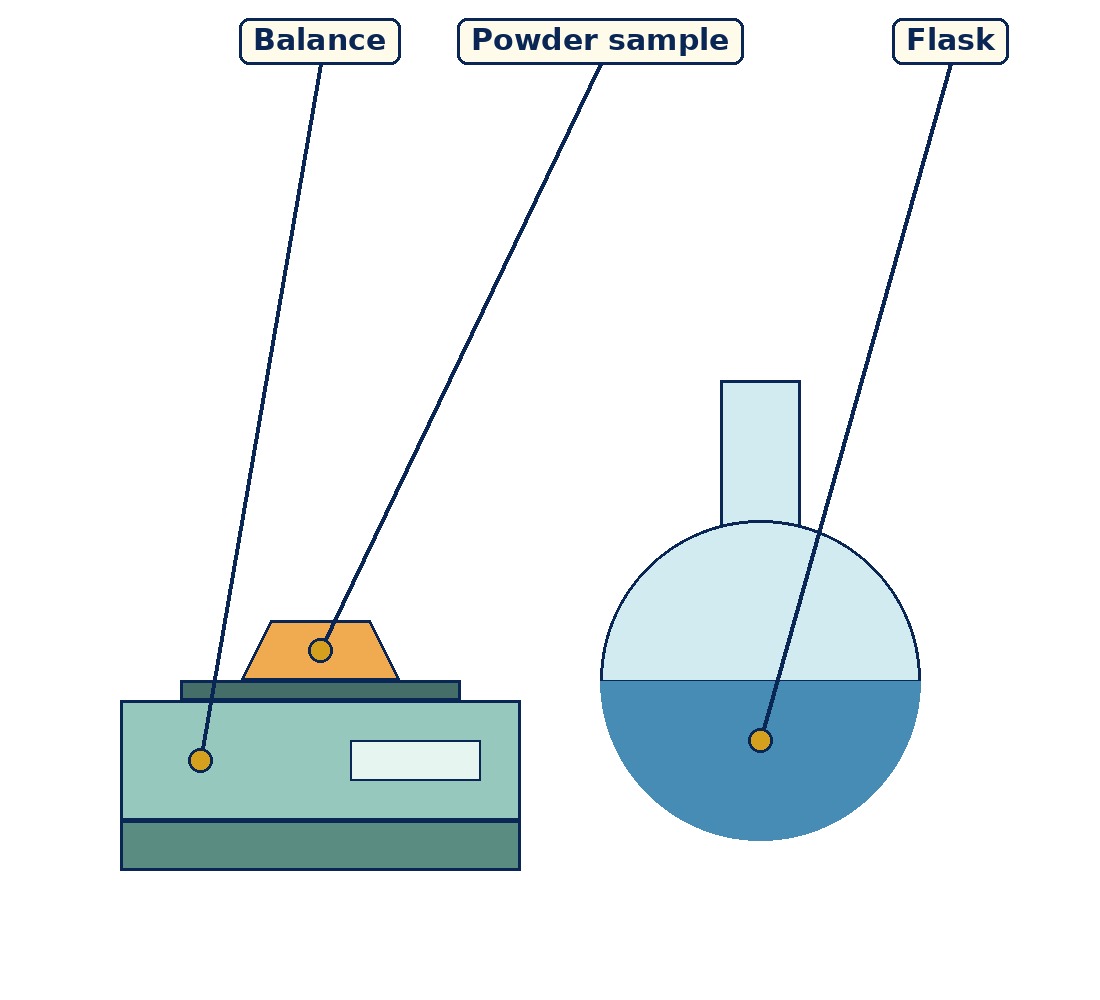
Diagram (labels on the image): Balance, Powder sample, Flask. This is an Educational Galaxy schematic drawn for this chapter; the second image below is a general illustration, not a textbook figure.
What you should learn
- State the SI units and convert between units without losing significant figures.
- Use the laws of chemical combination to explain why compounds have a fixed composition.
- Find average atomic mass, moles, molar mass and number of particles from a given mass.
- Work out percentage composition and empirical and molecular formulas from analysis data.
- Solve stoichiometry problems, including limiting reagent and solution concentration.
- Tell molarity, molality, mole fraction and mass percentage apart, and say which change with temperature.
Coverage map (NCERT): §1.1 and §1.3 are in Going further 1; §1.2 is in the opening section; §1.4 is in Going further 2; §1.5–§1.6 are the laws and Dalton sections; §1.7 is in Going further 3 and the mole section; §1.8–§1.10 are the mole, formula and stoichiometry sections. Every numbered section of the rationalised chapter is covered, and nothing here comes from outside it.
1. 1. What chemistry counts — matter and its kinds
Chemistry is the study of matter: anything that has mass and takes up space. Matter appears as solids, liquids and gases, and it can be a pure substance (one kind of particle) or a mixture (two or more substances mixed together, keeping their own properties).
An element is made of only one kind of atom — iron, oxygen and gold are elements. A compound is made of two or more elements joined in a fixed ratio — water is always H2O, whatever its source. A mixture, like air or salt water, can be separated by simple physical methods; a compound can only be split by a chemical change.
Two ideas run through the whole chapter. First, chemistry is quantitative: we do not just say a reaction happens, we say how much reacts and how much forms. Second, atoms are the counting unit — and because atoms are far too small to count one by one, chemists count them in bundles called moles.
2. 2. The laws of chemical combination
Law of conservation of mass: in a chemical reaction, total mass stays the same. Atoms are rearranged, not created or destroyed, so a balanced equation must have the same mass on both sides.
Law of definite proportions: a compound always contains the same elements in the same ratio by mass. Water from a tap, a river or a laboratory is always about 1 part hydrogen to 8 parts oxygen by mass.
Law of multiple proportions: when two elements form more than one compound, the masses of one element that join a fixed mass of the other are in a ratio of small whole numbers. Carbon monoxide and carbon dioxide are the classic pair.
Gay-Lussac's law of gaseous volumes: when gases react, their volumes (at the same temperature and pressure) are in a ratio of small whole numbers. Avogadro's law adds the key idea: equal volumes of gases, at the same temperature and pressure, contain equal numbers of molecules. This is what lets us read a balanced equation as a ratio of volumes for gases.

Caption: An originally generated illustration for this chapter — a general scene for the topic, not a photograph of a real experiment or a copy of a textbook figure. The labelled diagram above is the one to study for the named parts.
3. 3. Dalton's atomic theory — and where it needed fixing
Dalton proposed that matter is made of tiny indivisible atoms, that all atoms of one element are alike, and that compounds form when atoms join in small whole-number ratios. His theory explained the laws of combination beautifully.
Later work showed two limits: atoms of one element are not all identical (isotopes exist), and atoms can be divided further into electrons, protons and neutrons. The theory is still the right starting picture — it just needed these corrections, which Chapter 2 takes up.
4. 4. The mole — chemistry's counting bundle
One mole of anything contains 6.022 × 10^23 particles — Avogadro's number, written NA. It is like a dozen, but for atoms and molecules: 1 mole of carbon atoms weighs 12 g, 1 mole of water molecules weighs 18 g, and 1 mole of any gas at STP occupies 22.4 litres.
Molar mass is the mass of one mole of a substance, in grams per mole. Number of moles = given mass ÷ molar mass, and number of particles = moles × NA. Almost every numerical in this chapter is one of these two conversions, or both in sequence.
Worked example in words: 18 g of water is 18 ÷ 18 = 1 mole, so it contains 6.022 × 10^23 water molecules. 44 g of carbon dioxide is 44 ÷ 44 = 1 mole of CO2, which contains 1 mole of carbon atoms and 2 moles of oxygen atoms.
5. 5. Formulas: percentage composition, empirical and molecular
Percentage composition tells you what fraction of a compound's mass each element makes up: (mass of that element in one mole ÷ molar mass) × 100. It is the bridge from laboratory analysis to a formula.
The empirical formula is the simplest whole-number ratio of atoms in a compound; the molecular formula is the true number of atoms in one molecule. They are linked by: molecular formula = n × empirical formula, where n = molar mass ÷ empirical formula mass.
To find an empirical formula from percentages: convert each percentage to moles (divide by atomic mass), divide all mole values by the smallest, and round to small whole numbers. If a value comes out near 1.5, double everything rather than rounding badly.
6. 6. Stoichiometry and the limiting reagent
Stoichiometry is calculation from a balanced equation. The coefficients are a mole ratio: in 2H2 + O2 → 2H2O, 2 moles of hydrogen react with 1 mole of oxygen to give 2 moles of water. Convert every given mass to moles first, use the ratio, then convert back to the unit the question asks for.
The limiting reagent is the reactant that runs out first and decides how much product can form. Find it by dividing each reactant's moles by its coefficient — the smallest result is the limiting reagent. Always calculate the product from the limiting reagent, never from the reactant in excess.
Concentration terms you must not mix up: molarity = moles of solute per litre of solution (changes with temperature, because volume changes); molality = moles of solute per kilogram of solvent (does not change with temperature); mole fraction = moles of one component ÷ total moles; mass percentage = mass of solute ÷ mass of solution × 100.
Comparing the concentration terms
| Term | Definition | Changes with temperature? |
|---|---|---|
| Molarity (M) | Moles of solute per litre of solution | Yes — volume expands on heating |
| Molality (m) | Moles of solute per kilogram of solvent | No — mass does not change |
| Mole fraction (x) | Moles of a component ÷ total moles | No |
| Mass percentage | Mass of solute ÷ mass of solution × 100 | No |
Going further 1 — Why chemistry matters, and how chemists measure (NCERT §1.1, §1.3)
Chemistry touches daily life through the medicines that treat illness, the fertilisers that raise crop yields, the soaps and detergents that clean, and the materials — plastics, glass, cement — that build modern life. It also explains environmental problems such as ozone depletion and acid rain, which is why the subject is called a central science: it links physics, biology, geology and medicine.
Every measurement needs a unit and a number. Chemists use SI units: length in metres, mass in kilograms, time in seconds, temperature in kelvin and amount in moles. Density is mass per unit volume, and temperature in kelvin is the Celsius temperature plus 273.15, so 25 °C is 298 K. The unit you quote must match the quantity you measured, or the number is meaningless.
Exam note: always convert °C to K before using a gas or thermodynamics formula; a temperature difference is the same in both scales, but an absolute temperature is not.
Going further 2 — Uncertainty: significant figures and dimensional analysis (NCERT §1.4)
No measurement is exact. Precision means repeated measurements agree with each other; accuracy means they agree with the true value — a precise set can still be inaccurate. Significant figures show how much of a number is trustworthy: all non-zero digits count, zeros between digits count, and trailing zeros after a decimal point count. In multiplication and division, the answer carries as many significant figures as the least precise measurement; in addition and subtraction, it carries as many decimal places as the least precise measurement.
Dimensional analysis turns unit conversion into arithmetic: multiply by a conversion factor that equals one, such as 1 in = 2.54 cm, and let the units cancel. To find the seconds in 2 days: 2 days × 24 hours/day × 60 minutes/hour × 60 seconds/minute = 172,800 s. If the units do not cancel to the unit you want, the method is wrong — that check alone catches most conversion errors.
Exam note: round only at the last step; rounding at every step changes the final digit.
Going further 3 — Average atomic mass: why chlorine weighs 35.5 (NCERT §1.7)
Atomic mass is measured against carbon-12, which is fixed at exactly 12 u: one atomic mass unit is 1/12 of a carbon-12 atom. Most elements are mixtures of isotopes, so the atomic mass in the periodic table is an average, weighted by abundance. Chlorine is about 75.77% chlorine-35 and 24.23% chlorine-37, so its average mass is (35 × 75.77 + 37 × 24.23) ÷ 100 = 35.45 u — which is why the table shows 35.5, not a whole number.
Molecular mass is the sum of the atomic masses in the formula: water is 2(1.008) + 16.00 = 18.02 u, and its molar mass is 18.02 g/mol. The same idea gives formula mass for ionic compounds such as NaCl, where no separate molecule exists. Whenever a question gives a percentage abundance, it is asking for this weighted average — never just pick the commonest isotope.
Exam note: average atomic mass uses percentage abundance as weights; the answer must lie between the isotope masses.
Practice set — try it yourself
- A sample of water is found to contain hydrogen and oxygen in the ratio 1:8 by mass. Which law of chemical combination does this illustrate? Explain in one paragraph.
- Calculate the number of moles and the number of molecules in 36 g of water. (Molar mass of water = 18 g/mol.)
- A compound contains 40% carbon, 6.7% hydrogen and 53.3% oxygen by mass. Find its empirical formula. (Atomic masses: C = 12, H = 1, O = 16.)
- In the reaction N2 + 3H2 → 2NH3, 28 g of nitrogen reacts with 12 g of hydrogen. Which is the limiting reagent, and how many moles of ammonia form?
- Explain, with a reason, why molality is preferred over molarity when a solution is heated.
Key Terms / Important Terms
- Matter — Anything that has mass and occupies space.
- Element — A pure substance made of only one kind of atom.
- Compound — A pure substance of two or more elements joined in a fixed ratio.
- Mixture — Two or more substances mixed together, each keeping its own properties.
- Mole — The amount containing 6.022 × 10^23 particles (Avogadro's number).
- Molar mass — The mass of one mole of a substance, in g/mol.
- Empirical formula — The simplest whole-number ratio of atoms in a compound.
- Molecular formula — The actual number of atoms of each element in one molecule.
- Stoichiometry — Calculation of amounts in a reaction from its balanced equation.
- Limiting reagent — The reactant that is used up first and limits the product formed.
- SI unit — A unit of the International System, such as metre, kilogram, second, kelvin or mole.
- Significant figures — The digits in a measurement that are known reliably, plus one estimated digit.
- Average atomic mass — The abundance-weighted average mass of an element's isotopes, as shown in the periodic table.
Remember
- Convert every mass to moles before you use the equation's ratio — never apply the ratio to grams directly.
- A balanced equation gives a mole ratio, not a mass ratio and not (for non-gases) a volume ratio.
- Molarity depends on temperature; molality and mole fraction do not.
- Empirical formula is a ratio; you need the molar mass as well to get the molecular formula.
- The limiting reagent is found by moles ÷ coefficient, not by the smallest mass.
- In a numerical, match significant figures at the END, not at each step — rounding mid-way changes the last digit.
Exam Tip / Common Mistake
The most common error is applying the equation's coefficients to grams. Convert to moles first, use the ratio, then convert back. And when a question gives two reactant masses, always check for the limiting reagent before calculating the product — the reactant in excess must not decide your answer.
Questions with Answers — full answers
- What is a mole, and why do chemists need it? Answer: A mole is 6.022 × 10^23 particles. Atoms and molecules are far too small to count one by one, so chemists count them in mole-sized bundles, just as eggs are counted by the dozen. One mole of any substance has a weighable mass — its molar mass — so counting becomes weighing.
- State the law of definite proportions with an example. Answer: A compound always contains the same elements in the same proportion by mass, whatever its source. Water always contains hydrogen and oxygen in the ratio 1:8 by mass, whether it comes from a tap, a river or a laboratory preparation.
- How is the molecular formula found from the empirical formula? Answer: Divide the compound's molar mass by the empirical formula mass to get a whole number n, then multiply every subscript in the empirical formula by n. For example, an empirical formula CH2O with molar mass 180 g/mol gives n = 180 ÷ 30 = 6, so the molecular formula is C6H12O6.
- What is the limiting reagent? Why must the product be calculated from it? Answer: The limiting reagent is the reactant that is completely used up first in a reaction. It decides how much product can form, because once it runs out the reaction stops, however much of the other reactant is left. Calculating from the excess reactant would overstate the product.
- Distinguish molarity from molality. Answer: Molarity is moles of solute per litre of solution; molality is moles of solute per kilogram of solvent. Molarity changes with temperature because the volume of a solution expands on heating, while molality does not change because mass is unaffected by temperature.
Extension Questions with Answers — going further
- How many atoms are there in 52 moles of argon, and how many atoms are there in 52 u of helium? Answer: 52 moles of argon contain 52 × 6.022 × 10^23 = 3.13 × 10^25 atoms. 52 u of helium is 52 ÷ 4 = 13 helium atoms, since one helium atom weighs 4 u. The two questions look alike but ask for completely different things — moles versus mass units.
- Calculate the average atomic mass of chlorine from 75.77% chlorine-35 and 24.23% chlorine-37. Answer: (35 × 75.77 + 37 × 24.23) ÷ 100 = (2651.95 + 896.51) ÷ 100 = 35.48, about 35.5 u. The average is close to 35 because chlorine-35 is far more abundant.
- How many significant figures should the answer have for 0.02856 × 298.15 × 0.112, and what is the answer? Answer: Three significant figures, because 0.112 has only three. The product is 0.9537…, so the reported answer is 0.954.
- Convert 2 days into seconds using dimensional analysis. Answer: 2 days × (24 h / 1 day) × (60 min / 1 h) × (60 s / 1 min) = 172,800 s. Every unit cancels except seconds, which is the check that the method is right.
- Calculate the mass percentage of sodium in sodium sulphate, Na2SO4 (Na = 23, S = 32, O = 16). Answer: Molar mass = 2(23) + 32 + 4(16) = 142 g/mol. Sodium's share = 92 ÷ 142 × 100 = 32.4%. So sodium is 32.4% of the mass.
Board-pattern Questions with Answers
- Carbon monoxide and carbon dioxide both contain carbon and oxygen. How does this pair illustrate the law of multiple proportions? Answer: With a fixed mass of carbon, say 12 g, CO contains 16 g of oxygen and CO2 contains 32 g. The oxygen masses are in the ratio 16:32, that is 1:2 — a ratio of small whole numbers, exactly as the law states.
- What is the difference between 0.50 mol of Na2CO3 and 0.50 M Na2CO3? Answer: 0.50 mol is an amount — 0.50 × 106 = 53 g of solid. 0.50 M is a concentration — 0.50 moles dissolved per litre of solution. One is a quantity, the other is a quantity per litre.
- 50.0 kg of N2 and 10.0 kg of H2 react to form ammonia. Which is the limiting reagent, and how many moles of ammonia form? Answer: N2: 50,000 ÷ 28 = 1786 mol; H2: 10,000 ÷ 2 = 5000 mol. The reaction needs 3 × 1786 = 5358 mol of H2, but only 5000 mol are present, so H2 is limiting. Ammonia formed = (2/3) × 5000 = 3333 mol.
- A solution contains 10 g of ethanol (molar mass 46) in 90 g of water (molar mass 18). Calculate the mole fraction of ethanol. Answer: Moles of ethanol = 10 ÷ 46 = 0.217; moles of water = 90 ÷ 18 = 5. Mole fraction of ethanol = 0.217 ÷ (0.217 + 5) = 0.0416.
- Why does the molarity of a solution change when it is heated, but its molality does not? Answer: Molarity uses volume, and volume expands on heating, so the same moles occupy more litres and the molarity falls. Molality uses mass of solvent, and mass does not change with temperature.
Recap — the chapter in five lines
- SI units, density and kelvin conversion come before any calculation.
- Significant figures and dimensional analysis keep numbers honest.
- Average atomic mass is a weighted average over isotopes.
- Laws of combination and Dalton's theory explain fixed composition.
- Mole, formulas and stoichiometry turn masses into particle counts and back.