

Chapter 3: Recording of Transactions — I
Original notes — ready CBSE (NCERT, English Medium) • Class 11 • Accountancy • Book: Financial Accounting — Part I
Chapter 3: Recording of Transactions — I — EG's own notes, in simple words
Book: Financial Accounting — Part I (CBSE, Class 11) | Chapter 3 | Medium: English
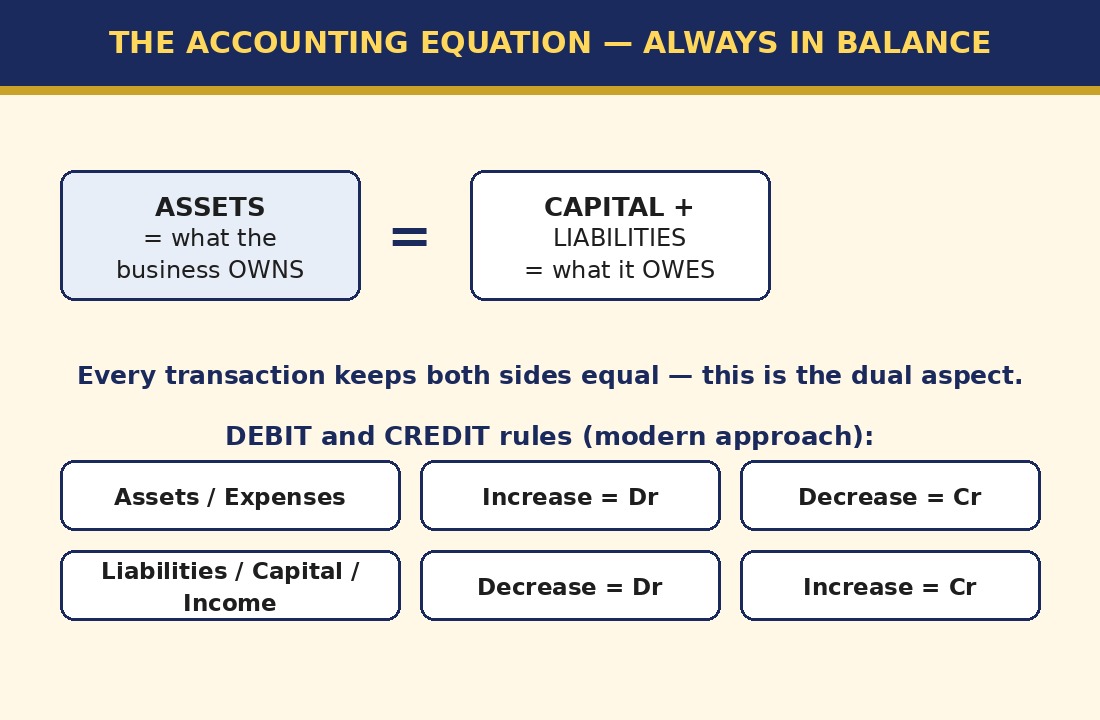
Diagram (labels on the image): The accounting equation in balance, with the modern debit and credit rules for assets, expenses, liabilities, capital and income.

A desk with an open journal book, a calculator and receipts — every entry begins with a source document.
1. Source documents and vouchers
No entry is made from memory. Every transaction rests on a source document: a cash memo for a cash sale, an invoice for a credit sale, a receipt for money received, a cheque counterfoil, or a pay-in-slip. From the source document a voucher is prepared — a written document that records the transaction, states the account to be debited and credited, and is signed as authority for the entry. Vouchers are the evidence that makes accounts objective and checkable.
2. The accounting equation and the rules of debit and credit
The accounting equation, Assets = Capital + Liabilities, was met in Chapter 1. The rules of debit and credit tell us which side of an account receives an increase. Under the modern (accounting equation) approach: increase in an asset or expense is a debit, decrease is a credit; increase in a liability, capital or income is a credit, decrease is a debit. Under the traditional approach, accounts are personal (debit the receiver, credit the giver), real (debit what comes in, credit what goes out) or nominal (debit expenses and losses, credit incomes and gains). Both approaches give the same entries; Class 11 questions accept either reasoning, but the entry must be the same.
At a glance — chart / table
| Type of account | Debit | Credit |
|---|---|---|
| Personal account (e.g. Mehta Traders) | Debit the receiver | Credit the giver |
| Real account (e.g. Cash, Furniture) | Debit what comes in | Credit what goes out |
| Nominal account (e.g. Rent, Sales) | Debit expenses and losses | Credit incomes and gains |
3. The journal — book of original entry
The journal is the book in which transactions are first recorded in date order, with the debit account, the credit account, the amount and a short explanation called the narration. Its columns are: Date, Particulars, Ledger Folio (L.F.), Debit amount and Credit amount. A compound entry records one transaction with more than one debit or credit account. The journal is a book of original entry because entries reach the ledger from it; it is not itself an account.
Worked example — journal of Sharma Traders, April. 1 April: started business with cash Rs 1,00,000. 3 April: bought goods for cash Rs 25,000. 5 April: bought goods on credit from Mehta Traders Rs 40,000. 7 April: sold goods for cash Rs 30,000. 9 April: paid rent Rs 5,000 in cash.
At a glance — chart / table
| Date | Particulars (narration in brackets) | Dr (Rs) | Cr (Rs) |
|---|---|---|---|
| 1 Apr | Cash A/c … Dr; To Capital A/c (started business with cash) | 1,00,000 | 1,00,000 |
| 3 Apr | Purchases A/c … Dr; To Cash A/c (goods bought for cash) | 25,000 | 25,000 |
| 5 Apr | Purchases A/c … Dr; To Mehta Traders A/c (goods bought on credit) | 40,000 | 40,000 |
| 7 Apr | Cash A/c … Dr; To Sales A/c (goods sold for cash) | 30,000 | 30,000 |
| 9 Apr | Rent A/c … Dr; To Cash A/c (rent paid in cash) | 5,000 | 5,000 |
4. The ledger — posting and balancing
The ledger is the book in which all entries are classified into separate accounts: one account for each person, asset, expense and income. Posting means transferring a journal entry to the right ledger account — a debit in the journal becomes a debit in that account, and similarly for credit. Each account is in 'T' form: debit on the left, credit on the right.
At the end of a period each account is balanced: the two sides are totalled, the smaller side is made equal to the larger by writing the difference as 'balance carried down' (balance c/d), and the balance is brought down (balance b/d) to start the next period. A debit balance means the account holds an asset or expense; a credit balance means a liability, capital or income.
Worked example — Cash Account of Sharma Traders. Debit side: Capital Rs 1,00,000 and Sales Rs 30,000, total Rs 1,30,000. Credit side: Purchases Rs 25,000 and Rent Rs 5,000, total Rs 30,000. The debit total is larger by Rs 1,00,000, so the balance c/d is Rs 1,00,000 on the credit side, and the account opens next month with a debit balance b/d of Rs 1,00,000 — the cash in hand.
What you should learn
- Explain what a source document is, what a voucher adds, and why no entry is made from memory.
- Apply the accounting equation to a transaction, and state both the modern and the traditional rules of debit and credit.
- Write a journal entry with date, particulars, ledger folio, amounts and narration, including a compound entry.
- Explain what a ledger is, why it is called the principal book, and how posting from the journal is done.
- Balance an account and carry its balance forward as balance carried down and brought down.
Going further — full coverage of the source chapter
§3.1 Business transactions and source documents. A business transaction is an exchange measurable in money. Its evidence is a source document: a cash memo for a cash sale, an invoice for a credit sale, a receipt for money received, a cheque counterfoil, a pay-in-slip. From it a voucher is prepared stating the accounts to be debited and credited, signed as authority. No entry is made from memory or from a verbal claim alone.
§3.2 Accounting equation. Assets = Capital + Liabilities holds after every transaction because of dual aspect. A credit purchase raises both stock (asset) and creditors (liability); paying a creditor lowers both cash and creditors. The equation is the check behind every journal entry.
§3.3 Using debit and credit. Modern (accounting equation) approach: debit an increase in an asset or expense, credit a decrease; credit an increase in a liability, capital or income, debit a decrease. Traditional approach: personal accounts — debit the receiver, credit the giver; real accounts — debit what comes in, credit what goes out; nominal accounts — debit expenses and losses, credit incomes and gains. Both approaches give the same entry.
§3.4 Books of original entry — the journal. The journal records transactions first, in date order. Columns: Date, Particulars, Ledger Folio (L.F.), Debit amount, Credit amount. Each entry ends with a narration in brackets — a short explanation. A compound entry records one transaction needing more than one debit or more than one credit, such as paying rent and salaries together by one cheque.
§3.5 The ledger. The ledger is the principal book (book of final entry): all journal entries are collected into accounts here, one account per head — Cash, Sales, each debtor and creditor. It is the ledger, not the journal, from which the trial balance is drawn.
§3.6 Posting from journal, and balancing. Posting copies each journal debit to the debit side of its ledger account and each journal credit to the credit side, writing the journal folio in the ledger and the ledger folio back in the journal. To balance: total both sides; the difference is the balance, written as 'By Balance c/d' on the shorter side and 'To Balance b/d' on the next period's longer side. A debit total larger than the credit total gives a debit balance.
Key Terms / Important Terms
- Source document — The original evidence of a transaction, such as an invoice, cash memo or receipt.
- Voucher — A written document prepared from a source document, authorising and explaining a journal entry.
- Journal — The book of original entry in which transactions are first recorded in date order.
- Narration — The short explanation written below a journal entry, in brackets.
- Ledger — The book containing all accounts, classified by person, asset, expense and income.
- Posting — Transferring a journal entry to the ledger account concerned.
- Balancing — Finding the difference between the debit and credit totals of an account.
- Compound entry — A journal entry with more than one debit or credit account for a single transaction.
- Ledger Folio (L.F.) — The page number of the ledger account, written in the journal so any entry can be traced to its account.
- Book of original entry — The book in which a transaction is recorded first, in date order — the journal.
- Book of final entry — The ledger, where journal entries are collected into accounts; the trial balance is drawn from it.
Remember
- Every entry needs a source document and a voucher — never record from memory.
- Assets and expenses increase with a debit; liabilities, capital and income increase with a credit.
- The journal records in date order; the ledger classifies by account.
- Balance c/d closes an account for the period; balance b/d reopens it next period.
- A debit balance in a personal account means a debtor; a credit balance means a creditor.
- Posting rule in one line: journal debit goes to the debit side of the ledger account, journal credit to the credit side — and the ledger folio goes back into the journal.
Exam Tip / Common Mistake
Common mistake: debiting 'Purchases' when goods are bought, but crediting 'Cash' even when goods are bought on credit. On credit, the giver is the seller, so credit the seller's personal account, not Cash. Read every question twice: 'for cash' and 'on credit' change the second half of the entry completely.
Practice set — try it yourself
- Pass the journal entry: goods of Rs 18,000 bought from Anita Traders on credit. Hint: Who is the giver here — cash or the seller?
- Pass the journal entry: the owner withdrew Rs 6,000 cash for personal use. Hint: The owner's drawings account is debited; cash goes out.
- Post the two entries of Q1 and Q2 into the Cash Account and balance it, assuming an opening cash balance of Rs 50,000. Hint: Post debits to the debit side and credits to the credit side, then total both sides.
- A machinery repair bill of Rs 2,500 is paid in cash. Which account is debited, and is it personal, real or nominal? Hint: Repairs are an expense — use the nominal rule.
- Why is the journal called a book of original entry? Hint: Think about where a transaction is recorded first.
Questions with Answers
- Pass journal entries: (a) machinery bought for cash Rs 60,000; (b) goods sold on credit to Anita for Rs 25,000. Answer: (a) Machinery A/c … Dr Rs 60,000; To Cash A/c Rs 60,000. (b) Anita A/c … Dr Rs 25,000; To Sales A/c Rs 25,000.
- Pass the entry: salary of Rs 15,000 paid by cheque. Answer: Salary A/c … Dr Rs 15,000; To Bank A/c Rs 15,000. Salary is an expense (debit); the bank balance falls (credit).
- Pass the entry: goods of Rs 8,000 returned by a customer who had bought on credit. Answer: Sales Returns A/c … Dr Rs 8,000; To Customer's A/c Rs 8,000. The customer now owes less, so his account is credited.
- From the notes, what is the closing cash balance of Sharma Traders, and how is it obtained? Answer: Rs 1,00,000 debit balance. Debit total Rs 1,30,000 (Capital Rs 1,00,000 + Sales Rs 30,000) minus credit total Rs 30,000 (Purchases Rs 25,000 + Rent Rs 5,000) = Rs 1,00,000.
- Distinguish the journal from the ledger in two points. Answer: The journal records transactions in date order as they occur; the ledger classifies the same entries into separate accounts. The journal is the book of original entry; the ledger is the book of final entry.
Extension Questions with Answers
- Pass a compound entry: rent Rs 5,000 and salaries Rs 8,000 are paid together by one cheque of Rs 13,000. Answer: Rent A/c … Dr Rs 5,000; Salaries A/c … Dr Rs 8,000; To Bank A/c Rs 13,000. (Narration: rent and salaries paid by cheque.)
- An account has a debit total of Rs 90,000 and a credit total of Rs 60,000. What is its balance, and how is it carried forward? Answer: Debit balance Rs 30,000: 'By Balance c/d Rs 30,000' on the credit side closes it, and 'To Balance b/d Rs 30,000' opens the next period on the debit side.
- A salesman says goods worth Rs 4,000 were sold on credit, but there is no invoice. Should the sale be entered? Answer: No. No entry is made without a source document; the invoice (or cash memo) is the evidence, and the voucher is prepared from it.
- A business starts with assets of Rs 1,00,000 equal to capital of Rs 1,00,000. It buys goods of Rs 20,000 on credit and then pays Rs 12,000 cash to the supplier. Show the equation after each step. Answer: After purchase: assets Rs 1,20,000 = capital Rs 1,00,000 + liabilities Rs 20,000. After payment: assets Rs 1,08,000 = capital Rs 1,00,000 + liabilities Rs 8,000.
- Classify each account as personal, real or nominal: Bank Account, Furniture Account, Commission Received Account. Answer: Bank Account — personal (an institution). Furniture Account — real (a thing owned). Commission Received Account — nominal (an income).
Board-pattern Questions with Answers
- Name the columns of a journal. Answer: Date, Particulars, Ledger Folio (L.F.), Debit amount, Credit amount.
- Why is the journal called the book of original entry? Answer: Because a transaction is recorded in it first, in date order, before it is posted anywhere else.
- Distinguish the journal from the ledger in one sentence each. Answer: The journal records transactions first in date order; the ledger collects them into accounts and is the book of final entry from which the trial balance is drawn.
- State the traditional rules of debit and credit for personal, real and nominal accounts. Answer: Personal: debit the receiver, credit the giver. Real: debit what comes in, credit what goes out. Nominal: debit expenses and losses, credit incomes and gains.
- Post this journal entry into the ledger: Salaries A/c … Dr Rs 6,000; To Cash A/c Rs 6,000. Answer: Salaries Account debited Rs 6,000 (To Cash); Cash Account credited Rs 6,000 (By Salaries).
Recap
No entry without a source document; the voucher states the debit and credit and authorises the entry. The accounting equation balances after every transaction. Debit and credit rules work under both the modern and the traditional approach. The journal is the book of original entry (with narration and ledger folio); the ledger is the principal book, where accounts are posted and balanced, with balances carried down and brought down.