

Unit 5: Story of English Drama
From church plays to modern theatre • mystery plays to Beckett • Original EG notes in simple English
Unit 5: Story of English Drama — EG's own notes, in simple English
Book: Rainbow – Story of English (BSEB, Class 12, Part 2) | Unit 5
This page carries Educational Galaxy's own original notes — a theme-level summary in simple English, not a copy of the textbook. No official textbook PDF is given here.
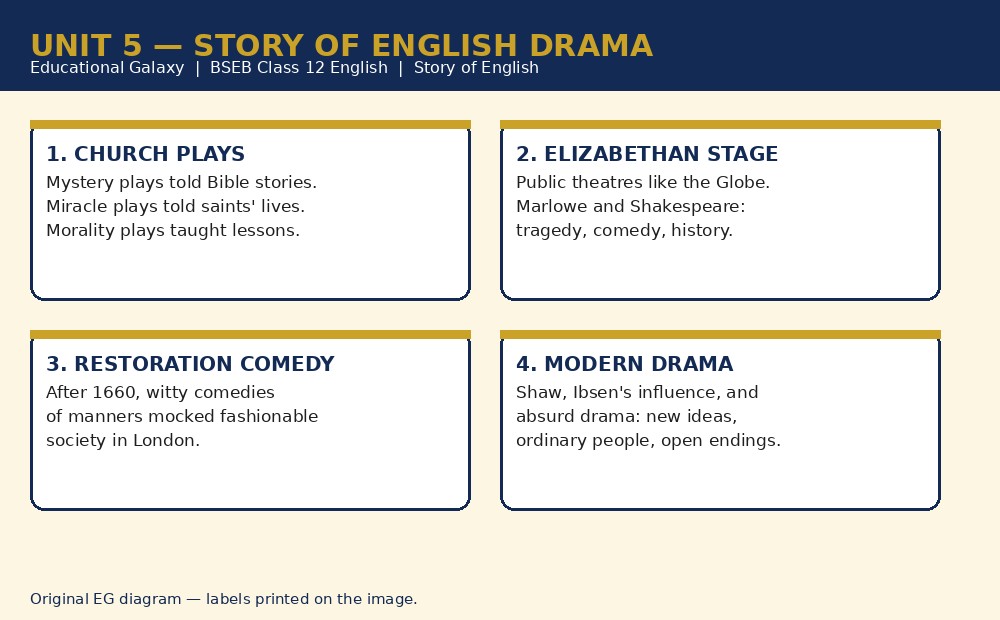
Diagram (labels are printed on the image): English drama at a glance: church plays, the Elizabethan stage, Restoration comedy, and modern drama.
Drama begins in the church
English drama did not begin in a theatre. It began in the church, in the Middle Ages, when priests acted out Bible stories to help ordinary people — most of whom could not read — understand them. Mystery plays told Bible stories such as the Creation and the Crucifixion; miracle plays told the lives of saints; and morality plays, like the famous Everyman, taught a moral lesson through characters named Good Deeds, Knowledge and Death.
These plays were performed by townspeople, often on wagons that moved from street to street, with the whole town watching. Drama was therefore public, communal and religious from the very start — a way for a community to see its own beliefs acted out in front of it.
Interludes and the first theatres
Over time, plays began to leave the churchyard. Short, lively interludes entertained at feasts and in great houses, mixing comedy with moral teaching. Humanist schools and universities added classical influence: students performed Roman comedies and tragedies, and learned the rules of plot and character from Roman writers.
In the later sixteenth century, London built the first permanent public playhouses — the Theatre in 1576, and then the Globe, the Rose and others. For the first time, professional actors performed every afternoon to paying audiences of all classes, from groundlings standing in the yard to gentlemen in the galleries. Drama had become a business as well as an art.
The Elizabethan golden age
The golden age of English drama is the Elizabethan and Jacobean age, roughly 1580 to 1640. Christopher Marlowe, with plays like Doctor Faustus and Tamburlaine, gave English tragedy its mighty line and its ambitious heroes. William Shakespeare, writing for the Globe, covered every kind — histories, comedies like A Midsummer Night's Dream, great tragedies like Hamlet, Macbeth and King Lear, and late romances.
Ben Jonson added sharp, satirical comedy, and other playwrights — Webster, Middleton, Ford — pushed tragedy towards darker, more violent subjects. Shakespeare's range is the reason he stands above them all: no other dramatist has matched his combination of poetry, character and story.
After Shakespeare: Restoration to modern drama
After the theatres were closed during the Civil War period, drama returned with the Restoration of 1660 — and with actresses on the English stage for the first time. Restoration comedy of manners, by writers like Congreve and Wycherley, mocked fashionable London society with brilliant wit. The eighteenth century added sentimental comedy and domestic tragedy; the nineteenth century loved melodrama, with clear heroes, villains and thrilling rescues.
Modern drama broke those patterns. Ibsen's realistic problem plays influenced Shaw, whose witty, argumentative plays debated social questions on stage. In the twentieth century, Samuel Beckett's Waiting for Godot — two tramps waiting for someone who never comes — created the Theatre of the Absurd, in which meaning itself is questioned. Indian English drama, from Sri Aurobindo to Girish Karnad and Mahesh Dattani in translation and in English, has added its own myths, histories and social questions to this long story. For exams, hold the chain: church plays → interludes → Elizabethan public theatre → Restoration comedy → modern and absurd drama.
What you should learn
Understand the story of English drama: church plays, Elizabethan public theatre, Restoration comedy, and modern/absurd drama.
Key Terms
- Mystery play — A medieval play telling a Bible story, performed by townspeople.
- Morality play — A medieval play teaching a moral lesson through allegorical characters, e.g. Everyman.
- Elizabethan drama — The golden age of English drama (c. 1580–1640), led by Marlowe and Shakespeare.
- Comedy of manners — A witty Restoration comedy mocking fashionable society and its manners.
- Theatre of the Absurd — Modern drama (e.g. Beckett) in which life appears meaningless and plots do not resolve.
- Tragedy — A serious play in which a hero's flaw or fate leads to downfall and often death.
Remember
- English drama began in church: mystery, miracle and morality plays.
- Public playhouses (the Theatre 1576, the Globe) made drama a profession.
- Marlowe and Shakespeare led the Elizabethan golden age (c. 1580–1640).
- Restoration comedy mocked society; modern drama (Shaw, Beckett) questioned it.
Exam Tip / Common Mistake
Common mistake: saying Shakespeare 'invented' English drama. Drama was already centuries old in church plays and interludes; Shakespeare perfected it in the public theatre.
Chart / Table
| Point | Detail |
|---|---|
| Medieval | Mystery, miracle, morality plays (church, townspeople) |
| 1500s | Interludes; first public playhouses (1576) |
| c. 1580–1640 | Elizabethan/Jacobean golden age: Marlowe, Shakespeare, Jonson |
| 1660 onwards | Restoration comedy of manners; actresses on stage |
| 19th century | Melodrama: heroes, villains, thrills |
| 20th century | Shaw's problem plays; Beckett's Theatre of the Absurd |
Practice set — try it yourself
- What were mystery, miracle and morality plays? Give one example of each type.
- Why did medieval plays matter to people who could not read?
- What changed when London built public playhouses?
- Name two Shakespeare tragedies and two comedies.
- What is the Theatre of the Absurd? Use Waiting for Godot as your example.
Core Questions with Answers
- Where did English drama begin?
In the medieval church, where priests and townspeople acted Bible stories (mystery plays), saints' lives (miracle plays) and moral lessons (morality plays like Everyman). - Why was the building of public playhouses important?
From 1576, theatres like the Theatre and the Globe let professional actors perform daily to paying audiences of all classes, making drama a profession and a business. - Who were the leading Elizabethan dramatists?
Christopher Marlowe (Doctor Faustus, Tamburlaine) and William Shakespeare (Hamlet, Macbeth, A Midsummer Night's Dream), with Ben Jonson in satirical comedy. - What is Restoration comedy of manners?
Witty comedy after 1660, by writers like Congreve, mocking fashionable London society; it also brought actresses to the English stage for the first time. - What is modern drama's break with the past?
Writers like Shaw turned plays into debates about social questions, and Beckett's absurd drama removed clear plot and resolution, questioning meaning itself.
Extension Questions with Answers
- Why was drama a good teaching tool in a mostly illiterate society?
Because people could see and hear a story even if they could not read it. Acting made abstract beliefs — sin, death, judgement — visible, memorable and communal. - How did the audience shape Elizabethan drama?
A mixed audience — groundlings and gentlemen together — pushed playwrights to mix comedy and tragedy, high poetry and low jokes, in the same play, so everyone found something to enjoy. - Compare a morality play with a Restoration comedy.
A morality play teaches a universal lesson through allegorical figures like Good Deeds; a Restoration comedy mocks a particular fashionable society through witty, realistic characters. One preaches, the other satirises. - Why is Waiting for Godot called absurd?
Because its two tramps wait for Godot, who never comes, and nothing is resolved. The play refuses the clear plot and moral that older drama promised, mirroring a world that feels meaningless. - Apply this unit: is a film or web series a kind of drama?
Yes, in the broad sense: it tells a story through acting and dialogue. But stage drama is live, communal and limited to what actors can do in one space — constraints that shaped its whole history.
Board Exam Questions (board-pattern practice)
These are Educational Galaxy's own board-pattern practice questions, written in the style of board questions. They are not claimed to be real past-year questions.
- Trace the origin of English drama. Answer: It began in the medieval church with mystery plays (Bible stories), miracle plays (saints' lives) and morality plays (moral lessons like Everyman), performed by townspeople.
- Why were public playhouses a turning point? Answer: From 1576, permanent theatres like the Theatre and the Globe made acting a profession, with daily performances for paying audiences of all classes.
- Discuss Shakespeare's place in English drama. Answer: He mastered every kind — history, comedy, tragedy and romance — combining poetry, character and story as no other dramatist has, in plays like Hamlet and Macbeth.
- What is Restoration comedy? Answer: Witty comedy after 1660, by Congreve and others, mocking fashionable society; it also introduced actresses to the English stage.
- What is the Theatre of the Absurd? Answer: Modern drama, e.g. Beckett's Waiting for Godot, in which plot does not resolve and life appears meaningless, breaking with traditional dramatic form.
How to use this page: First read the summary, say the key terms in your own words, then try the practice set without looking. Finally check yourself with the questions and answers. Get your answers checked by your teacher or parents.
In depth — understanding ‘Story of English Drama’ fully
The best way to prepare any lesson for an examination is to first state its central idea in one sentence, in your own words, and then join its supporting ideas to that sentence in order. Study ‘Story of English Drama’ in the same order. First ask what the central question of the lesson is, and towards which answer the text leads you. Once the central question is clear, the smaller incidents and details stop looking like things to memorise and start looking like evidence or examples for that answer.
In this lesson, key terms such as ‘Mystery play’ and ‘Morality play’ do much of the work. It is not enough to learn their definitions; you must also see where in the lesson each term appears, what result follows from it, and why the lesson's argument would be incomplete without it. A student who learns words with their context can answer a question even when its wording changes, because what he or she holds is understanding, not only a definition.
While reading, pause after every paragraph and ask yourself — what has this paragraph added to the central idea? Is it a new argument, an example, a comparison, or the removal of a misunderstanding? Answering that question, paragraph by paragraph, builds the outline of the lesson in your mind. At the end, try writing that outline in five to seven sentences without looking at the book. Wherever you get stuck, that is exactly where your understanding is still incomplete — read that part again.
Key terms explained in detail
Learn each word below at three levels — definition, context and importance. These three levels make an examination answer complete.
- Mystery play — ‘Mystery play’ means — A medieval play telling a Bible story, performed by townspeople.. In ‘Story of English Drama’ this word matters because the central argument of the lesson is built around this idea. In an examination, do not stop at the definition: add the context — where and why this word appears in the lesson — and finish with one result or importance. Definition, context and importance: these three links together make a complete answer.
- Morality play — To understand ‘Morality play’, first take its plain meaning — A medieval play teaching a moral lesson through allegorical characters, e.g. Everyman. — and then its special meaning in the context of ‘Story of English Drama’. Here the word carries the reader towards the central idea. An answer that gives only the definition remains incomplete; after the definition, add one sentence showing what difference this idea makes to the situation in the lesson.
- Elizabethan drama — ‘Elizabethan drama’ — The golden age of English drama (c. 1580–1640), led by Marlowe and Shakespeare.. Give this word special attention, because in ‘Story of English Drama’ it returns in one form or another in many questions — sometimes as a direct definition, sometimes as an example, and sometimes as a comparison. When you answer, connect the word with the main message of the lesson and make clear whether the lesson supports this idea or argues against it, and why.
- Comedy of manners — The general meaning of ‘Comedy of manners’ is — A witty Restoration comedy mocking fashionable society and its manners.. But in ‘Story of English Drama’ its meaning goes beyond the dictionary: here it is one link in the whole argument of the lesson. A simple way to remember it is to bind three things together in one group of sentences — the word, its context, and its result. When all three are remembered together, the examination answer writes itself in order.
- Theatre of the Absurd — ‘Theatre of the Absurd’ means — Modern drama (e.g. Beckett) in which life appears meaningless and plots do not resolve.. In ‘Story of English Drama’ this word matters because the central argument of the lesson is built around this idea. In an examination, do not stop at the definition: add the context — where and why this word appears in the lesson — and finish with one result or importance. Definition, context and importance: these three links together make a complete answer.
- Tragedy — To understand ‘Tragedy’, first take its plain meaning — A serious play in which a hero's flaw or fate leads to downfall and often death. — and then its special meaning in the context of ‘Story of English Drama’. Here the word carries the reader towards the central idea. An answer that gives only the definition remains incomplete; after the definition, add one sentence showing what difference this idea makes to the situation in the lesson.
Language and style — how to read this lesson
Prose, poetry and stories each demand a different way of reading. In prose, catch the order of the argument: what the writer first establishes, what example or comparison then supports it, and what conclusion follows. In poetry, catch the feeling and the image: through which picture does the poet express the feeling, and what effect does that picture leave on the reader's mind? In a story, catch the order of character, event and result: which character does what in which situation, and what lesson follows from it.
While reading, also notice the words that give a special colour to the feeling — comparisons, contrasts, questions and repetitions. When a writer wants to stress something, he repeats it, compares it with something familiar, or presents it as a question. Recognising these devices makes the feeling of the lesson clearer and makes language questions in the examination easier to face.
A useful exercise is to take one paragraph or stanza and write it in two or three sentences in your own language, without copying the original words. Then compare it with the original and check whether the central feeling has been left out. This exercise deepens understanding and is direct preparation for questions that ask you to ‘answer in your own words’.
How to write in the examination
Questions on ‘Story of English Drama’ usually come in three kinds — direct questions about a fact or definition, questions about the central idea or reason, and questions asking for a summary or opinion in your own words. The structure of the answer is the same for all three: introduction, main part and conclusion. In the introduction, give one sentence introducing the topic. In the main part, write two to four points in order — each point a separate argument, example or result. In the conclusion, write one sentence giving the message or importance of the lesson.
Fix the length of your answer by the marks. For a one- or two-mark question, a definition and one example are enough. For a three- or four-mark question, add the context and one or two results to the definition. For a five-mark long question, you need everything — introduction, three or four points, a comparison or example, and a conclusion. Divide the answer into paragraphs; writing everything in one long paragraph makes even a correct answer hard to read.
Use the key terms of the lesson correctly in your answer, but do not copy lines from the original text. The examiner wants to see that you have understood — and understanding shows only in your own words. After writing, read the answer once: does the first sentence directly answer the question? Are the points in order? Does the last sentence give a conclusion? If the answer to all three is yes, the answer is complete.
- English drama began in church: mystery, miracle and morality plays.
- Public playhouses (the Theatre 1576, the Globe) made drama a profession.
- Marlowe and Shakespeare led the Elizabethan golden age (c. 1580–1640).
- Restoration comedy mocked society; modern drama (Shaw, Beckett) questioned it.