

Story of English 4: Future of English
Story of English • Book: Rainbow Bhag-1 (Purani pustak — 2025 se pehle wali) — Story of English (BSTBPC) • Original EG notes in simple English
Future of English — EG's own notes, in simple English
Book: Rainbow Bhag-1 (Purani pustak — 2025 se pehle wali) — Story of English (BSTBPC, Class 11) | Story of English 4 | Type: Story of English
This page carries Educational Galaxy's own original notes — a summary in simple English in EG's own words, not a copy of the textbook. No official textbook PDF is given here.
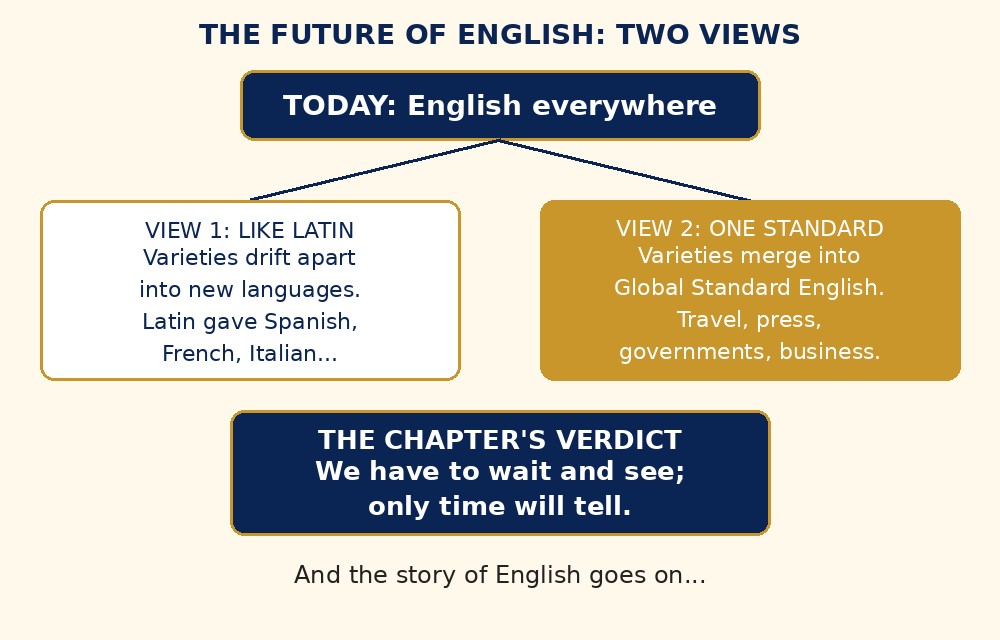
Diagram (labels are printed on the image): Two views of the future: English falls apart like Latin, or its varieties merge into one Global Standard English — and the chapter's verdict is to wait and see.

Students discussing in class — a general picture of speakers shaping a language's future.
What the chapter is about
The story of English cannot be concluded in the manner in which some of the greatest creations in the language can. When we come to the end of Milton's epics, or 'The Tale of the Ancient Mariner', or Keats's 'The Eve of St. Agnes', or the tragedies and comedies of Shakespeare, we experience a fulfilment which a work of art can provide. But it would be safe and correct to say that the story of English is the story of the evolution of modern man. Each person gifted with the power of speech comes and performs his part on the world stage.
The main purpose of adopting this story-telling technique is to familiarise language 2 and language 3 learners — learners for whom English is a second or third language — to understand, enjoy and equip themselves to master a language which will enable better human understanding, co-operation and work culture. All individuals can contribute to the story of English, and it will lead from one to another very much in the manner of our very own story-telling methods found in the Mahabharat, the Panchatantra and the Jataka Tales.
Despite all our deliberations on the growth of English, the question that remains nagging is: what is the future of English? Some people think that history will repeat itself, and English will go the same way as Latin. About 800 years ago, Latin was a world language. It spread all over Europe as the Roman Empire grew, and many new varieties came into being. With the fall of the Roman Empire, the varieties moved apart from Latin and from one another. The different varieties became new languages: Spanish, French, Italian and others. Latin became a language no longer in popular use.
Some other people think that the different varieties will move closer together and form a Global Standard English which will be spoken by all. It will be one common language for use in international travel and tourism, press coverage, means of communication between governments, and multinational business organisations. (The book prints the second use as 'Internal press coverage' — evidently a misprint for international press coverage; the sense is press coverage across countries.)
So, will English fall apart and go out of use like Latin? Or will it develop into a single global standard? We have to wait and see; only time will tell. The chapter adds a last section on modern usage: in the last few decades of the 20th century the English language has seen rapid changes, and many of the earlier concepts of standard grammar, spellings and pronunciation have been diluted. One major factor for this is the internet. In a little over ten years the internet has become a global phenomenon: only about 45 million people used the internet in 1995 around the world, and in 2006 the figure increased to more than double. The number of cyber cafes and outlets in all big and small cities and towns of India is an indicator of not only the popularity of computers and the internet but also its indispensability. The computer, as of now, is using the English language for a variety of purposes, though many countries are trying to develop programmes in their own language. And the story of English goes on...
What you should learn
Nobody knows English's future: it may split like Latin or merge into one global standard — and every speaker, including every learner, is helping to decide it.
Key Terms
- Language 2 / language 3 learners — Learners for whom English is a second or third language — the readers this story-telling technique is meant to help.
- Global Standard English — The single common form of English that some people think all varieties will merge into.
- Latin parallel — The warning example: a world language whose varieties drifted apart into Spanish, French, Italian and others, leaving Latin out of popular use.
- Modern usage — The chapter's last section: rapid recent change in grammar, spellings and pronunciation, driven largely by the internet.
- Cyber cafes — The chapter's indicator of how indispensable computers and the internet — and English with them — had become in India by 2006.
Remember
- The story of English cannot be concluded like a play or a poem — it is the story of modern man himself.
- Every speaker performs a part on the world stage; all individuals contribute to the story.
- View 1: English may go Latin's way — varieties drift apart into separate languages.
- About 800 years ago Latin was a world language; after Rome fell it split into Spanish, French, Italian and others.
- View 2: varieties may merge into one Global Standard English for all.
- That standard would serve travel and tourism, press coverage, governments, and multinational business.
- Verdict: wait and see — only time will tell.
- Modern usage: grammar, spellings and pronunciation diluted in recent decades, largely because of the internet (45 million users in 1995, more than double by 2006).
Exam Tip / Common Mistake
Common mistake: picking one future as certain. The chapter's whole point is that the outcome is uncertain — an answer that gives only the Latin view or only the standard view is half an answer.
Chart / Table
| Point | Detail |
|---|---|
| View 1: decline | Splits like Latin into many tongues |
| View 2: standard | Merges into Global Standard English |
| Uses of the standard | Travel and tourism; press coverage; governments; multinational business |
| Latin, 800 years ago | World language of the Roman Empire; then split into Spanish, French, Italian... |
| Modern change driver | The internet — 45 million users (1995) to more than double (2006) |
| Verdict | Uncertain — wait and see; only time will tell |
Practice set (try on your own)
- What are the two views of English's future?
Hint: Think about Latin versus one global standard. - How did Latin decline?
Hint: Think about varieties splitting into new languages. - What would Global Standard English be used for?
Hint: Think about travel, press, governments and business. - Why is the future uncertain?
Hint: Think about a story that is still being written. - How do learners shape English's future?
Hint: Think about every speaker adding a part to the story.
Core Questions with Answers — from the book's exercises
These answer the chapter's own exercise questions, one by one, in EG's own words.
- Name the language which was a world language about 800 years ago.
Latin — about 800 years ago, Latin was a world language, spread all over Europe as the Roman Empire grew. - Why is Latin no longer in popular use?
With the fall of the Roman Empire, its varieties moved apart from Latin and from one another and became new languages — Spanish, French, Italian and others — so Latin itself fell out of popular use. - Name three areas of English language in which rapid changes have been noticed in the last few decades.
Standard grammar, spellings, and pronunciation — many earlier concepts of all three have been diluted in the last few decades of the 20th century, largely because of the internet.
Extension Questions with Answers
- Why can the story of English not end like a Shakespeare play?
Because a play ends when its action ends, but English is still being spoken and changed by living people. The chapter says its story is the story of modern man himself — and every new speaker performs a new part on the world stage. - Who is this chapter written for, and why does it use stories?
For language 2 and language 3 learners — people learning English as a second or third language. Stories help them understand, enjoy and master a language that enables better human understanding, co-operation and work culture, in the manner of the Mahabharat, the Panchatantra and the Jataka Tales. - What evidence does the chapter give that the internet changed English?
The internet became a global phenomenon in a little over ten years: only about 45 million people used it worldwide in 1995, and by 2006 the figure had more than doubled. Cyber cafes in every big and small town of India show how indispensable computers and the internet — and English with them — had become. - Which future does the chapter itself favour — Latin's fate or a global standard?
Neither. It deliberately leaves the question open: 'We have to wait and see; only time will tell.' The honest exam answer gives both views and ends with that verdict.
Board-pattern Questions with Answers
- Short: What are the two views about the future of English?
One: English may decline like Latin, splitting into separate languages as its varieties drift apart. Two: its varieties may move closer together and form one Global Standard English spoken by all. - Short: How did Latin fall out of popular use?
Latin was a world language about 800 years ago, but when the Roman Empire fell, its varieties moved apart from Latin and from each other and became new languages — Spanish, French, Italian and others. - Long: What would a Global Standard English be, and what would it be used for?
It would be the single common form into which the different varieties of English move closer together, spoken by all. It would be one common language for international travel and tourism, press coverage, means of communication between governments, and multinational business organisations. The chapter lists these four uses, then refuses to predict whether this future will actually happen. - Long: 'The story of English goes on.' Explain with the chapter's argument.
The chapter begins by refusing to conclude English like a finished work of art: Milton's epics, the Ancient Mariner, the Eve of St. Agnes and Shakespeare's plays give fulfilment because they end, but English is the evolving story of modern man, with every speaker performing a part. Then it sets out the two possible futures — splitting like Latin, or merging into a Global Standard — and ends with 'we have to wait and see; only time will tell'. Finally it shows change still happening: in recent decades grammar, spellings and pronunciation have been diluted, largely by the internet. A language still changing, with an open future, is a story that goes on.
How to use this page: First read the summary, say the key terms in your own words, then try the practice set without looking. Finally check yourself with the questions and answers. Get your answers checked by your teacher or parents.
- The story of English cannot be concluded like a play or a poem — it is the story of modern man himself.
- Every speaker performs a part on the world stage; all individuals contribute to the story.
- View 1: English may go Latin's way — varieties drift apart into separate languages.
- About 800 years ago Latin was a world language; after Rome fell it split into Spanish, French, Italian and others.
- View 2: varieties may merge into one Global Standard English for all.
- That standard would serve travel and tourism, press coverage, governments, and multinational business.
- Verdict: wait and see — only time will tell.
- Modern usage: grammar, spellings and pronunciation diluted in recent decades, largely because of the internet (45 million users in 1995, more than double by 2006).